Mode40
Practitioner-built AI for industrial data, from factory floor to aerospace traceability.
NewName Editorial
Editorial Team
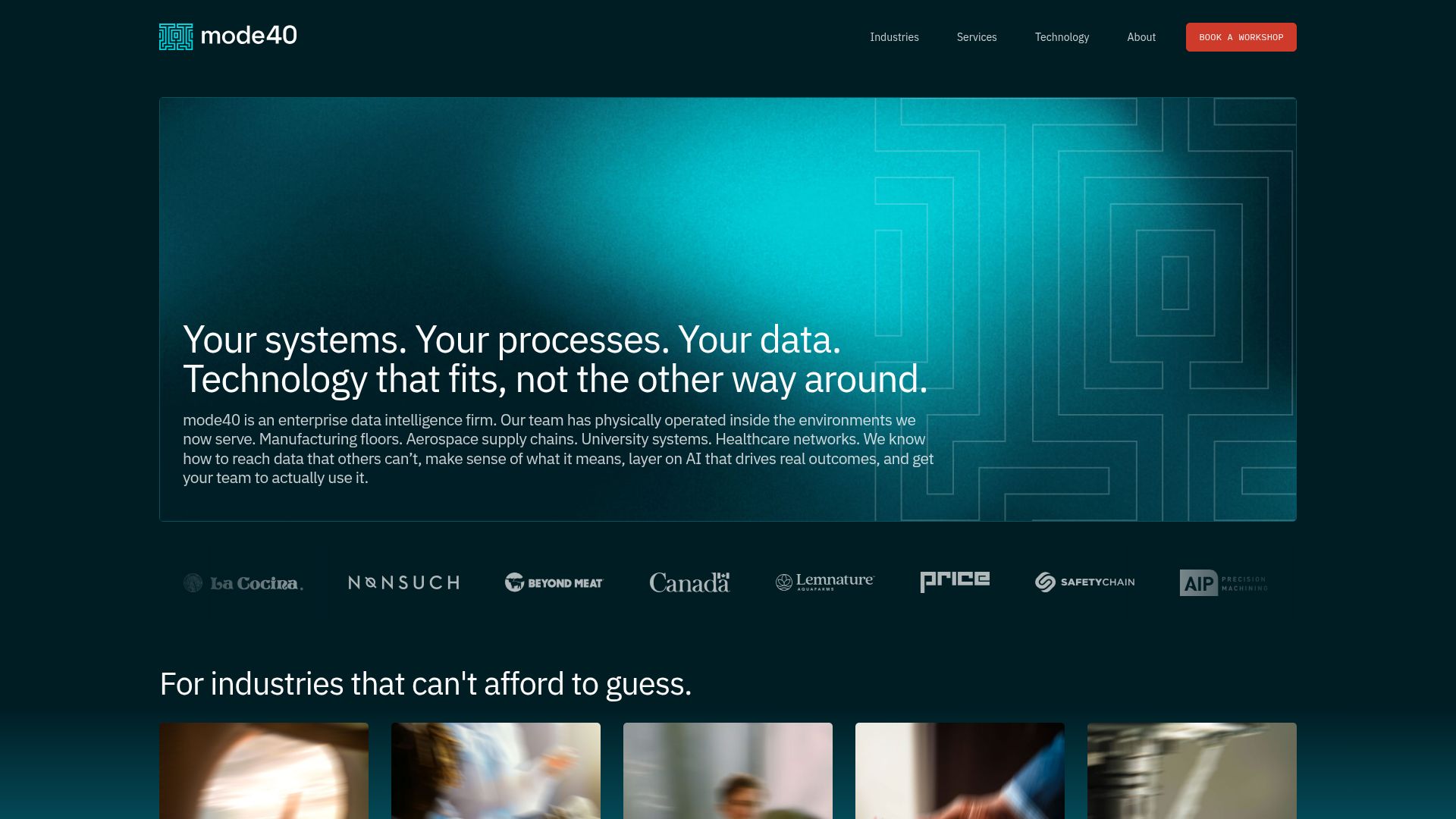


Most AI consultancies sell the algorithm first and learn the business later. Mode40, a Winnipeg-based data intelligence firm, does the opposite: its team has physically operated inside manufacturing floors, aerospace supply chains, and healthcare networks, and it treats that firsthand experience as the prerequisite for any AI deployment. The company's pitch is not about models or dashboards; it is about reaching data that others cannot, making sense of it, and getting teams to actually use the system. That positioning — practitioner-led, learn-first, outcome-obsessed — is what makes Mode40 worth watching, especially as it launches AeroTrace, a Prairies-wide initiative with Canadian Manufacturers and Exporters (CME) to push AI into aviation, aerospace, and defence.
The AI that only works if someone has stood on the factory floor
Mode40's core claim is that AI in industrial settings fails not because the technology is weak, but because the people building it do not understand the environment. The company's website is blunt: "Our team has physically operated inside the environments we now serve." That includes manufacturing floors, aerospace supply chains, university systems, and healthcare networks. The implication is that a data scientist who has never touched a legacy machine or watched a shift handover will miss the real constraints.
This is not just a rhetorical stance. Mode40's differentiation section contrasts itself with large consulting firms, software vendors, and the status quo. Large firms, it argues, deliver a strategy and a recommendation to buy software from someone else, with a six-to-twelve-month timeline before anyone connects to a system. Software vendors hand over a platform and credentials, leaving the customer to extract their own data and manage adoption. Mode40's answer is to embed practitioners who have already navigated the problem and built platforms to prove it. The company's own clients include recognizable names like Beyond Meat and Nonsuch Brewing, suggesting the approach has traction beyond a single vertical.
Why 'Learn, Implement, Automate, Enable' is a rebuke to six-month discovery phases
Mode40's methodology is laid out in four steps: Learn, Implement, Automate, Enable. The sequence is deliberate. Learn comes first, and it is not a quick intake call. The website describes it as assessing "systems, data, processes, people" and designing a roadmap grounded in what is actually possible, not what looks good in a proposal. The company insists on "no recommendations without firsthand understanding."
Implement is where Mode40 claims to connect systems that were never designed to talk. The copy is vivid: "Legacy systems. Paper processes. Equipment that predates the internet. Institutional knowledge that has never been formalized." The company says it builds systems where none exist, then contextualizes the data and designs workflows around it. Automate is the AI layer — "purpose-built AI configured for your industry," not a generic feature label. Mode40 describes it as a "compounding engine" that identifies patterns and surfaces anomalies before they escalate, becoming more valuable over time without additional headcount. Enable is the final step, and it is telling that the end goal is not a dashboard but outcomes: reduced downtime, improved throughput, recovered yield, faster compliance cycles, and preserved institutional knowledge.
This four-step framework is a direct challenge to the consulting playbook of long discovery phases and PowerPoint deliverables. Mode40's promise is results in weeks, not quarters. One client, a discrete manufacturer, saw customer shorts drop from 50 to 12 within six months. The company also cites an 86% downtime reduction across seven production facilities and 19 facilities on a single platform for an enterprise operations client. These numbers are presented as documented proof, not projections.
The cost of doing nothing: the option Mode40 names explicitly
One of the most striking parts of Mode40's positioning is its willingness to name the third option: "Change nothing." The website calls it "the most expensive option" and the one most organizations choose by default. It argues that every month without visibility is another month of decisions made on gut feel, tribal knowledge walking out the door with retirements, and compliance gaps widening. The cost never shows up on a line item; it shows up in unexplained downtime, unrecovered yield, and competitors who figured it out first.
This is a smart rhetorical move. It reframes the decision from "do we invest in AI?" to "what is the cost of inaction?" For industrial manufacturers, where margins are thin and downtime is expensive, the argument lands. Mode40 is not just selling AI; it is selling the avoidance of a slow, invisible decline.
AeroTrace: a Prairies-wide bet on aerospace AI
Mode40's partnership with Canadian Manufacturers and Exporters (CME) to launch AeroTrace is a significant signal. The initiative is described as a Prairies-wide effort to support AI integration in aviation, aerospace, and defence industries. The name "AeroTrace" suggests a focus on traceability — a critical requirement in aerospace, where every part must be tracked from receipt to finished product. Mode40's aerospace and defence page emphasizes "complete traceability. Every part. Every step. Every facility."
The partnership with CME, a major industry association, gives Mode40 credibility and access to a network of manufacturers. It also positions the company as a regional leader in an industry where trust and regulatory compliance are paramount. The fact that Mode40 is based in Winnipeg, a hub for aerospace manufacturing in Canada, further strengthens the fit. AeroTrace could be a proving ground for Mode40's methodology in one of the most demanding industrial sectors.
The diagnostic as a wedge: two weeks instead of six figures
Mode40's go-to-market includes a low-friction entry point: a two-to-four-week diagnostic engagement. The company connects to a client's environment and delivers a "Data Intelligence Scorecard" that shows where data resides, where it does not, and what those gaps are costing. The pitch is explicit: "Not a six-month discovery phase. Not a six-figure commitment. The most direct path to understanding what is possible."
This diagnostic-first approach is smart. It lowers the barrier to entry for skeptical manufacturers, gives Mode40 a chance to demonstrate its technical chops, and creates a natural upsell path to a full implementation. It also aligns with the company's learn-first philosophy — the diagnostic is essentially the Learn phase, but with a tangible deliverable and a clear price point.
What the evidence shows and what remains unproven
Mode40's website is rich with claims, but the evidence is largely self-reported. The client logos, the metrics (86% downtime reduction, 24% customer shorts reduction, 10% labor cost savings, 50% planning horizon increase), and the testimonials are all presented without external verification. The company does not disclose its funding stage, founding team, or specific client names beyond logos. The AeroTrace partnership with CME is confirmed by BetaKit, but details on scope, timeline, and participating companies are thin.
That said, the specificity of the claims — "customer shorts dropped from 50 to 12 within six months" — suggests real-world results, not marketing fluff. The practitioner-led positioning is credible, and the diagnostic offer is concrete. What remains to be seen is whether Mode40 can scale beyond its current client base and whether AeroTrace will produce measurable outcomes for the aerospace industry. For now, Mode40 is a compelling example of how AI in industrial manufacturing is less about the algorithm and more about the people who know where the bodies are buried — and are willing to dig them up.