Levocred
AI for credit funds, fintechs, and banks — automate back office, portfolio monitoring, compliance, and underwriting.
NewName Editorial
Editorial Team


Credit funds run on documents: loan tapes, credit agreements, borrowing base certificates, IC memos. The people who run them spend hours copying figures from one spreadsheet to another, checking eligibility tests, and drafting memos that get read once. Levocred, a Y Combinator-backed startup, is trying to compress that entire loop into a single AI workflow. Its pitch is not a chatbot that talks about credit; it is a system that takes a loan tape and a credit agreement in, and produces an IC memo draft out, with every figure cited. That is a different kind of AI promise — one about auditability, not eloquence.
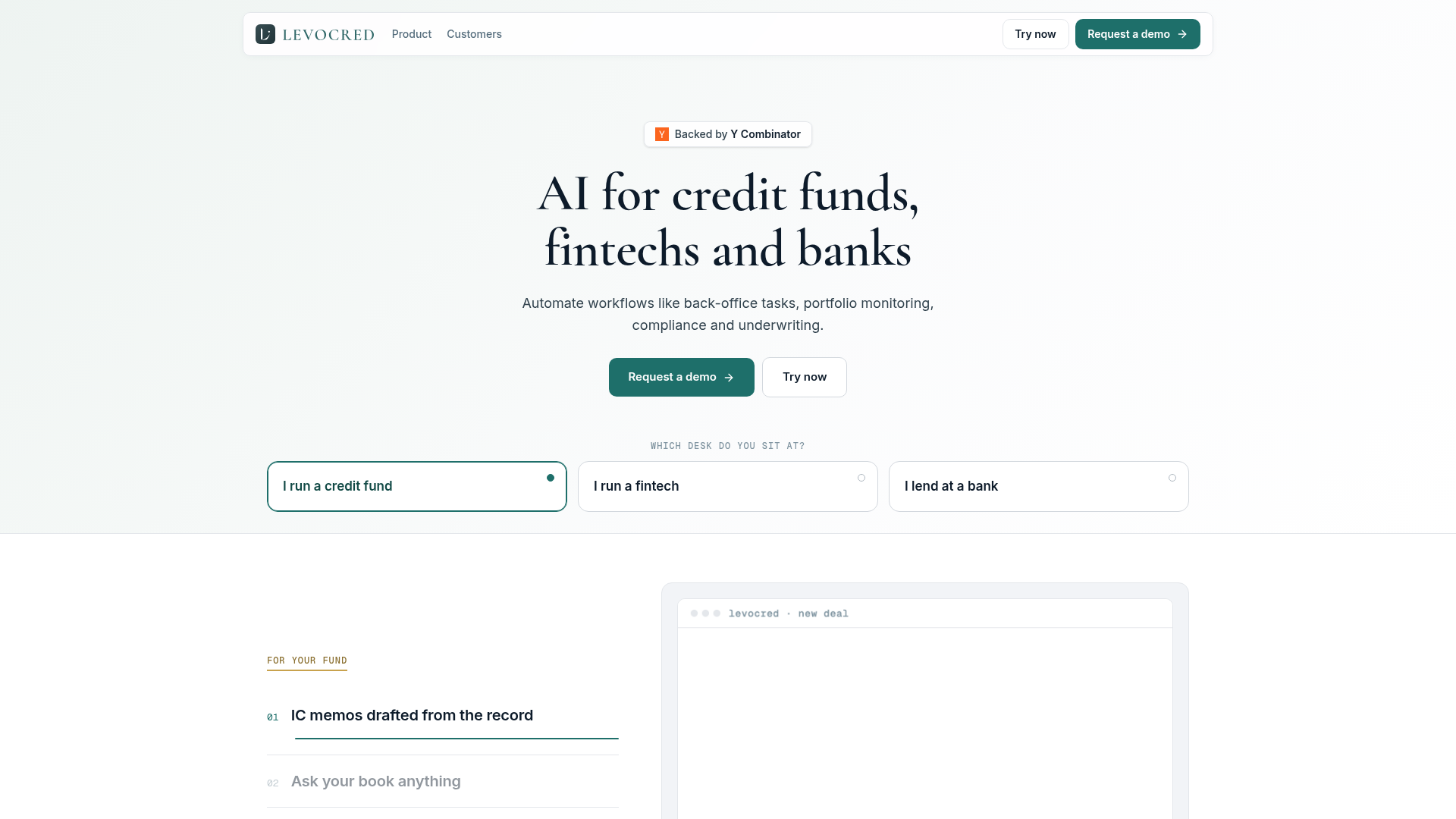
The company's homepage is sparse but pointed. It asks which desk you sit at: credit fund, fintech, or bank. Then it shows three workflows: IC memos drafted from the record, asking your book anything, and compliance checked, not rebuilt. The emphasis on 'from the record' and 'checked, not rebuilt' is the real thesis. Levocred is not trying to replace credit analysts; it is trying to make their work verifiable and repeatable.
The credit back office runs on documents — and that is the problem
Credit funds and bank lending desks are document factories. A single deal can involve a credit agreement with dozens of sections, a loan tape with thousands of rows, and a borrowing base certificate that must be recalculated monthly. The people who run these processes are not just analysts; they are also auditors of their own spreadsheets. Mistakes are expensive, and the cost of checking someone else's work is often higher than the cost of doing it yourself.
Levocred's entry point is that pain. The site's copy is direct: 'Automate workflows like back-office tasks, portfolio monitoring, compliance and underwriting.' It is not selling a dashboard; it is selling a workflow replacement. The demo workflow — a borrowing base calculation — is a perfect example. It takes a 4,182-row tape, applies 12 eligibility tests, excludes an obligor over the 10% cap, confirms the advance rate against a specific section of the credit agreement, and drafts a certificate for the CFO's signature. That is a process that normally takes hours, and it is exactly the kind of task that AI can do well if it is grounded in the actual documents.
What Levocred actually automates: IC memos, borrowing bases, and compliance
The homepage highlights three workflows, and each one maps to a specific pain point in credit operations.
01 IC memos drafted from the record. The IC memo is the investment committee's decision document. It summarizes the deal, the risks, the covenants, and the rationale. Drafting it is a grind, and most of the content is pulled from the credit agreement and the loan tape. Levocred's demo shows a loan tape and a credit agreement going in, and an IC memo draft coming out, with every figure cited. The citation part is key — it means the AI is not hallucinating; it is pointing to the source.
02 Ask your book anything. This is the natural-language query layer. Instead of asking an analyst to pull a report, you can ask the system a question about your portfolio. The site does not provide examples, but the implication is that the system has indexed your loan documents and can answer questions like 'What is our exposure to obligors over 10%?' or 'Which facilities are approaching their advance rate limits?'
03 Compliance checked, not rebuilt. This is the most subtle and perhaps the most important workflow. It suggests that Levocred does not want to replace your compliance process; it wants to check it. That is a lower-risk promise than 'we will handle compliance for you.' It means the system can read your existing compliance reports and verify them against the underlying documents. For a fund that already has a compliance team, this is a way to increase confidence without changing the process.
The borrowing base demo: a 4,182-row tape, 12 eligibility tests, one workflow
The 'Try now' section is the most concrete evidence of what Levocred does. It invites you to try a borrowing base workflow yourself, with a sample tape that has 4,182 rows. The output shows the key steps: gross receivables tied to the tape ($48,214,905), 12 eligibility tests applied (reducing the pool by $5,979,096), an obligor excluded for being over the 10% cap ($412,006), the advance rate confirmed against section 2.01(a) at 85%, and a certificate drafted for the CFO's signature, showing $35,550,233 in borrowing base and $4,350,233 in excess availability.
This is not a toy example. It is a real workflow with real numbers, and it demonstrates the core value proposition: the AI is not just summarizing; it is performing calculations and applying rules. The fact that it cites the specific section of the credit agreement ('vs. §2.01(a)') is a strong signal that the system is grounded in the document, not just in a general understanding of borrowing bases.
Compliance checked, not rebuilt: the underwriting paradox
There is an interesting tension in Levocred's positioning. On one hand, it is automating underwriting — the process of deciding whether to lend. On the other hand, it is not claiming to make the decision. The phrase 'compliance checked, not rebuilt' is a deliberate choice. It suggests that Levocred is not trying to replace the compliance function; it is trying to make it more efficient and more reliable.
This is a smart positioning for a regulated industry. Credit funds and banks are not going to hand over underwriting decisions to an AI without a human in the loop. But they are willing to let an AI draft the memo, check the compliance, and flag exceptions. Levocred is selling the back office, not the front office. That is a lower-risk sale, and it is probably why the company can claim '~$1B runs through Levocred' — a number that is impressive but not broken down by customer or time period.
Scale with tokens, not headcount: the YC-backed operating thesis
The homepage includes the line 'Scale with tokens, not headcount.' It is a clever phrase, and it is likely the core of Levocred's go-to-market strategy. Instead of hiring more analysts to handle more deals, a fund can use Levocred to do the same work with the same team. For a credit fund, that is a compelling ROI story.
Being backed by Y Combinator adds credibility, but it also signals that Levocred is early. The site does not disclose pricing, and the only customer quote is from Jonathan DiBenedetto of Pier Asset Management, who says the platform 'reduced the amount of time we spend managing our portfolio' and helped the team get 'a level deeper understanding of our credit facilities.' That is a positive but vague testimonial — it does not quantify the time saved.
The name as a positioning statement: 'Levocred' and the leverage of credit
The name 'Levocred' is a portmanteau of 'leverage' and 'credit.' It is a clever choice because it captures the product's promise: using AI to leverage the credit team's time and expertise. The name is short, memorable, and category-specific. It does not sound like a generic AI tool; it sounds like a financial infrastructure company.
The domain, levocred.com, is clean and professional. The brand uses a simple wordmark and a mark that appears to be a stylized 'L' or an abstract shape. The visual identity is minimal, which is appropriate for a B2B fintech. The name also works internationally, as 'cred' is recognizable in English and Romance languages.
One risk is that the name is not descriptive enough for someone who does not know the category. 'Levocred' could be a credit card company or a lending app. But for the target audience — credit funds, fintechs, and banks — the name is likely to resonate because it hints at leverage and credit, which are the core concepts of their business.
Open questions: what the site does not tell us
The Levocred website is sparse. It does not disclose pricing, a full customer list, or detailed technical documentation. The 'About' and 'Blog' pages return 404s, which suggests the site is a work in progress. The company claims '~$1B runs through Levocred,' but it does not specify whether that is assets under management, total loan volume, or something else.
For a product that is in production, the lack of public case studies is a gap. The single testimonial from Pier Asset Management is helpful, but it is not enough to evaluate the product's effectiveness across different types of credit funds. Potential customers will likely need to book a demo to get the full picture.
Despite these gaps, Levocred is an interesting bet. It is targeting a specific, high-value workflow that is ripe for automation. The borrowing base demo is a strong proof point, and the 'compliance checked, not rebuilt' positioning is a smart way to enter a regulated market. If the product delivers on its promise of auditable AI workflows, it could become a standard tool for credit funds and banks. But the proof will be in the adoption — and the site does not yet tell us how many funds are using it beyond the one testimonial.