Oasive
One workflow from market view to bond decision, starting with agency MBS.
NewName Editorial
Editorial Team
The fixed-income desk has never lacked data. It has lacked a single place to turn a market view into a bond decision. Oasive, a Fall 2026 Y Combinator company founded by former Wells Fargo and Google fixed-income and AI operator Anaïs Howland, is betting that the real product is not another data feed or another chatbot, but a connected workflow that runs from research through screening, analysis, valuation, and investment-committee reporting. The thesis is narrow on purpose: start with agency MBS, where the founder has genuine desk credibility, and expand into munis, ABS, and corporates only after the workflow is proven.
The Agency MBS Desk Is a Workflow Problem, Not a Data Problem
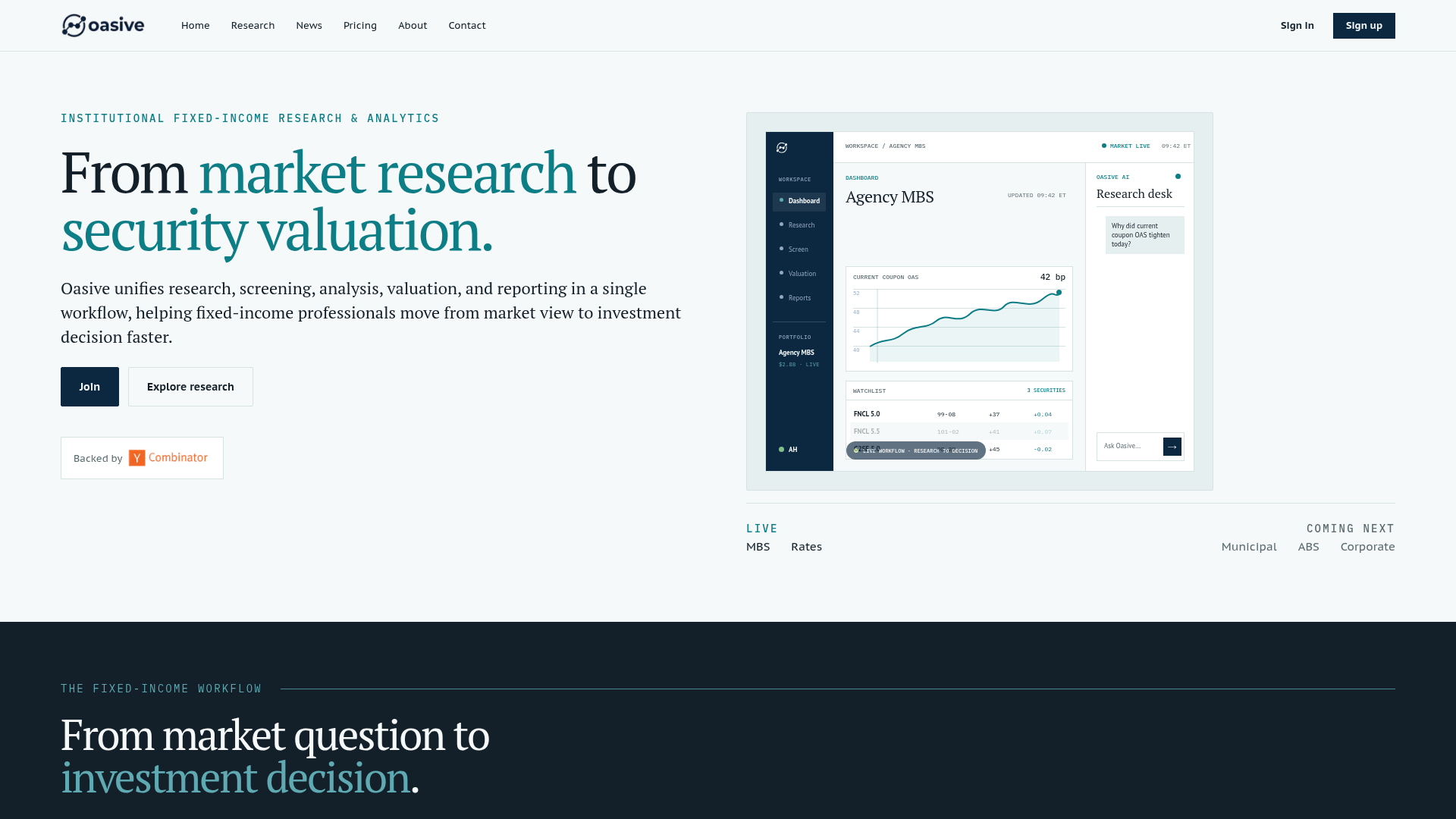
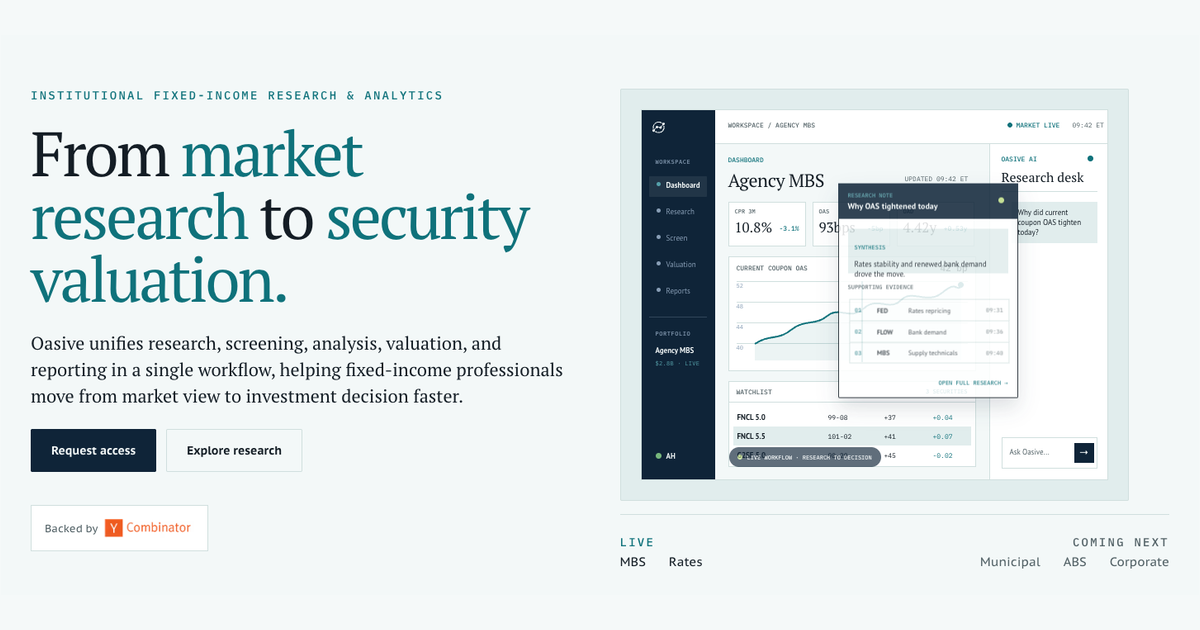
Agency MBS is one of the most analytically dense corners of fixed income. Prepayment behavior, convexity, OAS, current-coupon dynamics, bank demand, Fed flows, and supply technicals all interact, and the professionals who trade it already have Bloomberg terminals, dealer research, ICE prepayment models, and internal quant libraries. The bottleneck is not access to information; it is the cost of stitching information together. A portfolio manager who wants to answer "why did current coupon OAS tighten today?" typically reads a dealer note, pulls a chart, checks a prepayment model, and then rebuilds the same context in a memo. Oasive's homepage makes this friction the explicit target: it shows a live agency MBS dashboard with CPR, OAS, OAD, and current-coupon OAS, then a research note that synthesizes the move with timestamped supporting evidence, then a workflow that carries that research into screening, analysis, valuation, and reporting.
That is a workflow-consolidation pitch, not a data-vendor pitch. The distinction matters because it changes who Oasive competes with and how it gets bought.
What Oasive Actually Sells: A Connected Research-to-Valuation Pipeline
The product is organized around five steps — Research, Screen, Analyze, Value, Report — with the explicit design principle that every output becomes the starting point for the next step. In practice that means a market question ("why did OAS tighten?") produces a synthesized research note with cited evidence; that note informs a screen across thousands of securities filtered by coupon, vintage, and OAS; the screen feeds a comparison of collateral, prepayment behavior, and risk; the comparison feeds a valuation and scenario engine with proprietary prepayment and market assumptions; and the whole chain packages into an investment memo.
Two product choices stand out. First, the research layer is framed as evidence-backed synthesis rather than open-ended chat: the site shows three numbered supporting items (Fed rates repricing, bank demand, MBS supply technicals) with timestamps, which is a deliberate attempt to make AI output auditable for an investment committee. Second, the valuation layer is proprietary — Oasive claims its own prepayment and fair-value models — which is the part of the stack that is hardest to replicate with a generic LLM and a spreadsheet. The dashboard, watchlist, and live market state suggest the product is designed to sit open on a desk all day, not to be queried occasionally.
The Competitive Map: Bloomberg, ICE, Internal Quant Stacks, and the Spreadsheet
Oasive's real competition is not one company. It is four substitutes, each with a different weakness.
- Bloomberg Terminal. The default substrate for rates and MBS professionals. Enormous coverage, but the research-to-memo workflow is fragmented across functions, and the terminal does not package an investment-committee-ready thesis. Cost is also a persistent budget line.
- ICE and specialist prepayment/analytics vendors. Deep on MBS prepayment and valuation models, but typically sold as data and model access rather than as a research-and-reporting workflow. The user still assembles the narrative.
- Internal quant stacks. Large asset managers and bank portfolios build their own prepayment models and scenario tools. These are powerful but expensive to maintain, hard to onboard new analysts onto, and rarely produce clean research synthesis.
- ChatGPT plus a spreadsheet. The fastest-growing informal substitute. Cheap and flexible, but with no proprietary MBS models, no auditable evidence chain, and no compliance-friendly reporting layer.
Oasive's wedge is that it sits between the terminal and the internal stack: more workflow than Bloomberg, more research synthesis than ICE, less build cost than an internal quant team, and far more domain-specific than a general LLM. The risk is that each of those four substitutes is entrenched, and the buyer's default is to add Oasive as a fifth tool rather than replace one of the four.
Pricing as Strategy: A $200 Research Wedge Into a $12,000 Platform
Oasive's pricing ladder is unusually explicit for an early-stage institutional product, and it is the clearest signal of go-to-market intent.
- Free Research. Two selected macro and rates reports per month plus three follow-up chat queries, no card required. This is a top-of-funnel content and habit play aimed at individual analysts and PMs who can subscribe without procurement.
- Macro & Rates. $200 per user per month with a 14-day free trial and card required. This is the self-serve wedge: macro, rates, and housing research, Treasury fair-value tools, the full research library, custom and scheduled reports, and unlimited chat. It is priced to be expensable without a committee.
- Agency MBS Platform. $12,000 per user per year, paid upfront, with a 14-day evaluation arranged after a demo. This is the enterprise motion: full MBS research, pool screening, bond comparison, proprietary valuation and prepayment models, and hands-on setup and support.
The strategic logic is a classic land-and-expand: the $200 tier creates individual usage and internal advocacy, and the $12,000 tier converts that into a departmental contract. The $12,000 price point is also a positioning statement. It is high enough to signal institutional seriousness and to fund proprietary model maintenance, but low enough to sit below the fully loaded cost of a Bloomberg seat plus a specialist MBS analytics subscription, and far below the cost of maintaining an internal quant stack. Public materials do not disclose seat minimums, data licensing costs, or whether the $12,000 is per-seat or per-desk, which are the details that will determine real unit economics.
The Founder Arbitrage: Wells Fargo MBS Desk Meets Google AI Product
The founder profile is the most underrated asset here. Anaïs Howland was a quant analyst on Wells Fargo's $350B agency MBS portfolio, a PM on Google Treasury's $17B MBS/ABS book, and an AI product lead within Google consumer products including Search and Gemini. That combination is rare: most fixed-income software founders have desk credibility but not AI product experience, and most AI founders have product experience but no institutional fixed-income credibility. Oasive's product design — evidence-backed synthesis, proprietary prepayment models, an investment-memo output — reads like it was built by someone who has actually defended a trade in front of a committee. That is also the credibility that gets a first demo with a portfolio manager who would otherwise ignore a YC startup.
Scaling Constraints: Data Rights, Model Trust, and the Munis/ABS/Corporate Expansion
The site is explicit that munis, ABS, and corporates are "coming next," with early access open. That expansion is the growth story, but it is also where the constraints bite.
- Data rights. Agency MBS analytics depend on loan-level and pool-level data, prepayment feeds, and market pricing. Public materials do not disclose which data providers Oasive licenses or how those agreements scale across new asset classes. Munis and corporates have very different data economics and vendor landscapes.
- Model trust. Proprietary prepayment and fair-value models are only as good as their backtests, and institutional buyers will want to see validation. The site claims proprietary models but does not publish methodology, which is normal for a young vendor but a real diligence hurdle.
- Workflow stickiness vs. tool sprawl. The biggest risk is not that Oasive fails to build the product; it is that buyers treat it as a research add-on rather than the system of record for the research-to-decision loop. The $12,000 upfront annual contract is designed to force commitment, but it also raises the bar for proving value in the 14-day evaluation.
- AI trust in a regulated workflow. Investment committees need auditability. Oasive's timestamped supporting evidence is a good start, but the firm will need to demonstrate data lineage, model governance, and compliance-friendly retention as it moves upmarket.
What Has to Be True for Oasive to Win the Fixed-Income Workflow
Three things have to be true. First, the research-to-valuation workflow has to be materially faster than the Bloomberg-plus-spreadsheet status quo for a working PM, not just for a demo. Second, the $200 Macro & Rates tier has to generate enough individual usage to create internal pull for the $12,000 platform, which means the research product has to be genuinely good on its own merits. Third, the agency MBS beachhead has to produce referenceable institutional customers before the munis, ABS, and corporate expansions dilute focus.
If those hold, Oasive is not competing to replace Bloomberg. It is competing to own the layer above the data — the place where a market view becomes a sized, defended bond decision. That is a smaller market than the terminal, but it is a higher-margin one, and it is currently served mostly by human labor and duct tape. The window is open; the question is whether a YC-stage team can earn enough desk trust to close it before the incumbents ship their own AI research layers.