Omanta
Omanta gives complex oncology patients a PhD-level research team and a living treatment roadmap.
NewName Editorial
Editorial Team


A research lab, for one: Omanta's unusual premise
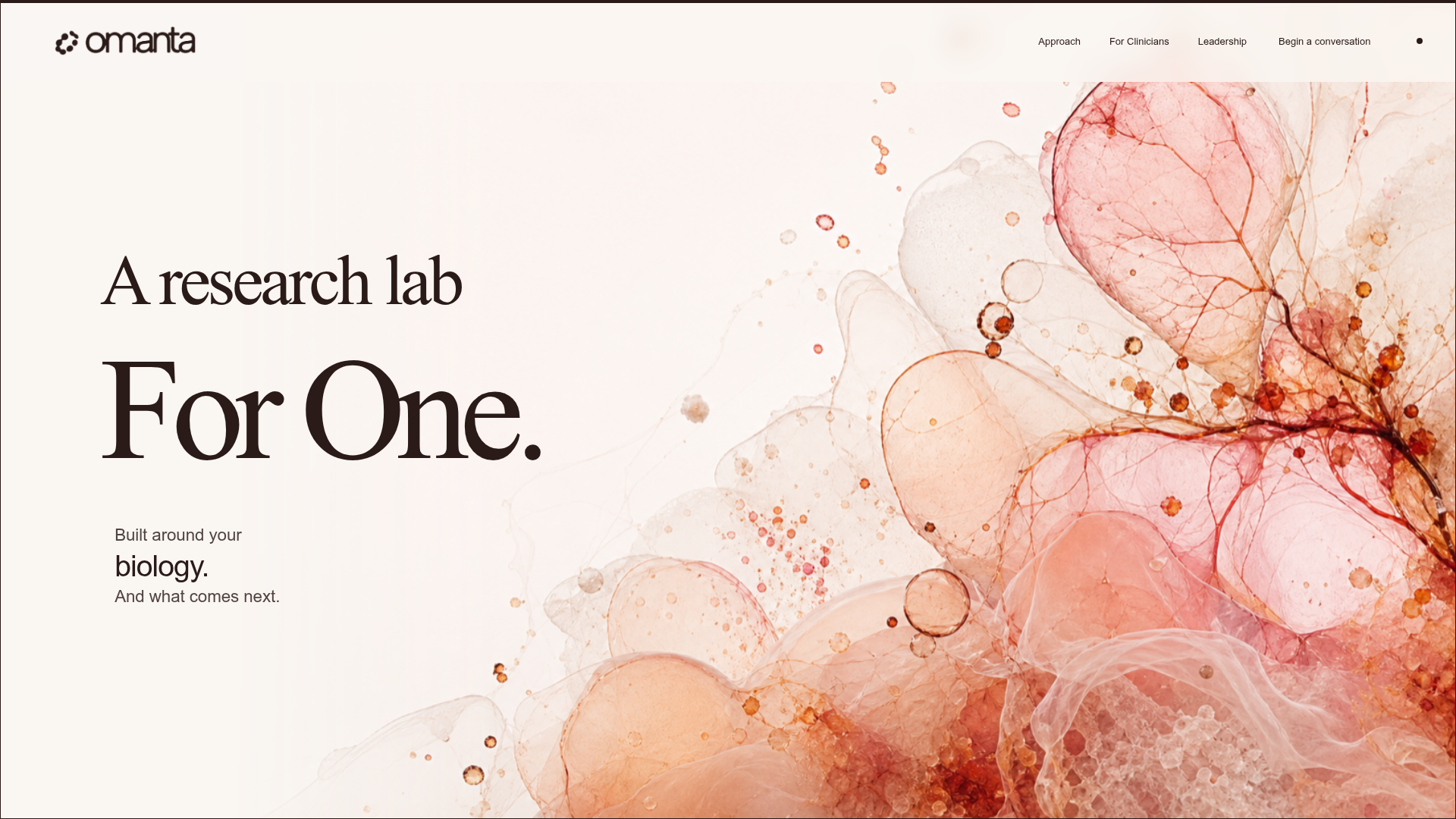
Most oncology care is built on averages. A patient gets a diagnosis, a standard protocol, and a prognosis drawn from population-level data. Omanta starts from the opposite assumption: that a complex case is a research problem, not a routine one. The company's tagline — "A personal research lab dedicated to each patient" — is not a metaphor. Omanta assembles a team of PhD scientists for every case, with the explicit goal of giving "complex patients the depth, continuity, and scientific attention their unique case demands."
The premise is bold, even audacious. It positions Omanta not as a diagnostic service or a second-opinion platform, but as a kind of bespoke research institute for one person. The website's language reinforces this: "A full PhD-level scientific research team for every case." That's a heavy promise, and the credibility of the whole venture rests on whether it can deliver on it.
The five-step case team: from records to roadmap
Omanta's process is laid out in five distinct stages, each with a clear output. The first step is assembling the case team: "PhD scientists are selected for the biology and questions unique to your case." This implies a matching process, though the site doesn't detail how scientists are vetted or matched. The second step is evidence collection — "your records, imaging, pathology, molecular data, and the research that already exists." This is the data-gathering phase, where Omanta acts as a central repository for everything relevant to the case.
The third step is closing diagnostic gaps. Omanta identifies what's missing and coordinates with the clinical team to run additional tests. This is where the service moves from passive analysis to active intervention. The fourth step is the core intellectual work: "We connect your disease biology to the strongest evidence and define the most promising next steps." This is where the PhD-level expertise is supposed to shine. Finally, the fifth step is integration into care: "We work alongside your physicians so the research can inform real clinical decisions." This is critical — Omanta is not replacing the doctor but augmenting them.
The site lists affiliations with Harvard Medical School, the Broad Institute, Dana-Farber Cancer Institute, Massachusetts General Hospital, and UCLA. These are prestigious names, but the site doesn't specify what the affiliation means — whether these institutions employ the scientists, train them, or merely provide a stamp of approval. The ambiguity is worth noting.
Reading the tumor: DNA, RNA, and protein layers
Omanta's analysis is built on a multi-omic approach, examining the disease at three molecular levels: DNA, RNA, and protein. The website presents an illustrative interface (no patient data shown) that walks through each layer. At the DNA level, Omanta reads the genome, looking at whole-genome sequencing, whole-exome sequencing, copy-number variation, and tumor mutational burden. At the RNA level, it sees what the tumor is expressing, using bulk RNA-seq, short-read and long-read RNA-seq, single-cell RNA-seq, and spatial transcriptomics. At the protein level, it maps the functional landscape through immunohistochemistry, multiplex immunofluorescence, spatial proteomics, and mass-spectrometry proteomics.
This is a comprehensive toolkit, but the site is careful to note that "test selection is case-specific." Not every patient will get every test. The illustrative example shows a tumor with EGFR, ERBB2, STK11, and PD-L1 signals, each rated high or moderate. This is a mock-up, but it gives a sense of how the data would be presented: as a clear, visual summary of molecular signals.
The multi-omic approach is a differentiator. Many precision oncology services focus on genomic sequencing alone. Omanta's inclusion of RNA and protein layers suggests a deeper, more mechanistic understanding of the tumor's behavior. That's a strong value proposition for complex cases where a single genomic mutation doesn't explain the clinical picture.
One case in population context: the 5,000-sample cohort
A single tumor's molecular profile is hard to interpret in isolation. Omanta addresses this by cross-referencing the patient's data against an internal reference dataset. The site mentions a "5,000-sample reference cohort" and shows an illustrative comparison of normalized expression values. This allows the team to see whether a patient's EGFR expression is high or low relative to a population of similar cases.
The site also describes three connected evidence layers: the internal reference dataset for population comparison, biomedical research for mechanistic interpretation, and clinical trials for potential relevance. This is a sophisticated framework, but the site doesn't disclose the composition of the reference cohort — is it all cancer types, or specific to the patient's disease? The size (5,000) is stated, but the provenance is not.
The case-to-cohort analysis is a key part of Omanta's value proposition. It moves beyond "what does this mutation mean?" to "how does this patient compare to others with similar biology?" That's a more nuanced question, and it's one that most clinical teams don't have the time or resources to answer.
A living roadmap: planning for what's next
The most distinctive feature of Omanta's offering is the "living therapeutic roadmap." This is not a static treatment plan but a dynamic framework that sequences options across the patient journey, from "no evidence of disease" to "aggressive disease." The roadmap is divided into four risk tiers, each with a strategy: protect and monitor, prepare the next move, escalate with context, and open the full horizon.
The roadmap is informed by three inputs: biology (disease state and molecular change), evidence (new data, literature, and trials), and practicality (feasibility, goals, and care context). It's designed to be revisited as the case evolves. This is a forward-looking approach that anticipates clinical changes before they happen. For a patient with a complex cancer, having a plan for multiple future states is empowering — it reduces the anxiety of the unknown.
The site is careful to note that the roadmap is an "illustrative planning framework only" and that "the clinical team directs care." This is a necessary disclaimer, but it also raises a question: how much authority does Omanta actually have? The roadmap is a recommendation, not a prescription. Its value depends on the clinical team's willingness to engage with it.
The name as a promise: Omanta and the 'lab' identity
The name "Omanta" is unusual — it's not a real word, but it carries connotations of "omnis" (all) and "anta" (suggesting a suffix of agency or place). It sounds like a scientific term, which fits the brand's positioning. The domain omanta.com is clean and memorable, and the logo — a simple lockup with the name in ink — conveys a sense of seriousness and precision.
The brand language is consistent: "A research lab for one." This is a powerful phrase that encapsulates the entire value proposition. It suggests that the patient is not a statistic but a unique scientific case. The name "Omanta" doesn't explicitly mean "lab" or "one," but it sounds like a place where research happens. This is a smart naming choice — it's distinctive, pronounceable, and carries a scientific aura.
However, the name is also a risk. It's not descriptive, so it requires the tagline to explain what the company does. The tagline does that job well, but it's a two-part brand: the name and the tagline must work together. If the tagline were dropped, the name alone would be ambiguous. That's a common tradeoff for coined names — they're memorable but need explanation.
Overall, Omanta's brand is coherent and purposeful. The name, the tagline, and the visual identity all point toward a single idea: a research lab dedicated to one patient. Whether the service can live up to that promise is the open question, but the branding is undeniably strong.