Peer
AI-native freight brokerage that automates the difficult loads—hazmat, oversize, and unloved lanes—from quote to clean close.
NewName Editorial
Editorial Team

The freight brokerage industry has long been a paradox: a $100 billion market in the US that runs on phone calls, spreadsheets, and tribal knowledge, yet one that has repeatedly defied digital disruption. The first wave of digital brokerages—Convoy, Uber Freight, and others—raised billions on the promise of algorithmic load matching, only to discover that the core friction wasn't finding trucks; it was the messy, high-stakes operational work of moving freight that requires judgment, compliance, and trust. Convoy, once valued at $3.8 billion, shut down in 2023. Uber Freight sold its brokerage arm in 2025. The lesson was brutal: the long tail of difficult freight—hazmat, oversize, temperature-controlled, and unloved lanes—remains the industry's most profitable yet most neglected segment, precisely because it resists automation.
Peer, an AI-native freight brokerage from Y Combinator, is attacking this paradox from a different angle. Instead of trying to match loads to trucks more efficiently, Peer is using AI to automate the entire brokerage workflow for the loads other brokers turn down. The company's thesis is that the economic opportunity lies not in the easy, transactional freight that software commoditized, but in the complex, compliance-heavy freight that incumbents manually manage with thin margins and high error rates. By embedding AI into quoting, carrier vetting, and proactive tracking, Peer aims to make difficult freight as easy to book as a standard dry van load—and to do it with a level of transparency that legacy brokers cannot match.
The Freight Brokerage Paradox: Why Digital Disruption Stalled
The first generation of digital freight brokers misunderstood the market's core inefficiency. They assumed that the problem was information asymmetry—that shippers didn't know which carriers were available, and carriers didn't know where the loads were. Their solution was a marketplace that matched supply and demand in real time, with dynamic pricing and automated tendering. But the market reality was more complex. Freight brokerage is not a matching problem; it's a risk management problem. A broker is responsible for the cargo, the carrier, the compliance, and the delivery—and if anything goes wrong, the broker eats the loss. The digital disruptors optimized for matching but underinvested in the operational layers: carrier fraud screening, equipment verification, insurance validation, and exception handling.
The result was a race to the bottom on price for easy loads, while the hard loads—hazmat, oversize, drayage, and lanes with poor backhaul—remained the domain of traditional brokers who charged higher margins for their expertise. Those brokers, however, are themselves inefficient, relying on manual phone calls, faxed rate confirmations, and paper PODs. They pass those costs to shippers in the form of higher rates and slower response times. Peer's insight is that AI can automate the operational layers that made difficult freight expensive to handle, thereby undercutting incumbents on price while improving service.
Peer's Operational Wedge: Automating the Unprofitable Load
Peer's website is explicit about its target: "We take the loads other brokers turn down: oversize freight, hazmat, and the lanes nobody wants to run." This is a deliberate strategic choice. These loads carry higher margins because they require specialized knowledge, compliance, and risk tolerance. They are also the loads that legacy brokers handle with the most manual effort, making them ripe for AI-driven automation.
The company's AI capabilities are deployed across three critical functions: quoting, carrier vetting, and proactive tracking. For quoting, Peer promises a rate within an hour, backed by "market comps" that show the spot and contract averages for the lane. This transparency is a direct challenge to the opaque pricing of traditional brokers, who often provide a single number with no justification. For vetting, Peer claims to screen carriers for fraud "ourselves," rechecking on every load rather than at signup. This is a significant differentiator in an industry where carrier fraud is a growing problem, with fake MC numbers and stolen identities costing shippers millions annually. For tracking, Peer provides live updates and a no-login tracking link, with status updates that arrive "before you ask."
The Four-Step Workflow: From Quote to Clean Close
Peer's website outlines a standardized four-step workflow that applies to every load, regardless of complexity: transparent quoting, fraud-screened coverage, proactive tracking, and a clean close. This workflow is designed to address the pain points that shippers most often cite with traditional brokers: slow quotes, unvetted carriers, lack of visibility, and paperwork delays.
- Transparent quoting: A rate within the hour, with market comps included. This is a direct answer to the industry's notorious opacity.
- Fraud-screened coverage: Carrier vetting that includes Carrier411 checks, FMCSA authority verification, insurance validation with the producer, and identity confirmation at dispatch. This goes beyond the standard MC number check.
- Proactive tracking: Status updates that are pushed to the shipper, not pulled. The load details page shows a timeline from booking to delivery, with a live tracking link that requires no login.
- Clean close: The POD and invoice are matched and closed the same day, with accessorials documented in writing. This eliminates the post-delivery reconciliation headache that plagues many shippers.
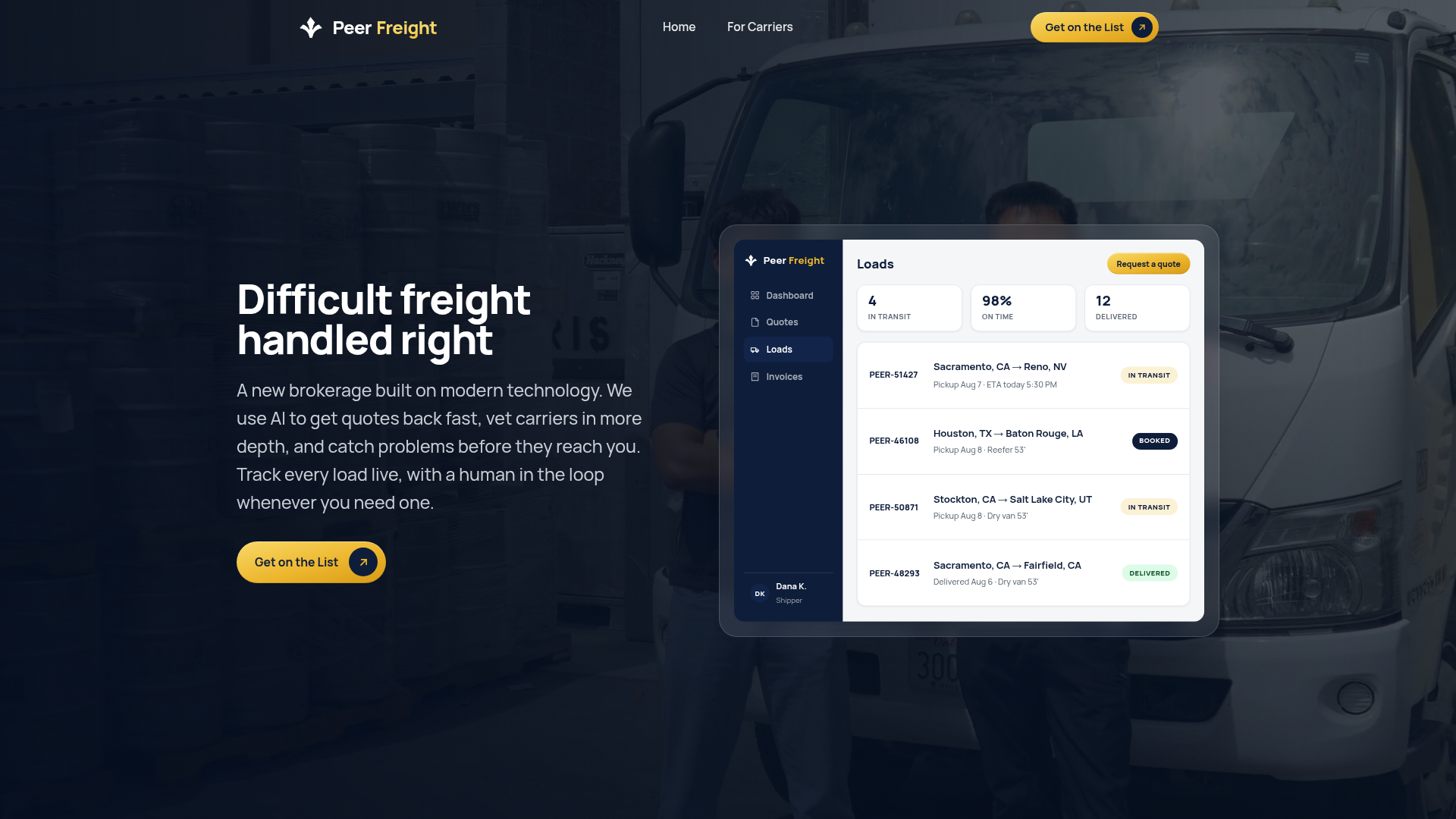
The workflow is supported by a dashboard that gives shippers a real-time view of their loads, quotes, and invoices. The example on the website shows a shipper with four in-transit loads, a 98% on-time rate, and 12 delivered loads—a level of operational detail that most brokers do not provide.
Competitive Landscape: Incumbent Brokers, Failed Digital Giants, and the AI Native
Peer's competitive set includes traditional brokers like C.H. Robinson and TQL, as well as the remnants of the digital brokerage wave. C.H. Robinson, the largest brokerage, processes millions of loads annually but relies heavily on manual processes and has been slow to adopt AI. TQL is known for its aggressive sales culture but similarly lacks AI-native automation. The failed digital giants—Convoy and Uber Freight—proved that a marketplace-only approach does not work in freight. Peer's differentiator is its focus on the difficult freight segment, where incumbents are least efficient and where AI can have the greatest impact.
Peer also faces competition from emerging AI-native brokers like Transfix and Loadsmart, which have pivoted toward automation. However, Peer's emphasis on hazmat and specialized freight is a narrower, more defensible niche. Hazmat requires specific carrier qualifications, placarding, and compliance—areas where a generalist broker may lack expertise. By specializing, Peer can build deep knowledge and trust that is hard to replicate.
The company's advisory board includes veterans from Ryder, Convoy, and CDL1000, which lends credibility but also signals the competitive pressure. The inclusion of Convoy's logo is notable—it suggests that Peer is learning from Convoy's failures and applying those lessons to a more sustainable model.
Commercial Model and GTM: Trust as the Currency
Peer's business model is straightforward: it earns a brokerage margin on each load, likely in the range of 10-20% of the transportation cost. The company does not publicly disclose its pricing, but its website emphasizes that rates are "all-in" and include fuel, which is a common practice in the industry.
Go-to-market is currently in a pre-launch phase, with a "Get on the List" form that captures shipper interest. The website indicates that FMCSA broker authority is pending, and Peer is building a carrier network. The company is targeting shippers who ship hazmat, oversize, or other difficult freight, and who are underserved by incumbents. The value proposition is clear: faster quotes, deeper vetting, and proactive tracking, with a human in the loop when needed.
Trust is the critical currency in freight brokerage. Peer is building trust through transparency (market comps, vetting details), compliance (TIA membership, insurance), and responsiveness (24/7 owner access). The fact that the founders are reachable directly is a signal of commitment.
Trajectory and Risks: Scaling Beyond the Niche
The next 3-5 years will determine whether Peer can scale beyond its niche or remain a boutique broker. The company's AI capabilities are a moat, but they are also a risk: if the AI fails to handle an exception, the human-in-the-loop must be able to resolve it quickly. Scaling AI in freight requires massive data on lanes, carriers, and pricing, which Peer is only beginning to accumulate.
The biggest risk is that the difficult freight niche is not large enough to sustain a high-growth venture. Hazmat and oversize loads represent a meaningful but limited portion of the market. To grow, Peer will need to expand into adjacent segments, such as refrigerated freight or port drayage, which it already covers. The company's website mentions these segments, suggesting that it is already positioning for expansion.
Another risk is competition from incumbents who are also investing in AI. C.H. Robinson has launched its own AI-powered platform, and other large brokers are following. However, incumbents face a legacy technology stack and a culture resistant to change, which gives startups like Peer a window of opportunity.
Ultimately, Peer's success will depend on its ability to execute on the operational details that have defeated previous digital brokers. If it can consistently deliver on its promises—fast quotes, deep vetting, proactive tracking, and clean closes—it can build a loyal customer base in the difficult freight segment and expand from there. The market is watching, and the stakes are high.