Derya
Derya: AI employees that move freight faster than traditional forwarders.
NewName Editorial
Editorial Team


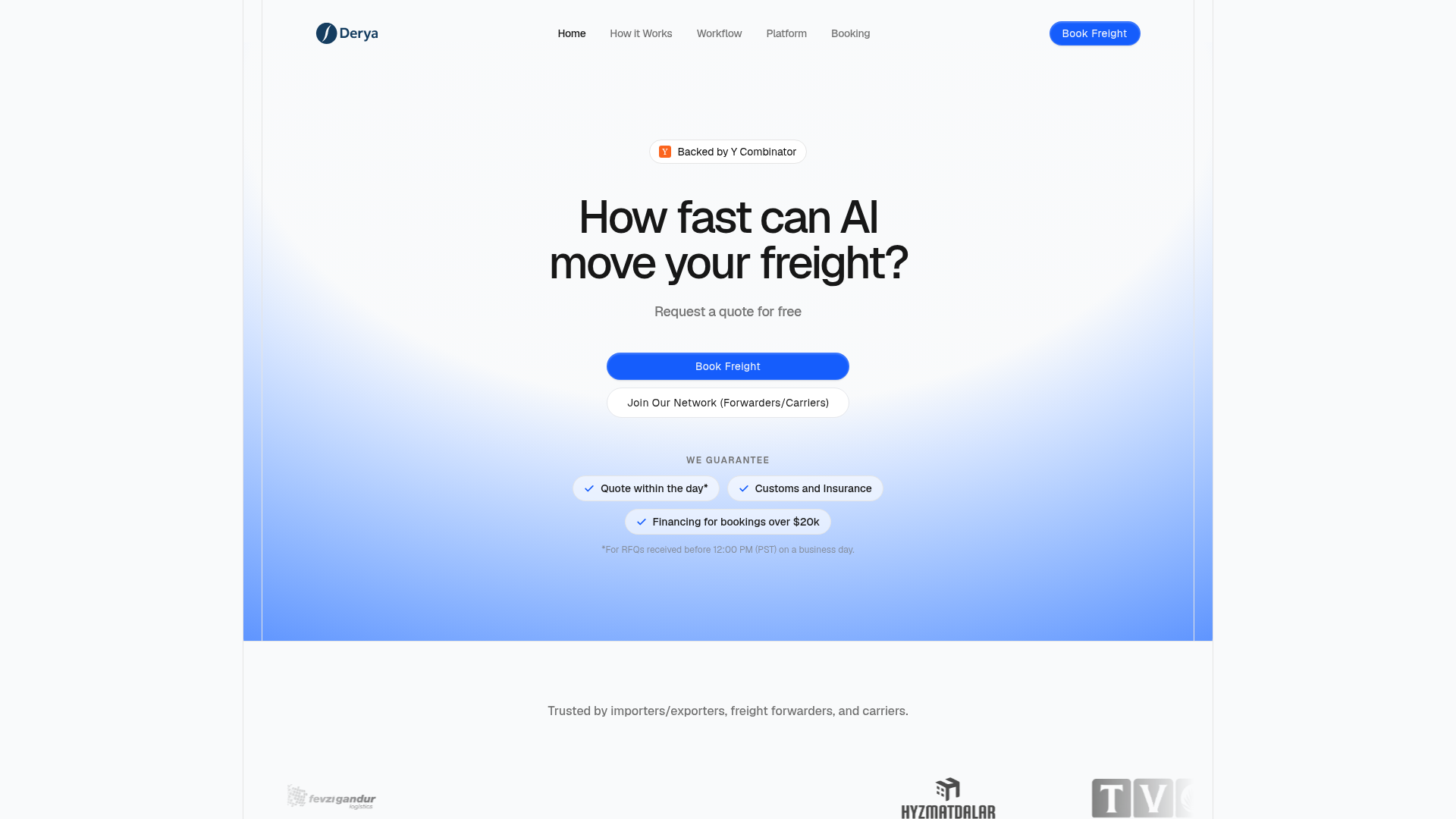
In a freight industry where speed is measured in days and quotes arrive after lunch, Derya is betting that AI employees can compress the entire forwarder workflow into minutes. The Y Combinator-backed startup, with a tagline about being a "supply chain autopilot," isn't just digitizing paperwork; it's building a team of AI agents that handle sales, pricing, and carrier relations, all orchestrated by a central "Derya Brain." The pitch is bold: quote within the day, book with the right carrier, and even finance deals over $20,000. But is this the future of freight forwarding, or just another automation layer on top of a deeply human industry?
The AI Employee Org Chart
Derya's website introduces a cast of characters that feel like a preview of a logistics sitcom: Jane, the AI Employee in Sales; Harry, in Carrier Relations; and Amanda, in Pricing. They're not chatbots tucked into a corner; they're presented as full-fledged team members, each with a specific role. The "Derya Assistant" coordinates them, and together they handle tasks like finding 87 carrier contacts for a Brazil-to-Ukraine deal or pricing a dangerous-goods shipment from Irving, TX to Istanbul in minutes. This isn't just a feature list; it's a deliberate organizational metaphor. Derya is selling the idea that AI can replace the traditional forwarder's team structure, not just augment it. The website even shows a workflow where a user asks for an update on a soybean supply and freight deal, and the AI responds with a status report, as if it's a project manager.
This "AI employee" framing is clever because it speaks to the pain point of fragmented communication. In a typical forwarder, the salesperson, pricing desk, and operations team often operate in silos, leading to delays and miscommunication. Derya's agents are designed to work in concert, sharing information in real-time. The evidence is in the customer testimonials: one client notes that Derya was "the first to quote in all requests for quotation so far," and another praises the team's availability for operations. The AI employees aren't just about automation; they're about eliminating the friction of handoffs.
Why Derya Is Not a Digital Freight Broker
It's tempting to lump Derya with digital freight brokers like Flexport or Freightos, but the positioning is distinct. Derya calls itself an "AI Native Freight Forwarder," not a broker. The distinction matters. A broker connects shippers with carriers, often as a marketplace. Derya, on the other hand, takes on the full forwarder responsibility: booking, customs, documentation, and even financing. The website outlines a four-step workflow: Booking (and Financing), Exporter to Port, Port to Port + Customs, and Port to Importer. This is end-to-end execution, not just a matchmaking service.
The AI agents are embedded in this workflow, not bolted on. For example, the "Derya Assistant" can open a new lane for a Sudan deal, and the AI employee in Sales locks 10x40HC containers with a line, confirming the vessel date. This is operational work, not just lead generation. The company also emphasizes a global partner network, leveraging local expertise and licenses to scale. So, while a digital broker might offer a platform for quotes, Derya is positioning itself as a full-service forwarder that happens to run on AI.
The Workflow: From Booking to Demurrage
Derya's website breaks down the freight forwarding process into four steps, and it's worth examining each for what it reveals about the company's approach. The first step, Booking, is where speed matters most. Derya promises a quote within the day for RFQs received before noon PST, and it handles carrier selection. The second step, Exporter to Port, involves loading and trucking to the shipping line. The third step, Port to Port + Customs, is where the complexity lies: customs clearance, bill of lading release, and monitoring free time to avoid demurrage and detention charges, which the site says can average $2,500 per container. The fourth step, Port to Importer, is the final inland delivery.
This breakdown is standard forwarder fare, but Derya's use of AI is meant to streamline each step. For instance, the AI can chase missing documents like MSDS (Material Safety Data Sheets) for dangerous goods, a common pain point mentioned in a testimonial from Andelog: "We almost always have something missing, like an MSDS. Derya chases the info and only passes on fully-informed loads." This is a concrete example of how AI reduces friction. The website also highlights a "Derya in Action" section with specific deals, like a sunflower oil shipment from Yumurtalık to Port Sudan, showing the AI in real scenarios.
Financing as a Friction Killer
One of the most distinctive aspects of Derya is its financing offering. For bookings over $20,000, Derya provides its own financing with term payments. This is a significant differentiator in the freight industry, where cash flow is a major pain point for importers and exporters. By offering financing, Derya isn't just a service provider; it's a financial partner. The website mentions that Derya has managed over $3 million in freight and supply procurement transactions, though it doesn't disclose the scale of its financing book. Still, the move is strategic: it lowers the barrier to entry for clients who might otherwise struggle to fund large shipments.
This financing is integrated into the booking process, as shown in the workflow. It's not a separate product; it's part of the autopilot promise. For a startup, this is a bold move, as it carries credit risk. But it also creates a moat: competitors without financing capabilities may struggle to compete on large deals. The website's pricing section suggests a free quote request, with financing as an add-on for larger transactions, which could be a way to attract smaller clients and upsell them.
The Name Derya: A Sea of Ambiguity
"Derya" is a Turkish name meaning "sea" or "ocean," and it's also a common given name. For a logistics company, the maritime connotation is fitting, but the name's broader meaning could be a double-edged sword. On one hand, it evokes vastness and connectivity, which aligns with the global supply chain. On the other hand, it's a personal name, which might make the company feel approachable and human, despite its AI-driven core. The domain, usederya.com, is clean and memorable, though it doesn't immediately signal "freight." A name like "Derya" requires explanation, which could be a hurdle in a B2B context where clarity is valued.
However, the name's ambiguity might be intentional. Derya isn't just about freight; it's about supply chain processes for hardware companies, as the tagline suggests. The name could work across multiple verticals, from logistics to procurement. The website's branding is consistent: a clean, modern design with a logo that features a stylized "D" and a wave-like element. The AI employees are named (Jane, Harry, Amanda), which humanizes the technology and makes the brand feel approachable. This is a smart branding move, as it softens the intimidating nature of AI.
What's Missing and What's Next
Derya's website is impressive, but there are gaps. The company doesn't disclose its founding team beyond a mention of "Oguzhan [Derya Co-Founder]" in a testimonial, and there's no information on funding beyond the Y Combinator backing. The site also lacks detailed case studies or metrics on success rates, though it does claim to have managed over $3 million in transactions. For a startup, this is early days, and the focus on speed and AI is compelling, but the proof will be in the execution.
The biggest risk is whether AI can truly handle the complexity of global freight, which involves customs regulations, varying carrier requirements, and unforeseen disruptions. Derya's partner network is meant to mitigate this, but it's unclear how deep that network is. The testimonials from forwarders and shippers are positive, but they're limited in number. As Derya scales, it will need to prove that its AI employees can maintain quality across diverse routes and regions.
For importers, exporters, and freight forwarders, Derya is worth watching. If it can deliver on its promise of speed and financing, it could disrupt the traditional forwarder model. But the name, while poetic, may need to become synonymous with reliability before it's a household name in logistics. For now, Derya is a bold experiment in AI-native freight, and the sea is wide open.