SpaceFlow
Enterprise AI agents that learn your legacy systems and prove every task.
NewName Editorial
Editorial Team


SpaceFlow is not trying to replace your ERP. It is trying to make it finally useful. The Y Combinator-backed startup sells what it calls a "managed runtime for enterprise AI agents" — a full stack of open frontier models, a governance gateway, and purpose-built agents that sit on top of the systems you already run. No migration. No data-cleansing megaproject. No consultants rewriting your Z-tables into a modern schema. Instead, SpaceFlow deploys inside your network, reads your custom tables, price conditions, approval chains, and email threads, and then puts AI employees to work on the messiest corner of the enterprise: procurement and supply chain.
The pitch is deliberately contrarian. While most enterprise AI vendors push cloud transformation as a prerequisite, SpaceFlow's entire thesis is that owning your systems was a good decision and still is. The company brings the whole AI stack to what you own — models, controls, workforce — deployed and operated inside your boundary. For manufacturers, banks, and defence contractors living on perpetual licenses and air-gapped networks, that is not a nice-to-have. It is the only way AI gets in the door.
The anti-migration pitch
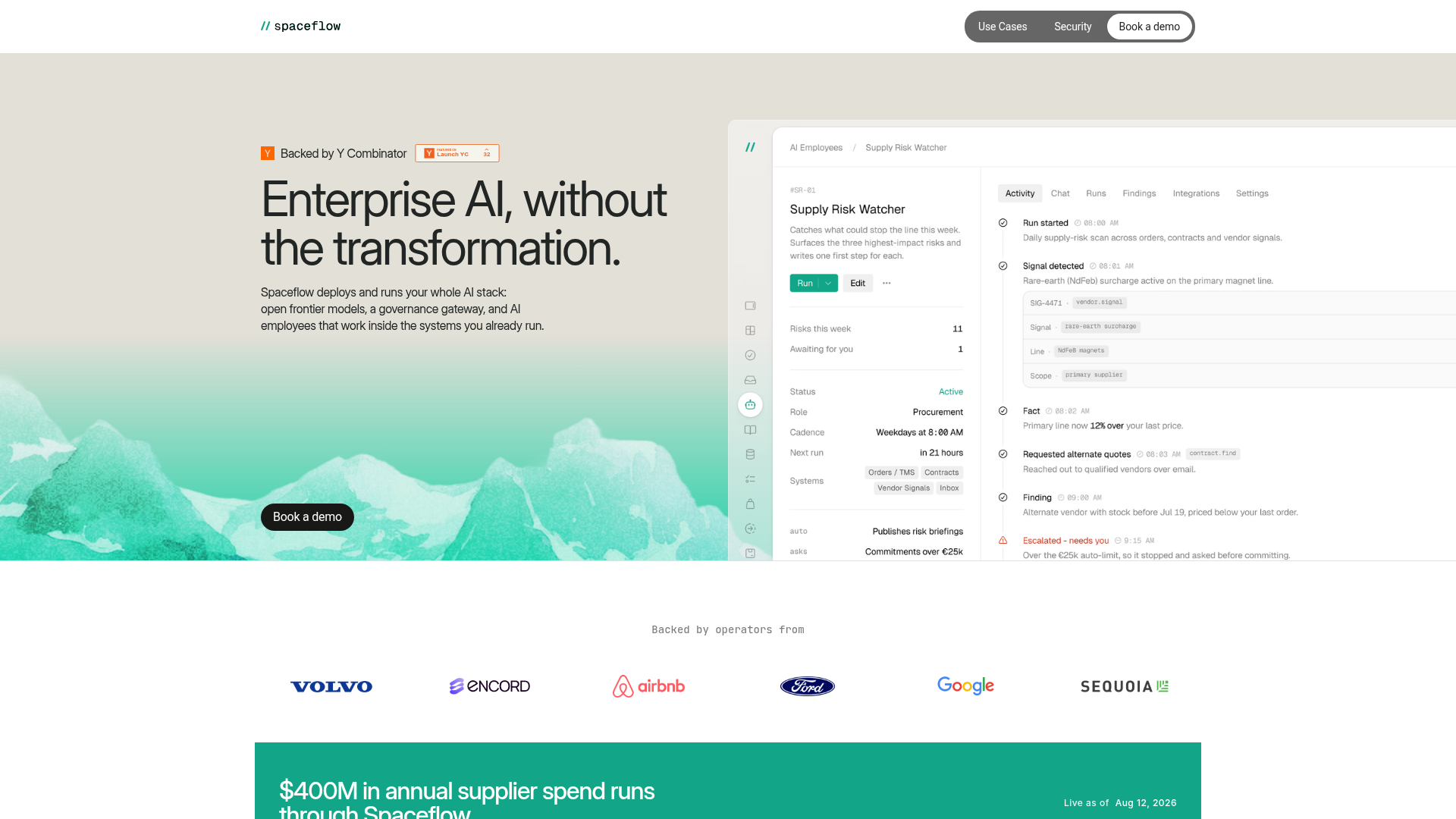
SpaceFlow's homepage leads with a slogan that sounds like a relief: "Enterprise AI, without the transformation." That is a direct jab at the decade-long industry assumption that modernizing your core systems is a prerequisite for innovation. SpaceFlow argues the opposite: your decades of customization are not a liability to be cleaned up, but an asset to be learned. The product connects read-only inside your network, maps your ECC 6.0 heavy Z-tables, and treats the institutional memory encoded in your spreadsheets and email threads as the raw material for an AI workforce.
This is a fundamentally different go-to-market than most AI copilots. Instead of asking you to re-architect your data for a new platform, SpaceFlow adapts to the data you have. The company's materials emphasize that it deploys remotely in days, not months, and that the first month is spent in "shadow mode" — learning, not acting. That is a low-friction entry point for enterprises that have been burned by multi-year ERP rollouts.
The anti-migration stance also solves a real pain: the cost and risk of moving off legacy systems. For companies with decades of custom Z-tables and approval chains, the idea of a clean migration is fiction. SpaceFlow's bet is that AI can be the bridge, not the bulldozer.
First it learns, then it staffs
SpaceFlow's core mechanism is a two-phase model: learn, then work. In phase one, the system builds what the company calls "the brain" — a queryable memory of your vendors, price conditions, approval rules, contract terms, and the email threads that carry the real decisions. This is not a static data dump; it is a living model that gets richer with every cycle. The website shows a sample of what that looks like: a vendor with six years of history, a price condition code like ZPRICE_COND_A904, an approval rule that routes anything over $25K to a director, an RFQ thread with twelve replies, a BOM with 214 items, and a contract with net-45 terms at $41.75 per line.
Once the brain is in place, SpaceFlow deploys "AI employees" — purpose-built agents that work inside your systems 24/7. These are not chatbots waiting for prompts. They read what arrives, extract what matters, draft what's next, and route what needs a human. Every action is proposed, logged, and approved by your team. Autonomy is earned task by task, with evidence. The company is explicit that this is not an all-or-nothing handover: agents start in shadow mode, then earn the right to act as they demonstrate reliability.
This learn-then-work sequence is what separates SpaceFlow from generic automation tools. It is not a set of pre-built connectors and macros; it is an adaptive layer that understands your specific business context. The promise is that within the first month, the system is already connected, learning, and working in shadow mode.
A day in the life of one agent
SpaceFlow's website includes a fictional but concrete "day in the life" of one agent on a Tuesday. It starts at 6:00 a.m. reading 47 supplier emails that arrived overnight, filing each one against the right vendor, PO, or RFQ. By 6:04, a delay notice becomes an alert on two affected purchase orders. By 7:30, the agent has extracted prices, lead times, and minimums from quote replies, normalized units, and ranked them. At 8:15, the buyer opens a finished comparison table instead of an inbox. By 9:00, the agent drafts a purchase order from the winning quote, applies approval thresholds, and routes it to a director because it exceeds $25K. The director gets one card with vendor, amount, and three of three checks passed. One click. Done.
By 11:40, the agent has matched 22 invoices to purchase orders and contract prices, line by line. Twenty reconcile clean; two don't, and both are routed to a human with evidence attached. At 14:00, a supplier asks for a price increase in prose; the agent files it against the contract, pulls price history, and drafts a reply. At 16:30, it updates vendor scorecards and flags a supplier that has gone late for the third time this quarter. At 18:00, it writes the day into the audit log.
The point of this narrative is not the individual tasks — it is the pattern. The human team made six decisions that day. The agent did everything between them. That is the value proposition: not replacing humans, but absorbing the invisible work that currently buries them.
The governance gateway: control without the slowdown
SpaceFlow's security page describes a five-step control loop: identity passthrough, guardrails, one gateway, monitoring, and an immutable audit log. Agents act as the person who asked, so permissions are inherited from the human. Thresholds and approvals are enforced by the gateway. Every agent call is logged and checked. Anomalies are quarantined automatically. And the audit log allows you to reconstruct anything, always.
This governance layer is not an afterthought; it is the product's spine. The company's tagline — "AI employees that do supply chain work and prove every task" — hinges on the word "prove." In a regulated enterprise, an AI that cannot show its work is a liability. SpaceFlow's answer is an immutable record of every read, draft, and routing decision. That is what makes autonomy earnable: the system can demonstrate that it followed the rules.
The on-prem deployment model reinforces this. Model inference can run inside your boundary, so transactional data never travels. The product installs remotely in days, and the full feature set is available on your servers or private cloud. For companies with air-gapped networks, this is the only viable option.
Why procurement is the perfect first battlefield
SpaceFlow starts where the manual work is worst: procurement and supply chain. This is the most email-buried, spreadsheet-driven, re-keyed corner of the enterprise. It is also a high-stakes, high-volume function where errors are costly. The company's use-case page lists concrete outcomes: 42% less maverick spend at one fast-casual chain, 4x faster RFQ cycles at a restaurant chain, 3x more RFQs processed by the same team at an enterprise group, and $120K saved per year at a foodservice operator.
These numbers are specific and credible, though the company does not disclose the underlying methodology. The strategic choice is clear: procurement is a domain where AI agents can deliver measurable ROI quickly, and where the governance requirements are strict enough to justify the on-prem, evidence-based approach. By winning here, SpaceFlow can build a beachhead and expand to adjacent functions like logistics and manufacturing.
The company also emphasizes that it works with the stack you already run: ERP, mail, spreadsheets, and AI assistants — connected, not migrated. It is open by design, with every capability exposed as an API endpoint, callable from its agents or any MCP-compatible client. That openness is a hedge against lock-in and a signal to enterprise architects that SpaceFlow is not trying to own the whole stack.
The name says 'flow' — but the product is about control
The name "SpaceFlow" is a study in contrasts. "Space" evokes the frontier, the new, the vast — appropriate for a company deploying cutting-edge AI. "Flow" suggests smoothness, automation, things moving without friction. But the product's core promise is not frictionless flow; it is controlled, evidence-based action. The marketing copy leans into this tension: "Enterprise AI, without the transformation" is about removing friction, but the security page is all about guardrails, approvals, and audit logs.
The name also carries a subtle risk. "SpaceFlow" is generic enough to be a tech company of any stripe — it could be a logistics startup, a data pipeline tool, or a cryptocurrency exchange. It does not immediately signal "AI agents for procurement." That is a deliberate trade-off: the name is safe, scalable, and easy to say, but it lacks the category specificity of, say, "ProcureAI." The company seems to be betting that the product's clarity will overcome the name's ambiguity.
The domain, spaceflow.tech, is clean and memorable, though the .tech TLD is a slight downgrade from .com. The brand is professional and understated, which fits the enterprise audience. The tagline, "Enterprise AI, without the transformation," is the strongest piece of branding — it captures the anti-migration thesis in seven words.
What's still unproven
SpaceFlow's pitch is compelling, but there are open questions. The company is at Seed stage, backed by Y Combinator, and claims $400M in annual supplier spend runs through the platform as of August 2026 — a striking figure for a seed-stage startup. The website includes testimonials from named customers like Dürümle, Tavuk Dünyası, and Doğuş Teknoloji, but the exact nature of those engagements is unclear. Are these design partners, paying customers, or pilot programs? The site does not disclose.
The bigger question is whether the learn-then-work model can scale beyond procurement. The company's tagline mentions "supply chain work" broadly, but the use cases are all procurement-centric. Expanding to logistics, manufacturing, or finance will require new agent types and new governance patterns. The open API and MCP compatibility suggest a platform ambition, but platforms are hard to build and even harder to sell to enterprises.
There is also the question of competition. The enterprise AI agent space is crowded, with players like Microsoft, Salesforce, and a host of startups all chasing the same workflow automation dollars. SpaceFlow's differentiators — on-prem deployment, evidence-based autonomy, and a focus on legacy systems — are real, but they are also defensible only if the execution is flawless. A single high-profile security breach or a botched deployment could sink the trust that the entire model depends on.
Finally, the "without the transformation" promise is a double-edged sword. It lowers the barrier to entry, but it also means SpaceFlow must handle the messiest, most idiosyncratic systems in the enterprise. That is a hard engineering problem, and the company's ability to map Z-tables and email threads at scale is unproven beyond a handful of customers.
For now, SpaceFlow is a bet worth watching. It has identified a real pain — the gap between AI's promise and the reality of legacy enterprise systems — and built a product that addresses it without asking customers to tear anything down. If the learn-then-work model delivers on its promise, the name "SpaceFlow" might become synonymous with the quiet, controlled automation of the back office. If not, it will be another cautionary tale about the difficulty of selling AI to the enterprise. The evidence so far suggests the former is more likely, but the proof is still in the audit log.