Impact-Site-Verification: 41b53a0c-6d04-458b-a457-fe9e29acde1a

AI & Machine Learning··7 min read

ProgSEO

ProgSEO turns your website into an auto-updating SEO engine for AI-era discovery.

NN

NewName Editorial

Editorial Team

ProgSEO product image 1
ProgSEO product image 2
ProgSEO product image 3

ProgSEO is not another AI content generator that spits out blog posts and hopes for the best. It's a bet on a specific future: that SEO's center of gravity is shifting from keyword rankings to AI recommendations, and that the only way to keep up is to stop doing SEO manually. The product's promise is audacious—"Rank on Google and get recommended by AI without doing SEO manually"—and its mechanism is refreshingly concrete. You connect your domain, ProgSEO analyzes it, hands you a month-long content calendar, and then generates and continuously updates SEO pages. No spreadsheets, no keyword tools, no 3 a.m. panic about a Google update. The question is whether that autopilot can actually deliver traffic, or whether it's just another automation fantasy.

The Autopilot Promise: SEO Without the SEO

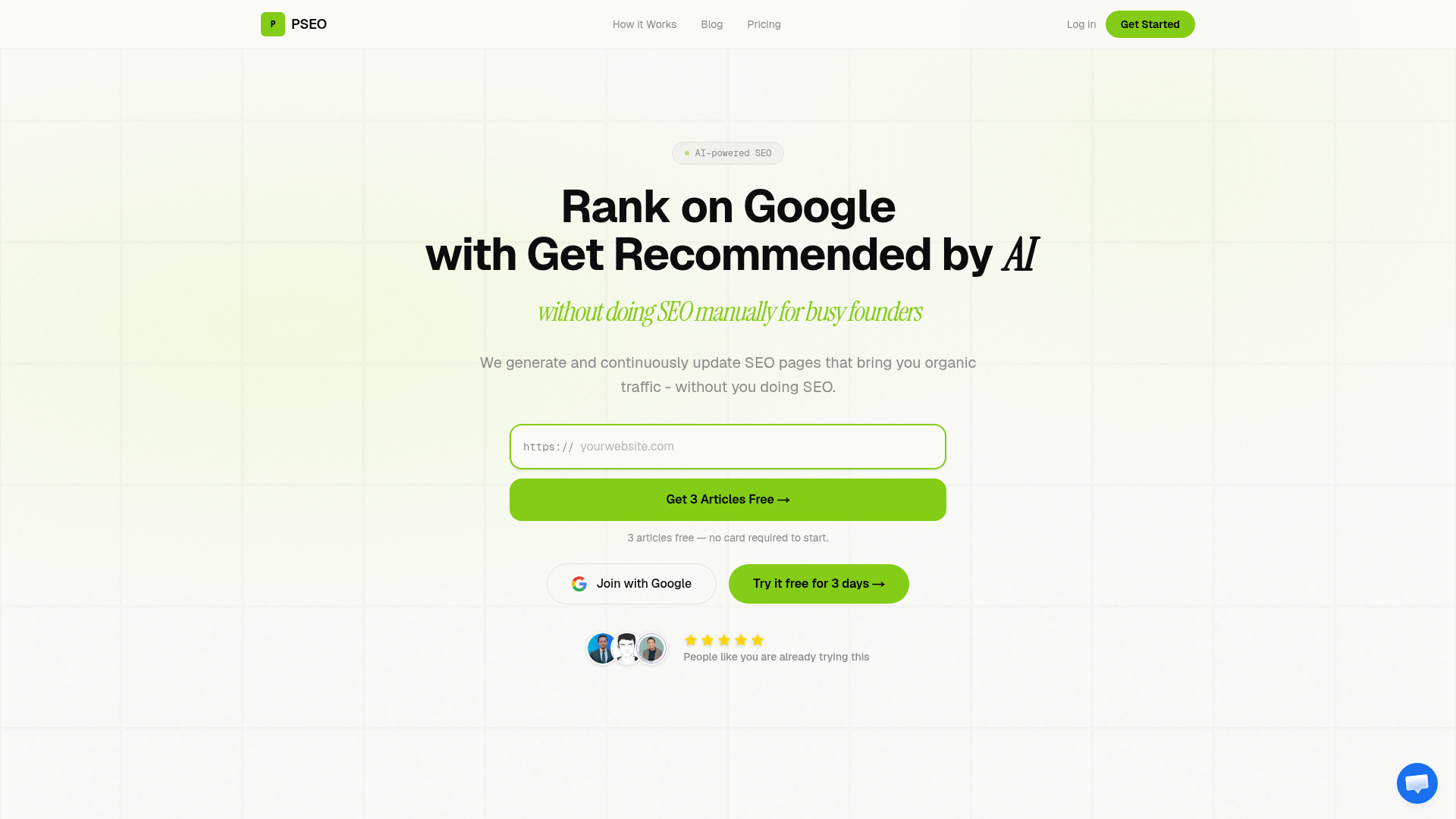
The pitch to founders is simple: you have a business to run, and SEO is a time-sink that never ends. ProgSEO's homepage doesn't mince words—"We generate and continuously update SEO pages that bring you organic traffic—without you doing SEO." This is the core thesis: SEO is not a one-time project but an ongoing operational burden, and the only way to win is to automate the entire loop. The product is explicitly built for "busy founders," not SEO specialists. That's a meaningful distinction. Most SEO tools are power tools for experts; ProgSEO wants to be the self-driving car for people who don't even want to think about the road.

The evidence suggests they're serious about the "no setup" claim. The workflow is: enter your domain, get a content plan, generate and publish. No mention of integrating with Google Search Console, no backlink analysis, no technical audits. It's a radical simplification that will either be liberating or dangerous, depending on how much you trust the algorithm.

From Domain to Content Calendar in Seconds

The first step is almost anticlimactic: you type in your domain, and ProgSEO "analyzes your site to find high-impact keywords you should be ranking for." The site claims it takes seconds and requires no setup. This is the classic automated SEO pitch—let the machine do the keyword research that would take a human days. But the real product is what happens next.

ProgSEO doesn't just hand you a list of keywords; it generates a "month-long content calendar—each day targeting a keyword with real growth potential." That's 30+ topics, structured and ready. This is a fundamentally different approach from most AI SEO tools, which let you generate articles one-off. ProgSEO is building a pipeline: a month of content, planned in advance, designed to build topical authority systematically.

The calendar is the product's first differentiator. It's not just a content idea generator; it's a strategic plan. For a founder who doesn't know what to write about, this is the missing roadmap. But it also raises a question: how does ProgSEO determine "real growth potential"? The marketing doesn't say, and that's a black box that could be a source of trust or a source of anxiety.

The 30-Topic Content Calendar: A Month of SEO, Pre-Planned

The content calendar is the heart of ProgSEO's value proposition. Instead of staring at a blank page, you get 30+ topics, each tied to a keyword with growth potential. The site shows a GIF of the calendar being generated, and it looks like a clean list of article titles, each with a target keyword. This is the kind of structure that makes SEO feel manageable.

But the calendar is not just a list; it's a schedule. "Each day targeting a keyword" implies a daily publishing cadence, which is a significant commitment. For a busy founder, publishing daily is a lot, even if the content is AI-generated. ProgSEO's answer is that you don't have to do the writing—you just edit and publish. The workflow is: open an article, edit if needed, and publish. The site says "Content created and shipped daily," suggesting that if you leave it on autopilot, it will keep generating and you just have to approve.

This is where the product's promise of "autopilot" gets real. It's not just generating content; it's managing a content operation. The calendar is the operational backbone, and it's a smart way to turn SEO from a chaotic mess into a predictable process.

Continuous Updates: The Anti-Stale Content Engine

The most interesting claim in ProgSEO's marketing is that articles "don't just get published—they evolve." The site says: "ProgSEO automatically updates content based on new data, helping pages stay relevant and competitive over time." This is the feature that separates it from a simple AI writer. Most AI content tools generate a static article and then it sits there, decaying in relevance. ProgSEO is building an engine that refreshes pages as search trends shift.

This is a bold promise, and it's the one that could make or break the product. If it works, it means your blog is always fresh, always aligned with what Google and AI assistants want to see. If it doesn't, you could end up with pages that are constantly changing, potentially losing rankings or confusing readers. The site doesn't explain the update mechanism in detail—how often, based on what data—so there's a leap of faith involved.

For a founder, the appeal is obvious: you don't have to revisit old posts or worry about content decay. The system does it for you. But it also means you're handing over control of your content's evolution to an algorithm. That's a trade-off that will appeal to some and terrify others.

From Keywords to AI Recommendations: A Strategic Pivot

ProgSEO's homepage has a section titled "Built for AI Recommendations, Not Just Rankings." This is a strategic pivot that acknowledges a fundamental shift in how people discover content. The site argues: "As AI assistants become the new discovery layer of the internet, content needs more than keywords. ProgSEO creates articles structured for search engines, AI understanding, and future recommendations."

This is the most forward-thinking part of the product. Most SEO tools are still obsessed with Google rankings, but ProgSEO is positioning itself for a world where ChatGPT, Perplexity, or other AI assistants are the entry point to information. That means content needs to be structured in a way that AI can parse and recommend. It's a smart bet, and it's one that few competitors are making explicitly.

The site even shows a comparison: a "With ProgSEO" article is structured with clear headings, a bolded thesis, and a Q&A section at the end—all things that make it easy for an AI to extract key points. This is a subtle but important differentiator. It's not just about keywords; it's about creating content that machines can understand and trust.

The Name, the Domain, and the Founder's Dilemma

The name "ProgSEO" is a portmanteau of "programmatic" and "SEO," suggesting a technical, automated approach. The domain, progseo.dev, is a .dev TLD, which is a signal to developers and tech-savvy founders. It's a name that prioritizes clarity over creativity—it tells you exactly what the product does. That's a strength for a tool that's selling automation, but it also makes it sound a bit generic. There's no story, no emotion, just function.

The branding is consistent with the product's ethos: no-nonsense, automated, efficient. The tagline, "From keywords to traffic - on autopilot for founders who want real results!" is a bit long and exclamation-heavy, but it gets the point across. The name is memorable enough, and the .dev domain fits the target audience.

For a founder, the name is a double-edged sword. It's easy to understand, but it's also forgettable in a crowded market. The product's real differentiation is in its continuous updates and AI-recommendation focus, not its name. That's fine—many successful tools have boring names—but it means ProgSEO will have to win on substance, not style.

Who Should Care (and Who Should Wait)

ProgSEO is aimed squarely at busy founders who want organic traffic without the SEO grind. If that's you, and you're comfortable with a black-box algorithm deciding what to write and when to update, this could be a serious time-saver. The free trial—3 articles, no card required—is a low-risk way to test the quality of the content and the calendar.

But if you're an SEO professional, or if you have a niche that requires deep expertise, you should be cautious. The product is designed for automation, not nuance. It won't replace a human strategist who understands your industry's subtleties. And if you're skeptical about AI-generated content's ability to rank in 2025, ProgSEO's success will depend on Google's tolerance for automated content. The site's own sample article is a meta-commentary on automation, which is clever but also a reminder that this is a tool for a specific kind of founder.

ProgSEO is a bet on the future of SEO—a future where automation is not just a convenience but a necessity, and where AI recommendations matter as much as rankings. Whether that bet pays off depends on execution, but the product's clear focus and continuous-update engine make it one to watch.