Impact-Site-Verification: 41b53a0c-6d04-458b-a457-fe9e29acde1a

SaaS & Productivity·Unknown··6 min read

RankFast

Automated SEO for Google and AI search, from keyword to published post.

NN

NewName Editorial

Editorial Team

RankFast product image 1

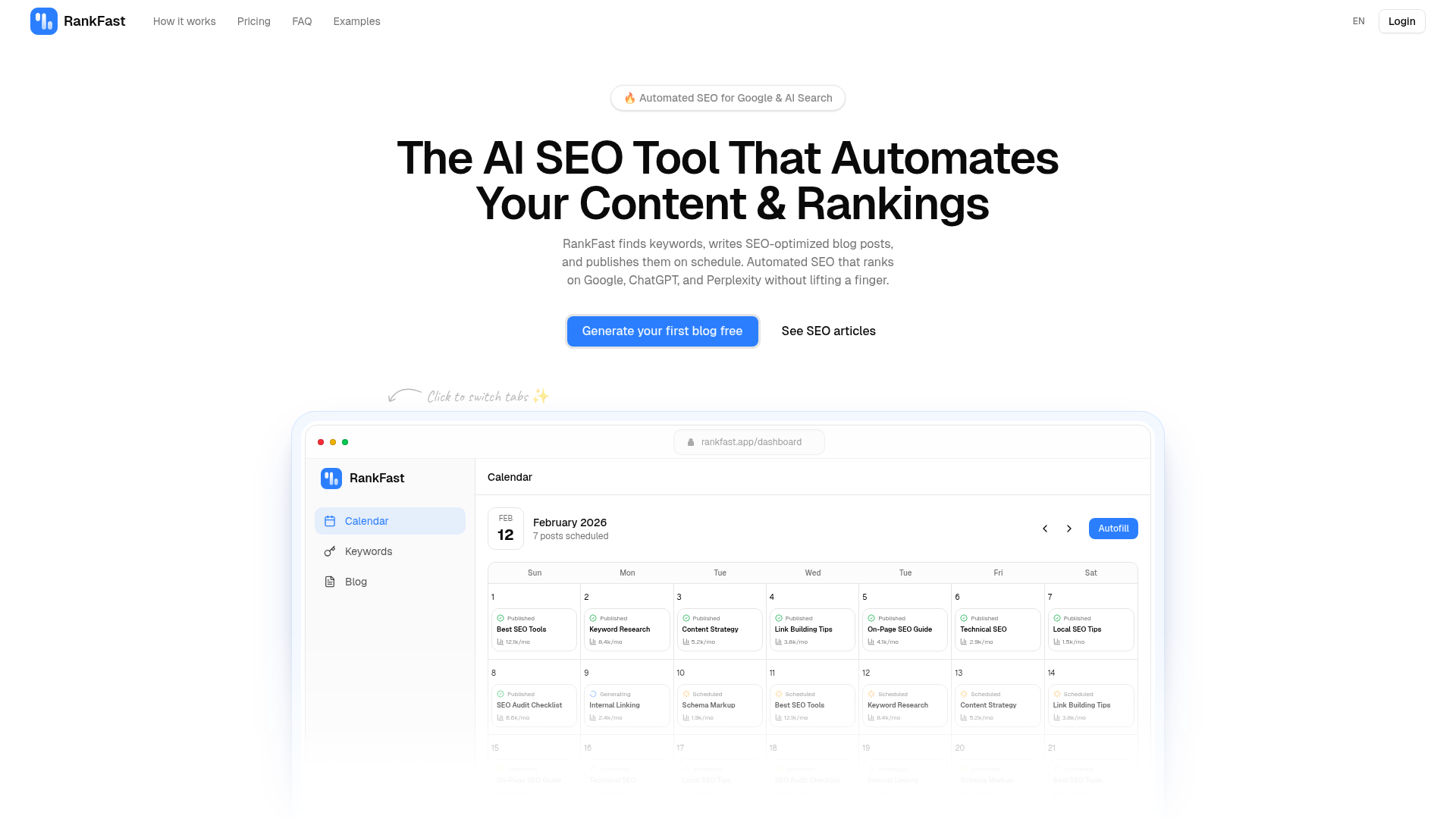
The SEO calendar is usually a planning artifact—a spreadsheet that tells you what to write next week. RankFast turns it into the product itself. Open the dashboard and you see a month grid, each day assigned a keyword with a search volume, status flipping from Scheduled to Generating to Published. The tool doesn't just suggest topics; it writes the articles, generates images, and pushes them to your CMS on schedule. That's a different philosophy from most SEO software, which stops at recommendations and leaves the execution to you.

RankFast's pitch is blunt: stop spending hours on keyword research and writing, and let the machine handle the entire pipeline. The website claims it can publish a fully optimized article with custom images every day, on autopilot. For a solo founder or a small marketing team, that's a tempting promise. But it also raises a question: when the calendar runs itself, what's left for the human to do?

The SEO Calendar as a Product

The dashboard screenshot on RankFast's homepage shows a February 2026 calendar with 7 posts already scheduled, each tagged with a monthly search volume like "Best SEO Tools 12.1k/mo" or "Keyword Research 8.4k/mo." The numbers are estimates, but they serve a purpose: they make the calendar feel like a portfolio of opportunities rather than a to-do list. Each day is a potential traffic slice, and the autopilot fills them in.

This is a deliberate design choice. Instead of a blank editor where you stare at a cursor, you get a pre-populated plan. The tool analyzes your website, niche, and competitors to find keywords, then organizes them into a monthly schedule. You can adjust which topics publish and when, but the default is to keep the pipeline moving. The calendar becomes the interface for strategy—you're not writing, you're approving.

That's a shift from traditional SEO tools like Ahrefs or SEMrush, which give you data and let you figure out the rest. RankFast collapses the distance between insight and action. It's not just telling you what to write; it's writing it for you. The question is whether that's a feature or a crutch.

What 'Ranking on ChatGPT' Actually Requires

RankFast's tagline is "Generate and publish articles for Google and AI search," and the site explicitly lists ChatGPT, Perplexity, Gemini, and other AI engines as targets. This is the GEO (Generative Engine Optimization) play. The marketing copy cites a 357% year-over-year growth in AI referrals to top websites, hitting 1.13 billion visits in a single month—a stat from the Uneed listing, not the product site itself, but it underscores the urgency.

AI search engines don't rank pages the way Google does. They parse content into chunks, evaluate each for authority and clarity, then assemble an answer from multiple sources. RankFast's response is to structure articles with JSON-LD schemas, FAQ markup, comparison tables, and semantic heading structure—the things AI engines look for when deciding what to cite. It also embeds YouTube videos and generates custom images, making the content richer and more likely to be picked up.

The research-first approach is notable: the site claims it uses Perplexity AI for deep research before writing a single word, pulling real sources and data to avoid hallucinations. That's a differentiator from generic AI writers that just string together plausible sentences. If the claims hold, the output should be more trustworthy, which is exactly what AI engines reward.

But here's the catch: no one can guarantee rankings. The FAQ asks "Will the content actually rank on Google?" and the answer is likely a careful hedge. The site doesn't disclose specific success metrics, so the effectiveness remains unproven. Still, the focus on AI search is a forward-looking bet. As more users turn to ChatGPT for answers, being cited there could become more valuable than a top-10 Google result.

The Autopilot Tradeoff: Volume vs. Editorial Judgment

RankFast's core promise is automation: "Articles publish to your site on autopilot. Your brand starts appearing in AI search results and climbing Google rankings without you writing a single word." That's a powerful lure for businesses that know content is important but can't dedicate 100+ hours a month to it.

The tradeoff is control. When the tool writes and publishes, you're trusting its algorithms to make the right editorial calls. The calendar shows keywords with search volumes, but does it know which topics are strategically important for your brand? Can it capture your unique voice or industry nuance? Probably not as well as a human writer.

RankFast mitigates this with a content calendar you can edit, and the site says you can control the schedule. But the default is autopilot, and the value proposition is hands-off. For a brand that needs thought leadership or deeply researched pieces, that's a risk. For a site that just needs to cover a broad set of keywords to capture traffic, it might be fine.

There's also the question of quality. The site claims articles are research-first and plagiarism-free, but it doesn't show examples on the homepage. The demo article about "How to Write SEO Content That Ranks" is a dummy, not a real sample. Without seeing actual output, it's hard to judge whether the content is genuinely useful or just SEO filler. The promise of custom images and YouTube embeds suggests a richer experience, but the proof is in the published posts.

Publishing Without a CMS Hassle

One of the biggest friction points in content marketing is getting the article from a draft to a published page. RankFast addresses this with native integrations for WordPress, Webflow, Framer, Shopify, Wix, and a generic webhook. The site says articles publish directly with images, meta tags, and formatting—no code required.

That's a practical advantage. Many AI writing tools generate text but leave you to copy-paste into your CMS, which is a chore. RankFast automates the final step, making the pipeline truly end-to-end. For non-technical users, this could be the difference between actually publishing and abandoning the effort.

The integrations also signal a target market: small to medium businesses that use popular CMS platforms and don't have a dedicated developer. The webhook option adds flexibility for custom setups, though it's less turnkey.

The Name Says Fast, But the Value Is Consistency

The name "RankFast" is a direct promise: speed. It's a common pattern in SEO tools—think of similar names that emphasize quick results. But the real value RankFast offers isn't just speed; it's consistency. The calendar-based autopilot ensures you publish regularly, which is what search engines and AI engines reward. The name might be a bit generic, but it's memorable and clearly communicates the benefit.

The domain rankfast.app is clean and easy to type, though the .app TLD is less conventional than .com. It's a minor point, but for a tool that promises speed, a .com might feel more established. Still, the name aligns with the product's promise, and the logo is simple.

In a crowded market of AI SEO tools, RankFast's differentiation lies in the automation of the entire pipeline, not just the writing. The name captures that, but it doesn't convey the GEO focus or the calendar approach. Those are the features that set it apart.

Who Should Care (and Who Shouldn't)

RankFast is designed for businesses that need a steady stream of SEO content but lack the time or resources to produce it manually. A solo founder, a small marketing team, or an agency managing multiple client sites could all benefit. The pricing—$59/month for 15 articles, $99/month for 30—is accessible for a business that sees content as an investment.

But it's not for everyone. If you're a brand that relies on a unique voice or deep expertise, autopilot content might dilute your message. If you're in a highly regulated industry, the lack of human oversight could be a liability. And if you're skeptical of AI-generated content's ability to rank, you'll want to test it on a small scale first.

The site offers a one-day free trial, which is enough to see the dashboard and maybe a sample article, but not enough to judge rankings. Still, for the price, it's a low-risk experiment. The real test is whether the articles actually get cited by ChatGPT or climb Google's results. That's a question only time—and the calendar—can answer.