SEOBeast
Autonomous SEO content that writes, checks, and publishes in your brand voice.
NewName Editorial
Editorial Team

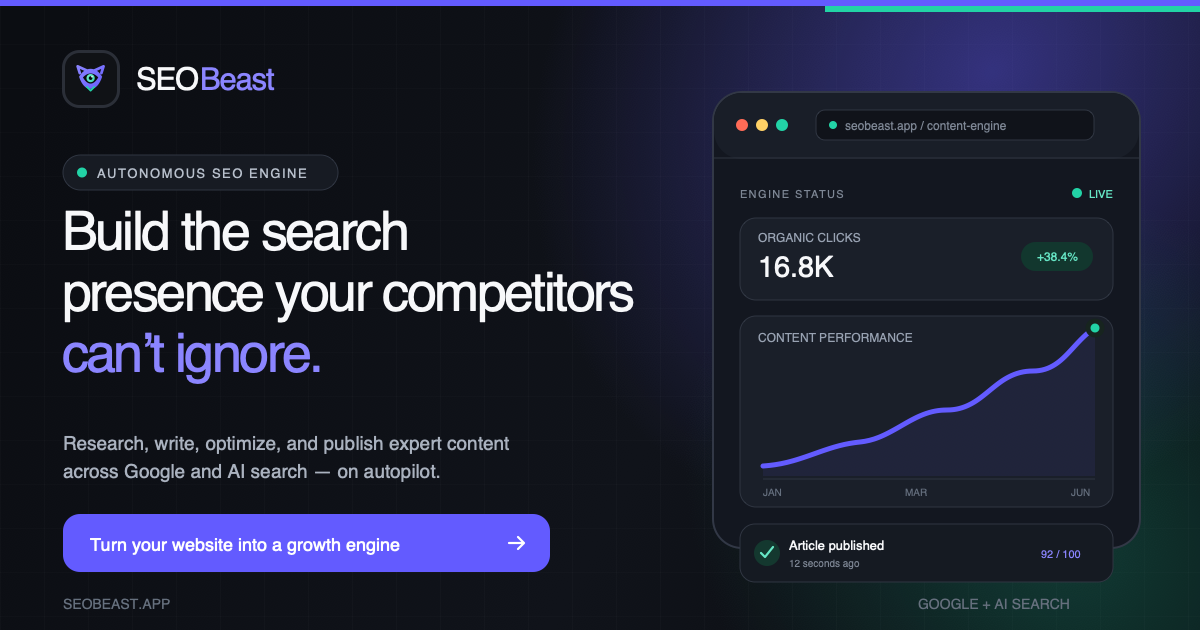
The promise of AI content tools has always been a paradox: they make publishing cheap, but cheap publishing is exactly what Google's helpful-content systems are designed to demote. The result is a market flooded with generic, machine-generated articles that rank for a week and then vanish. SEOBeast, an autonomous SEO platform aimed at lean teams, is trying to escape that trap by automating not just the writing, but the entire editorial discipline around it—the research, the quality checks, the internal linking, the publishing. The bet is that consistency, not creativity, is what makes AI content actually work.
The Autonomy Trap in SEO Content
Most AI writing tools are glorified autocomplete. You type a prompt, get an article, and then the real work begins: editing for voice, checking facts, optimizing for SEO, finding internal links, and finally publishing. For a lean team, that's not automation—it's a different kind of drudgery. SEOBeast's pitch is that it removes the drudgery entirely. The website shows a six-step engine: connect your site, find topics, approve a strategy, write and check, publish, and grow. The key word is "approve." You're not approving thirty individual tasks; you're approving a month's worth of content in one go. That's a fundamentally different interaction model from a chatbot that hands you a draft and says "good luck."
The autonomy is the point, but it's also the risk. The more you delegate, the more you're trusting the machine to make judgment calls that used to be human—like whether an article is good enough to publish. SEOBeast's answer is to build a quality gate into the pipeline, and that's where the product gets interesting.
How SEOBeast Replaces the Content Team, Not Just the Writer
SEOBeast's workflow is designed to replace an entire content operation, not just the writing. The landing page shows a dashboard with a content calendar, scores, and organic click metrics. It's the kind of interface a content manager would use, not a writer. The tool handles keyword research, topic clustering, and prioritization—the strategic work that usually requires a dedicated SEO specialist. It then drafts articles in your brand voice, runs over 50 SEO and quality checks, and publishes directly to WordPress, Webflow, Shopify, Ghost, Framer, or Notion.
The integration list is telling. By connecting to the CMS, SEOBeast isn't just producing content; it's managing the entire publication pipeline. That's a significant step beyond tools that generate a document you have to copy-paste. It also means the tool can do things like automatically internal-link new articles to existing ones, a task that's tedious but crucial for SEO. For a lean team, this is the difference between a tool that helps and a tool that does the job.
The Quality Gate: Where SEOBeast Earns Its Keep
The quality gate is SEOBeast's most distinctive feature. The product tour shows an article draft with a "Quality gate" section that checks search intent, brand voice, and internal links, and assigns an SEO score. This is a deliberate response to the problem of thin AI content. Google's helpful-content system doesn't demote AI content per se; it demotes unhelpful content, and AI makes it cheap to produce unhelpful content at scale. SEOBeast's gate is an attempt to enforce quality programmatically.
The checks are not just about keyword density or meta descriptions. They're about intent matching—does the article actually answer the query a user would type?—and brand voice—does it sound like you, not like a generic model? The scoring system gives a numeric quality signal, which is useful for a team that can't read every draft. But it's also a black box. The site doesn't disclose what the 50+ checks are, and the scores are self-referential. A score of 92 means SEOBeast thinks it's good, not necessarily that Google will agree.
Brand Voice as a Machine-Learned Constraint
The brand voice feature is a clever answer to one of the most common criticisms of AI content: it all sounds the same. SEOBeast claims to learn your brand's voice from your existing content and apply it to new articles. The product tour shows a "Brand voice" check in the quality gate, suggesting it's a measurable, enforced constraint, not just a prompt tweak.
This is a different approach from tools that let you paste a style guide and hope for the best. By learning from your actual published content, the model can mimic your sentence structure, vocabulary, and tone. The risk is that it learns your bad habits too, or that it produces a pastiche that's close but not quite right. The site's own blog post on AI content acknowledges that voice is a form of trust, and that the final "does this sound like us?" judgment has to be human. So the feature is a starting line, not a finish line.
The CMS Pipeline: From Draft to Live Without a Human
The CMS integrations are where SEOBeast becomes truly autonomous. The tour shows an article moving from "SEOBeast" to "WordPress" to "Live" with an "Indexed queue." This is the part that eliminates the last mile of manual work. Once you approve a strategy, the tool can publish on a schedule, with your formatting, images, and metadata intact.
This is a significant trust exercise. You're giving a machine the keys to your website's content management system. The site shows an "Auto-publish is on" toggle, which is a clear signal that you can turn it off. But the default is on, and that's a bold statement. For a lean team, the time savings are enormous. For a brand that's cautious about quality, it's a leap of faith.
The pipeline also enables a compounding effect. As articles are published, they get internal links from new articles, and the dashboard tracks rankings, organic clicks, and AI citations. This is the "growth engine" loop that SEOBeast promises: content begets content, and the system learns what works.
The AI Search Wildcard
SEOBeast's tagline mentions "Google and AI search," and the dashboard tracks "AI citations." This is a forward-looking bet. As AI-powered search engines like Perplexity and ChatGPT become more prominent, the rules of SEO are shifting. Being cited by an AI is different from ranking on a Google results page. SEOBeast is positioning itself to help brands win in both channels.
The site shows a metric for "AI citations" alongside organic clicks and ranking pages. That's a signal that the tool is tracking not just traditional SEO but also visibility in AI-generated answers. It's an acknowledgment that the search landscape is fragmenting, and that content needs to be optimized for machines that read and synthesize, not just index.
This is a smart hedge, but it's also unproven. The site doesn't explain how AI citations are measured or how the tool optimizes for them. It's a dashboard number that could be meaningful or could be vanity. For now, it's a differentiator that suggests SEOBeast is thinking about the future, but the details are thin.
What SEOBeast Doesn't Solve (and Why That's Honest)
SEOBeast's own blog post is refreshingly honest about the limits of AI content. It notes that AI cannot provide first-hand experience, and that the best content comes from a human injecting specifics only they would know. The post recommends using AI for structure and drafting, but editing for accuracy and voice. This is a nuanced position that acknowledges the tool's limitations.
The implication is that SEOBeast is not a replacement for a human expert, but a force multiplier for a lean team. It handles the research, the drafting, the SEO checks, and the publishing, but it can't manufacture the kind of original insight that makes content truly authoritative. The site's examples—like a comparison of AI reply tools or a guide to LinkedIn automation—are the kind of content that can be written from public information, not from proprietary experience.
That's a reasonable positioning, but it also limits the ceiling. For a startup with a unique product or a founder with deep expertise, the AI-generated content might not capture the nuance that makes their content distinctive. The quality gate can check for intent and voice, but it can't check for truth. The blog post warns about fabricated statistics, and that's a risk that no automated system can fully mitigate.
The name "SEOBeast" itself is a double-edged sword. It's memorable and aggressive, suggesting raw power and dominance. But it also signals a focus on SEO as a game to be won, which might attract the wrong kind of user—someone looking for shortcuts rather than sustainable growth. The brand voice feature and the quality gate suggest a more mature approach, but the name leans into the beastly, automated side.
In the end, SEOBeast is a bet that the future of content marketing is not about human creativity but about systematic execution. It's a tool for teams that would rather spend their time on product and customers than on blog posts. The quality gate is an attempt to keep the machine honest, but it's a self-imposed check. Whether that's enough to satisfy Google's raters is the open question. The $1 trial for three articles is a smart way to find out without much risk. For lean teams drowning in content demands, that's an offer worth taking seriously.