Snill
Describe your business in plain language; get a database, API, and dashboards — generated, not built.
NewName Editorial
Editorial Team
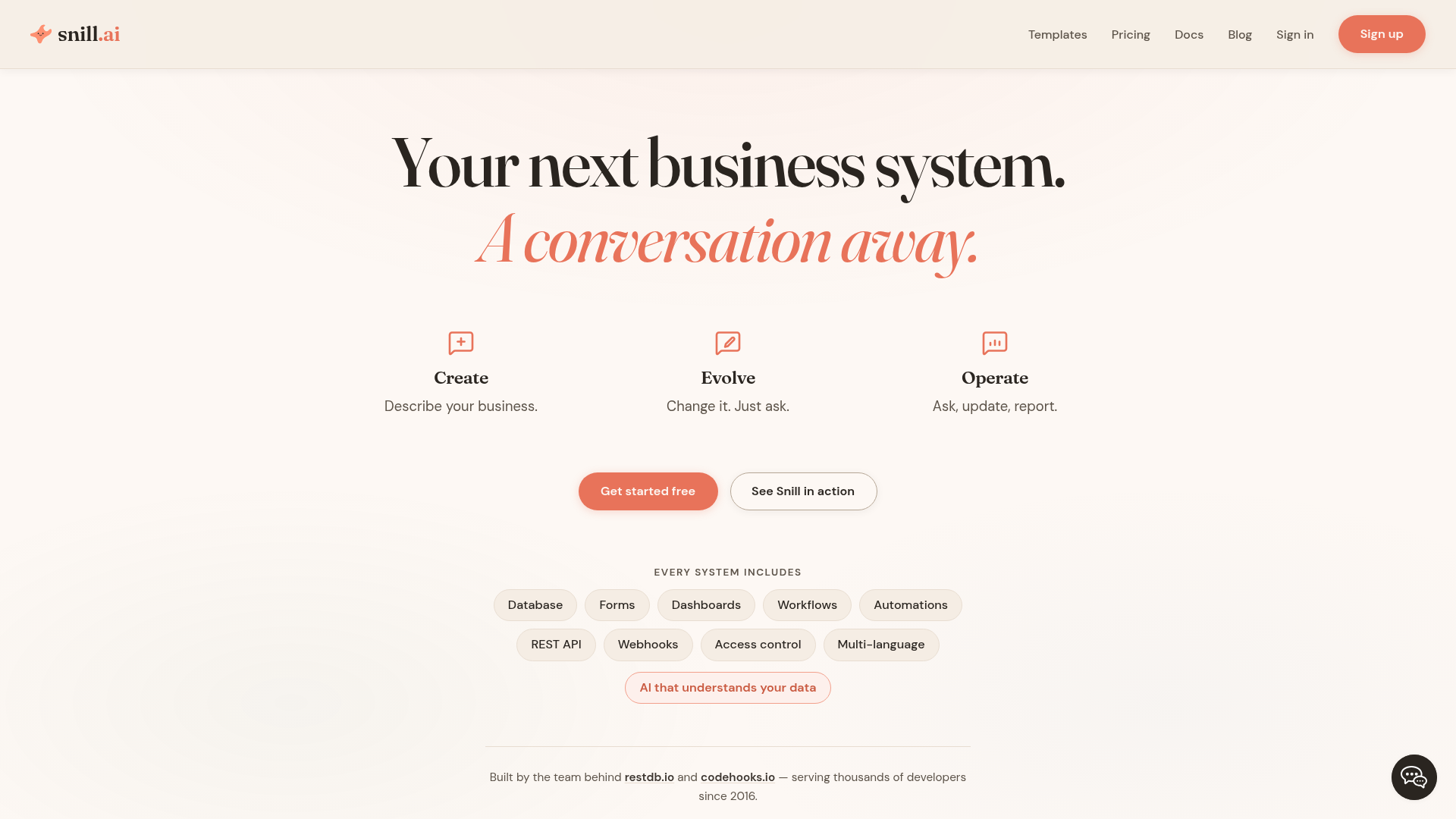
Snill's pitch is disarmingly simple: describe your business the way you would to a new hire, and get a complete system — database, forms, dashboards, workflows, API — deployed before you finish the sentence. The company, built by the team behind restdb.io and codehooks.io, is betting that the hardest part of business software isn't the interface or the infrastructure, but the articulation of the business itself. If you can explain how billing works, what you track, and who needs to see what, Snill claims it can generate the rest.
That's a bold claim in a category crowded with no-code builders, Airtable alternatives, and AI app generators. But Snill's approach differs in a crucial way: it doesn't generate a mockup or a prototype. It generates a real, database-backed system with a relational data model, scoped API keys, and version history. The question is whether that depth can survive the simplicity of the prompt.
The conversation is the schema
The core mechanic is a natural language prompt. You describe your clients, projects, billing, and what you track — no forms, no schema design. Snill interprets that description and generates collections, fields, relationships, and validation rules. The company's walkthrough shows a consultancy app — clients, projects, time tracking, invoices, reports — built and refined in one unedited conversation.
This inverts the usual no-code flow. Tools like Airtable or Glide start with a blank grid or a canvas; you assemble the pieces. Snill starts with a description and assembles the pieces for you. The schema isn't something you design; it's something you reveal through language. That's a meaningful shift for operators who think in terms of "how we work" rather than "what tables we need."
The risk is that the AI misinterprets the description. Snill's answer is iteration: you can keep talking to the AI to make changes, or switch to a visual Appmodel Editor. Both produce the same output, so you're never locked into the prompt as the only interface. But the initial schema quality still depends on how well you describe your business — which is exactly the skill Snill assumes you have.
A real database under the prompt
The most important distinction from a spreadsheet-with-AI is what sits underneath. Snill generates a relational data model with lookups, calculated fields, and proper relationships — not flat tables. Every system includes a REST API with an auto-generated OpenAPI 3.0 spec, scoped API keys, and HMAC-signed outbound webhooks. That's not a feature for hobbyists; it's a signal that Snill is aimed at businesses that will eventually need to integrate with accounting software, a website, or an automation tool.
The API isn't an afterthought. It's part of the pitch: "API and integrations from day one." For a founder who's outgrown spreadsheets but doesn't want to hire a developer, the promise is that the system can grow into a real backend without a rewrite. The fact that the team behind restdb.io — a database-as-a-service product used by thousands of developers since 2016 — is building this lends credibility to the "real database" claim. They've spent a decade making databases accessible to developers; now they're making them accessible to operators.
The versioning safety net for AI-generated changes
One of the biggest fears with AI-generated software is that a prompt will break something you liked. Snill addresses this with version history and rollback: every change to the system is saved, and you can revert to any earlier point in one click. The FAQ frames it as "change anything, break nothing" — a direct answer to the anxiety of letting an AI restructure your data model.
This is a smart design choice. It lowers the cost of experimentation, which is exactly what you want when the primary interface is conversation. If the AI adds a status field that messes up a workflow, you roll back. If you're not sure about a new dashboard, you try it and revert. The safety net makes the AI's autonomy tolerable.
The versioning also has a subtle trust benefit: it signals that Snill understands the stakes. Business systems contain operational data — clients, invoices, schedules. A tool that can't undo mistakes isn't fit for that job. By making rollback a headline feature, Snill positions itself as dependable, not just clever.
From restdb.io to Snill: a decade of data-first tools
Snill's origin story is unusual in the AI-app space. Most such tools come from front-end or design backgrounds; Snill comes from the database world. The team behind restdb.io and codehooks.io has been building data-first developer tools since 2016. That heritage shows in the product's priorities: relational integrity, API access, scoped keys, and EU hosting.
The branding reinforces this. "Snill" is Norwegian for kind, friendly, helpful — a deliberate contrast to the cold, technical feel of database infrastructure. The site's footer reads "Software that speaks your language. Made in Norway." The name softens the technical core, making it approachable for non-developers while nodding to the team's Scandinavian roots.
This positioning is smart: it targets the operator who doesn't want to be a developer but needs developer-grade foundations. The name says "friendly," the product says "production-grade." The tension between those two messages is the product's identity.
The EU card and the trust angle
Snill makes a point of being EU-based: "Your data and the AI that powers Snill both run in the EU." In a market where many competitors route data through US servers, this is a concrete differentiator for European businesses concerned about GDPR and data sovereignty. It's not a marketing slogan; it's a structural choice that affects where data lives and which regulations apply.
The trust angle extends to data ownership. Snill's FAQ is explicit: you own your data, you can export CSV or JSON anytime, and daily backups are kept for 30 days. There's no lock-in rhetoric — just a clear statement of portability. For a tool that asks you to describe your entire business, that's a reassuring stance.
Who should care — and what's still unproven
The target customer is clear: founders, consultants, and operators who've outgrown spreadsheets but don't want to wrestle with no-code tools. The use cases listed — consulting, rental marketplace, agency, property management, logistics — are all operational businesses with structured data and recurring workflows. For them, Snill promises to replace a patchwork of Google Sheets, WhatsApp, and specialized SaaS with one system that fits.
What's unproven is how well the AI handles complex, messy descriptions. The walkthrough is impressive, but it's a curated example. Real businesses have edge cases, legacy data, and conflicting terminology. Snill's CSV/JSON import and field mapping help, but the initial generation still depends on the quality of the prompt.
Another open question is pricing. At $19 per user per month, Snill is competitive with Airtable and Notion, but the AI request limits (10 per day on Free, 50 per user per day on Pro) could become a bottleneck for teams that rely heavily on conversational changes. The free tier is generous enough to test, but scaling AI usage may require the Pro plan.
Overall, Snill is a credible attempt to make business software feel like conversation. It's not the first AI app builder, but it may be the first that treats the database as the product, not the interface. For operators who can describe their business — and who value data ownership and EU hosting — it's worth a serious look. The proof will be in how well it handles the second prompt, and the third, and the hundredth.