Impact-Site-Verification: 41b53a0c-6d04-458b-a457-fe9e29acde1a

SaaS & Productivity··6 min read

Sprachlify

German vocabulary with the context that makes it stick

NN

NewName Editorial

Editorial Team

Sprachlify product image 1
Sprachlify product image 2
Sprachlify product image 3

Most translation tools treat German as a code to be cracked: type a word, get a word, move on. Sprachlify, a free German vocabulary tool built in Berlin, takes a different stance. It assumes that a translation without grammatical context is a half-finished thought. For a language where the article changes the meaning of a sentence and formality can make you sound like a robot or a grandmother, that context isn't a luxury—it's the point.

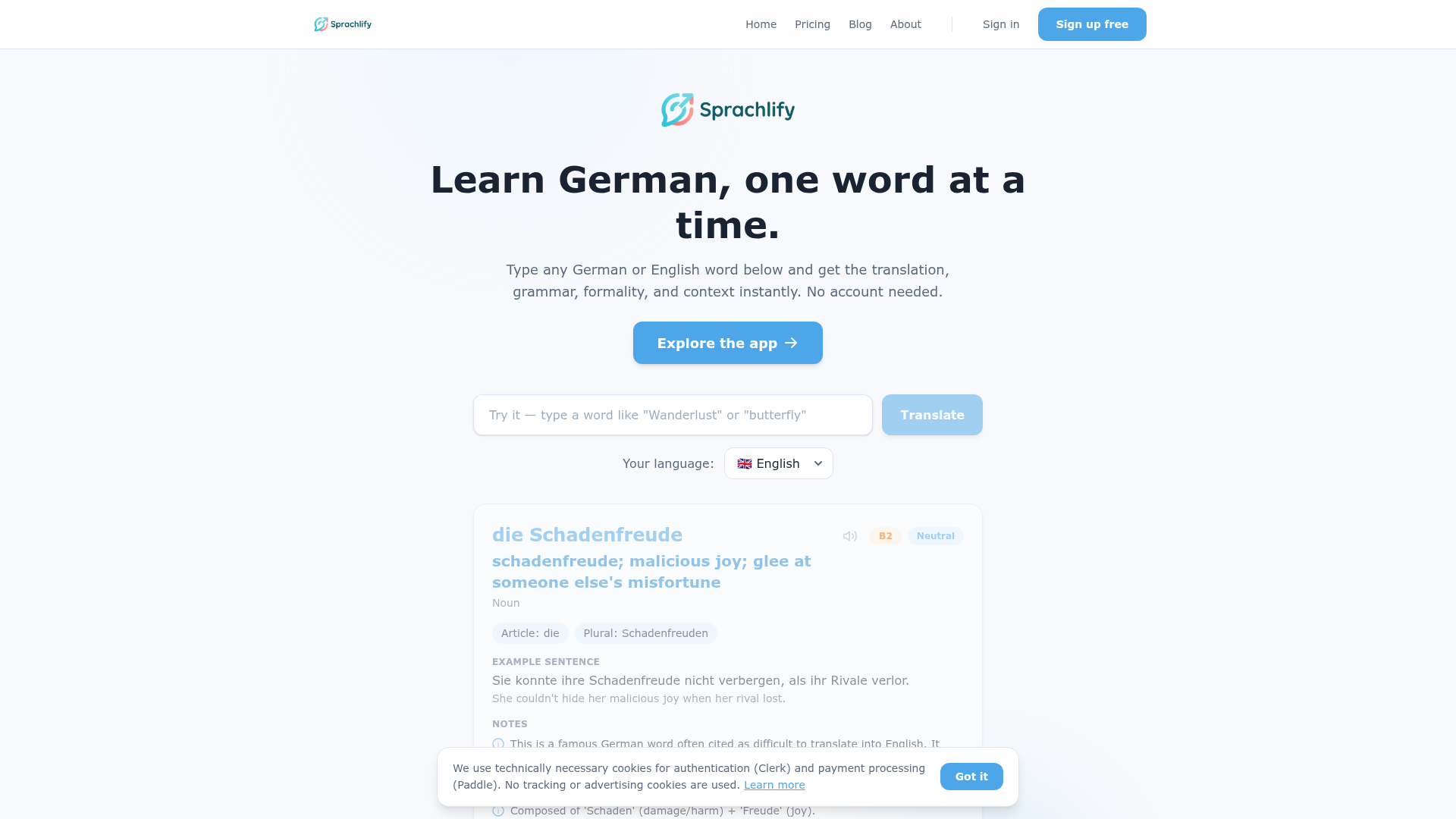
The homepage doesn't ask you to sign up. It drops you straight into a translation field with a live example: die Schadenfreude. The result shows not just the English gloss, but the article, the plural, the formality level, and a usage note explaining that this word has entered English as a loanword. It's a small demonstration of the product's thesis: you learn a word when you see how it behaves, not just what it means.

The grammar gap in translation tools

Google Translate gives you a word. That's its job. But for a German learner, a bare translation is often a trap. The noun's gender determines the article, the plural can be unpredictable, and the verb's conjugation changes with the subject. A word like "Schadenfreude" is a noun, but knowing that doesn't tell you whether it's der, die, or das, or how to use it in a sentence.

Sprachlify's pitch is that it fills this gap. Every translation returns the article (der/die/das), the plural form, verb conjugations, formality level (from vulgar to archaic), and an example sentence. It also flags connotations that don't exist in English—like whether a word sounds rude or overly formal. This is the kind of information that textbooks bury in appendices and that tutors charge by the hour to explain.

The product's origin story reinforces this. The about page notes it was built in Berlin by a developer learning German themselves. That's not just a biographical detail; it explains the product's focus. A person who has struggled with der, die, and das knows that a dictionary entry is insufficient. The tool is shaped by that frustration.

What Sprachlify returns that Google Translate does not

The core interaction is simple: type a German or English word, get a translation with grammatical detail. The example on the homepage shows the depth. For "die Schadenfreude," you get:

  • The translation: schadenfreude; malicious joy; glee at someone else's misfortune
  • The part of speech: Noun
  • The article: die
  • The plural: Schadenfreuden
  • The formality level: B2, Neutral
  • An example sentence with its English translation
  • Notes explaining the word's cultural weight and etymology

This is not a dictionary entry. It's a mini-lesson. The notes section explains that Schadenfreude is a famous untranslatable word, that it has entered English as a loanword, and that it's composed of "Schaden" (damage) and "Freude" (joy). For a learner, that's the difference between memorizing a word and understanding it.

The same structure applies to verbs, with conjugations, and to phrases, with formality flags. The tool supports English, Italian, Polish, and Spanish, which widens its appeal beyond the typical English-speaking learner.

Why the Berlin origin story matters

The about page is refreshingly honest: "It started as a personal tool, built in Berlin while I was deep in the process of learning German myself. It's still that—just open to anyone who needs it." This is not a corporate product. It's a solo developer's solution to a personal problem.

That origin shapes the product in visible ways. The interface is minimal, the pricing is simple, and the blog is written with the voice of someone who has personally grappled with German cases and separable verbs. The blog posts—"What Does 'Doch' Mean in German?" and "German Separable Verbs: What They Are and How to Use Them"—are the kind of content that comes from lived experience, not SEO research.

For a learner, this is a signal of trust. A tool built by someone who has been through the same struggle is more likely to understand the pain points. It also explains why the product is free at the entry level: it's a passion project, not a growth hack.

The freemium funnel: limits that push serious learners to Pro

The free plan is generous enough to be useful: 10 translations per day (the homepage says 10, the about page says 20—the discrepancy suggests the limits are still being tuned), 50 saved words, 3 audio pronunciations per day, and access to selected word packs. Pro costs €5/month and unlocks unlimited translations, saved vocabulary, and pronunciation.

This is a classic freemium funnel, but the limits are set to encourage a specific behavior: serious study. A casual user might look up a few words a day and never hit the cap. A serious learner, building a vocabulary list and reviewing with flashcards, will quickly need more. The 50-word saved vocabulary limit is particularly telling—it's enough to start a list, but not enough to sustain a long-term learning habit.

The pricing page doesn't hide the upgrade path. It says "Upgrade when you're serious about learning." That's a clear value proposition: the free tier is a taste, the Pro tier is the meal.

The blog as a vocabulary engine

The blog is not a marketing afterthought. It's a content engine that reinforces the product's core value: understanding German words in context. Posts like "25 German Words That Don't Exist in English" and "The 100 Most Useful German Words for Beginners" are not just listicles; they're invitations to use the tool. Each post is a curated vocabulary list, and the tool is the way to look up those words with full context.

This is a smart content strategy. It attracts organic traffic from learners searching for specific words or grammar topics, and it converts that traffic into product usage. The blog also builds authority—a learner who reads "German Cases Explained" is more likely to trust the tool's grammar information.

The blog's voice is consistent with the product's: practical, honest, and slightly irreverent. The post titles alone—"How to Say 'I Love You' in German (and When to Use Each Phrase)"—suggest a writer who knows that language learning is full of awkward moments.

What Sprachlify still doesn't tell you

For all its strengths, Sprachlify has limits. The interface is currently English-only, though the about page says support for Spanish, Italian, and Polish is planned. That's a gap for a product that claims to support those languages as source languages.

The free tier's translation limit is also a friction point. A learner who wants to look up a full paragraph of text will hit the cap quickly. And while the tool provides example sentences, it doesn't offer the kind of spaced repetition that dedicated vocabulary apps like Anki provide. The flashcard practice is a start, but it's not a full SRS system.

The product also doesn't disclose how the AI generates its translations. The homepage says "powered by AI," but there's no detail on the model or the training data. For a tool that claims accuracy, that's a transparency question.

Who should care about Sprachlify

Sprachlify is for anyone who has ever looked up a German word, gotten a one-line translation, and forgotten it a week later. It's for the learner who knows that "der, die, or das" is not a trivial detail, and that formality matters in a language where you can address someone as "du" or "Sie."

It's also for the self-directed learner who wants more than a dictionary but less than a full course. Sprachlify fills the gap between a translator and a textbook, and it does so with a free tier that's genuinely useful.

The €5/month Pro price is low enough to be an impulse buy for anyone serious about German. And the blog is a free resource that's worth reading even if you never sign up.

In a market dominated by Duolingo's gamification and Google Translate's convenience, Sprachlify stakes out a narrow but valuable niche: the grammar-obsessed learner who wants to understand, not just memorize. That's a small audience, but a loyal one—and a product built by a learner, for learners, is exactly the kind of tool that earns that loyalty.