Spur
Spur turns mobile QA from a headcount line item into metered validation infrastructure.
NewName Editorial
Editorial Team
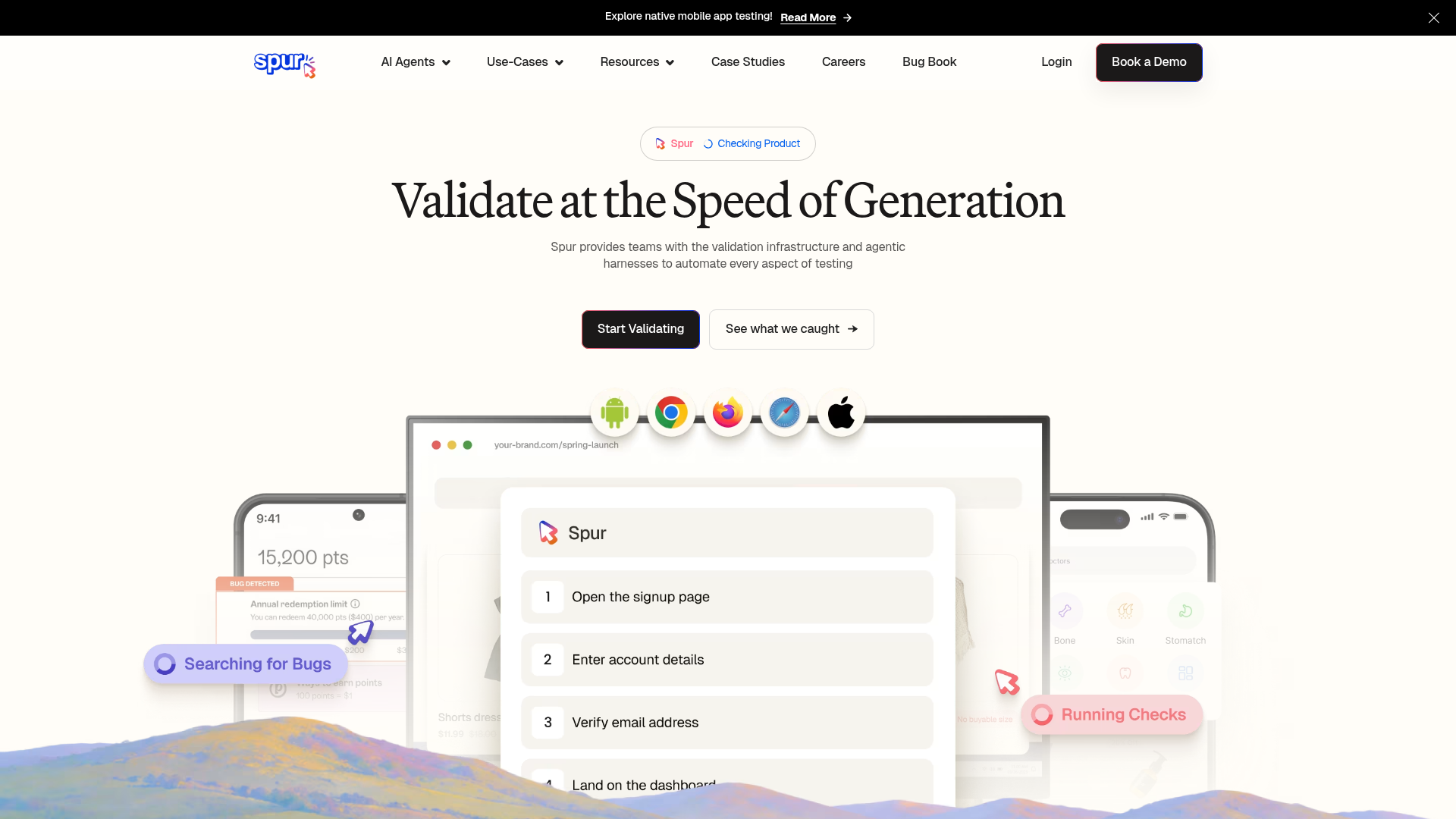
Mobile QA has been a structural cost center for a decade, and the economics only got worse the moment AI coding assistants started shipping features faster than any human test suite could absorb. Spur's pitch — "validate at the speed of generation" — is a direct response to that gap. The company is not selling another test recorder or a cloud device farm. It is selling a validation layer: a set of AI agents that exercise a mobile app the way a human QA engineer would, then report what broke. The interesting question is not whether AI can click through an app. It is whether QA can finally be re-priced from a headcount line item into a metered infrastructure cost — and whether Spur can own that transition before the incumbents do.
The QA Cost Center That AI Coding Tools Just Broke
For most consumer mobile teams, QA is staffed, not engineered. A mid-size e-commerce or consumer app typically runs a mix of manual testers (often offshore), a brittle Selenium/Appium suite that a few engineers maintain reluctantly, and a device cloud subscription for coverage. The manual layer is expensive and slow; the automated layer is expensive to maintain and constantly breaks on OS releases and UI churn. Neither scales with the pace at which AI-assisted engineering now produces code.
That mismatch is the wedge. When a team can generate a feature in an afternoon, a QA cycle measured in days becomes the bottleneck. Spur's framing — "validation infrastructure and agentic harnesses to automate every aspect of testing" — is aimed squarely at that bottleneck. The company is betting that the constraint has shifted from "can we write enough test scripts" to "can we validate continuously, in plain English, without a standing army of testers."
Inside the Agent Harness: What Spur Actually Automates
Spur's product surface is organized around discrete agents rather than a single monolithic test runner. Public materials list Exploratory Testing, Localization, UI/UX Feedback, Functional Testing, and AI Feature Testing agents. That taxonomy matters because it maps to different buyers and different failure modes. Functional testing is the classic regression suite replacement. Exploratory testing is the fuzzy, judgment-heavy work that has historically resisted automation. Localization catches the string truncation and RTL bugs that ship constantly. UI/UX feedback is closer to a design review than a test. AI Feature Testing is aimed at the new class of LLM-powered in-app features, where outputs are non-deterministic and traditional assertions fail.
The stated interaction model is plain English: "test and validate your mobile apps in plain english." That is the same interface bet Cursor, Claude Code, and GitHub Copilot made for code generation — natural language as the authoring layer, with the system handling execution. Spur also exposes an MCP endpoint (Spur MCP), which suggests the agents are designed to be called from within AI coding environments rather than only from a standalone dashboard. If that integration works, Spur becomes a validation step inside the developer's existing agentic workflow, not a separate tool the team has to remember to open.
The supporting assets — a Bug Book collection of caught defects, an ROI calculator, a Buyers Guide to E-Commerce QA — are classic enterprise-education content. They signal a sales motion that needs to justify budget against existing QA spend, not a pure self-serve developer tool.
Why Appium, Device Clouds, and Offshore QA Are the Real Incumbents
Spur's competition is not other AI testing startups. It is the status quo stack that every mobile team already pays for. That stack has three layers.
- Open-source frameworks: Appium, Detox, Espresso, XCUITest. Free, deeply embedded, and maintained by engineers who will resist replacing them. Their weakness is maintenance cost and flakiness, not capability.
- Device clouds: BrowserStack, Sauce Labs, AWS Device Farm, Firebase Test Lab. They solve coverage and infrastructure, not test authoring. Spur could sit on top of them rather than replace them.
- Manual and offshore QA vendors: the largest line item in most QA budgets. This is where the real displacement opportunity sits, because it is the most expensive and least defensible layer.
Against open-source frameworks, Spur's argument is maintenance economics: agents that adapt to UI changes instead of breaking on every selector update. Against device clouds, Spur is complementary — it needs somewhere to run. Against manual QA, Spur's argument is speed and consistency, and the Vuori webinar is explicitly framed around that displacement: "why the line between automated and manual QA is disappearing."
The risk is that incumbents move. BrowserStack and Sauce have both been adding AI-assisted test authoring. If device clouds bundle competent agentic testing into existing contracts, Spur's standalone value proposition narrows to the quality of its agents and its workflow integration — a defensible but thinner moat.
The Vuori Playbook: Selling Agentic QA to a Billion-Dollar Storefront
Spur's most concrete go-to-market evidence is the Vuori webinar, featuring Chris Bremmer, Vuori's Lead Automation Engineer, in conversation with Spur CEO Sneha Sivakumar. The framing is deliberate: "QA is often treated as a cost center, but at Vuori, it's become a driver of growth." That is a reference-customer motion, not a product-led one. It tells you Spur's buyer is a QA or automation lead at a large consumer brand, and that the sale is justified on ROI rather than developer delight.
Vuori is also a specific vertical signal. Spur markets a dedicated Merchandising QA use case alongside mobile app testing, which points at e-commerce and retail as a beachhead. That makes sense: these companies have high-traffic mobile apps, seasonal release pressure, and measurable revenue impact from checkout or catalog bugs. A single caught regression can pay for the contract.
The pattern — land with a pilot on one app or one workflow, prove ROI with a named case study, expand across the QA org — is the standard enterprise expansion playbook. Spur's content library (ROI calculator, buyers guide, bug book) is built to support exactly that motion. What public materials do not disclose is contract size, seat vs. usage pricing, or how much of the Vuori deployment is production vs. showcase.
Pricing, Metering, and the Unit Economics of Synthetic Testers
Spur does not publish pricing. The site routes every conversion path to "Book a Demo" or "Start Validating," which is consistent with enterprise-quoted contracts. That is a deliberate choice, and it has consequences.
Agentic testing has a fundamentally different cost structure than scripted testing. Every exploratory run consumes LLM inference, device time, and orchestration compute. That means Spur's gross margin depends on how efficiently it runs agents — how many tokens per test, how much redundant exploration it avoids, how well it caches app state. A manual QA vendor's cost is linear in headcount; an agentic vendor's cost is linear in inference and device minutes, which can scale better but is exposed to model pricing.
This is why metering matters. If Spur prices per test run or per validated workflow, it aligns revenue with its own variable costs and with the customer's perceived value. If it prices per seat, it captures QA headcount budget but decouples from usage. The ROI calculator on the site suggests the company is coaching buyers to compare against fully-loaded QA salaries — a favorable comparison, since a single automation engineer's cost can exceed a meaningful agentic testing contract.
The open question is expansion. Once a team automates functional regression, the natural next purchases are localization, exploratory, and AI feature testing — each a separate agent, each a separate budget conversation. Spur's multi-agent taxonomy is designed to make that expansion legible.
Where Agentic QA Hits Its Ceiling
Three constraints will shape Spur's next three years.
First, trust. Agentic test results are probabilistic. A human QA lead will not sign off on a release based on an LLM's judgment without a verification layer, and false negatives (bugs the agent misses) are far more damaging than false positives. Spur's Bug Book is partly a trust-building device, but the industry has not settled on how to audit agentic test coverage.
Second, platform control. Apple and Google both ship first-party testing tooling and change OS behavior on their own schedule. Any agent that interacts with a mobile UI is exposed to those changes. This is the same fragility that made Appium suites expensive to maintain — agents may reduce it, but they do not eliminate it.
Third, competition from above and below. Below, open-source agentic testing projects will emerge and commoditize basic functional coverage. Above, device clouds and CI vendors (BrowserStack, Sauce, GitHub Actions ecosystem) will bundle AI testing into existing spend. Spur's defensible ground is the quality of its agents on hard problems — exploratory, localization, and non-deterministic AI feature testing — plus the MCP integration that puts validation inside the developer's agentic loop.
If Spur executes, the category it is really building is not "AI testing." It is continuous validation as infrastructure: a metered layer that scales with how fast code is generated, priced against QA headcount rather than tooling budgets. That is a larger market than test automation, and a harder one to defend. The Vuori case study is the first real evidence that enterprise buyers will pay for it.