Stoa
Blind-bid GPU marketplace bringing price discovery to AI hardware trading.
NewName Editorial
Editorial Team


The GPU market has a dirty secret: nobody really knows what a rack of H100s is worth. Prices vary by SKU, condition, delivery timing, region, and the urgency of the buyer. Deals happen in private channels—DMs, spreadsheets, and broker calls—where the same hardware can clear at wildly different prices depending on who is asking. Stoa, a YC S26 startup, is trying to build the missing price-discovery layer for AI hardware. Its pitch: a marketplace where vetted dealers bid blind with firm quotes, and buyers see clearing levels across the market. In its first month, Stoa claims $300M+ in RFQs, a signal that the pain is real. But the harder question is whether a marketplace can overcome the trust and liquidity barriers that have kept GPU trading in the shadows.
The GPU market's dirty secret: nobody knows the real price
Stoa's homepage makes a stark observation: "GPU supply has no shared price discovery layer." Supply is scattered across OEM allocations, cloud capacity, brokers, operators, and secondary sellers. Price depends on context—SKU, delivery timing, region, quantity, condition, financing, and urgency all shift where hardware actually clears. Signals are incomplete: buyers and sellers rely on private quotes, stale lists, and partial broker color. This is a classic fragmented market problem, but with a twist: the asset is both scarce and rapidly depreciating, and the participants are often sophisticated institutions that guard their pricing information fiercely.
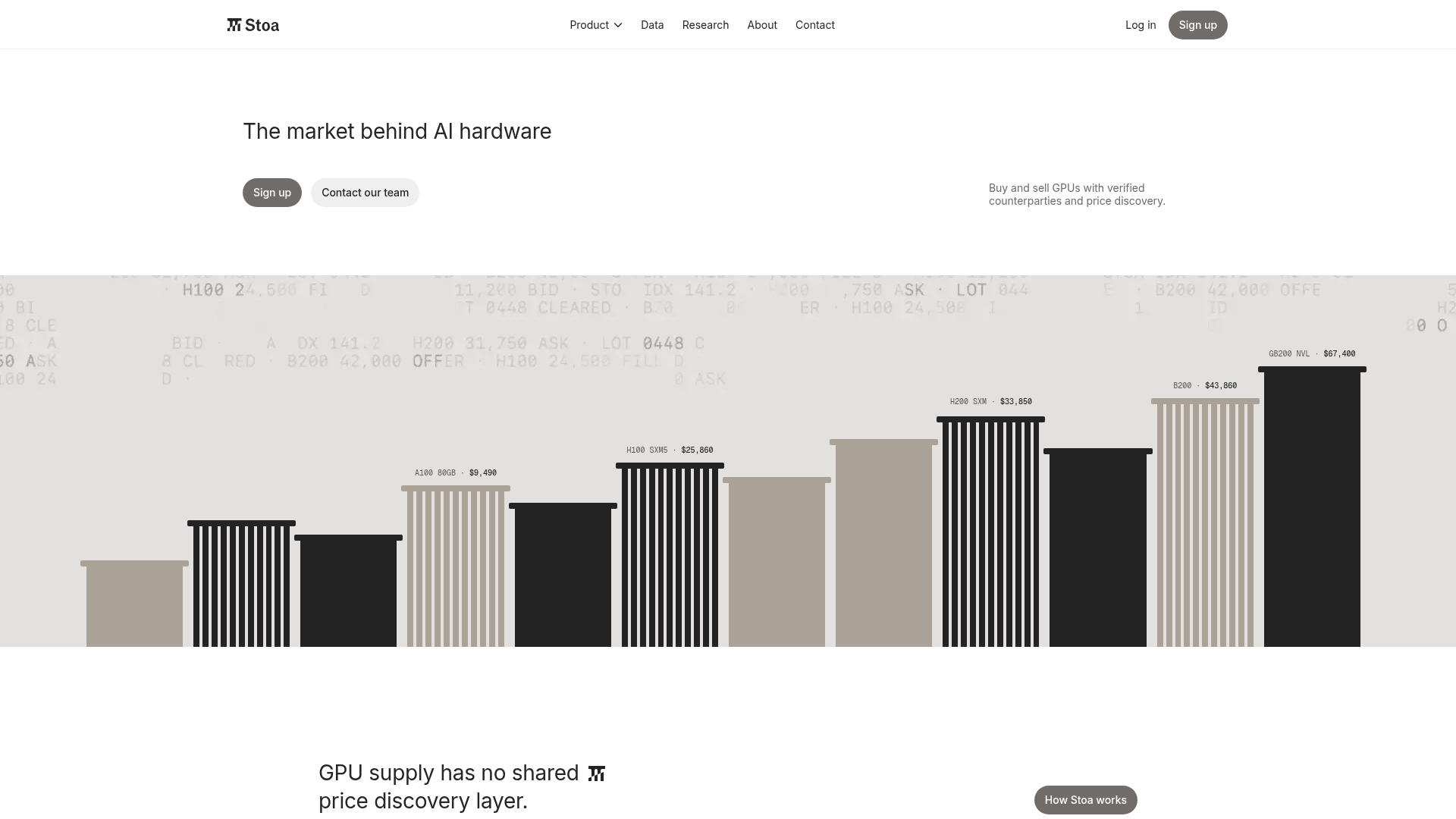
Stoa's thesis is that this fragmentation is an opportunity. By aggregating supply and demand into a single venue, it can create a reference price for GPUs—something the market has never had. The site even shows illustrative levels (e.g., A100 80GB at $9,490, H100 SXM5 at $25,860, B200 at $43,860), hinting at the kind of transparency it wants to bring.
Blind bids, firm quotes: how Stoa forces the market to show its hand
Stoa's core mechanism is a blind-bid auction. Buyers submit an RFQ (request for quote) describing the hardware they need—SKU, quantity, condition, delivery timeline. Verified dealers then respond with firm quotes, but they cannot see each other's bids. This is a deliberate design choice: it prevents dealers from colluding or anchoring on each other's prices, and it forces them to put their best price forward if they want to win the deal.
The site emphasizes that quotes are "firm"—accepting one creates a binding trade. This is a critical distinction from the typical "indication of interest" that brokers throw around. By making quotes binding, Stoa aims to reduce the friction and uncertainty that plague off-market deals, where a price can change between a phone call and a signed contract.
The blind-bid structure also gives buyers a form of price discovery: they can see the range of quotes they receive, and Stoa claims to show "clearing levels across the whole market." This is the kind of data that could become the industry's benchmark, if enough trades flow through the platform.
From RFQ to settled trade: the workflow that replaces DMs and spreadsheets
Stoa's "How it works" section outlines a four-step process that reads like a structured alternative to the chaos of private deals:
- Describe the trade: Buyers describe hardware in plain language or upload a quote PDF. AI drafts the RFQ, with the buyer in control of every field.
- Review and send: Terms, delivery, and deadlines are explicit before anything goes out. Accepting a quote creates a binding trade.
- Execute at a firm price: Verified dealers respond with firm quotes. Accept, and the trade executes with grade, condition, and verification expectations on record.
- Settle step by step: Settlement runs on a recorded timeline: confirmed, payment, shipped, delivered, inspected, settled, with evidence required along the way.
The settlement step is particularly notable. Stoa holds payment until delivery confirms, and every stage is documented. This is a direct answer to the "wire-and-hope" settlement risk that plagues off-market GPU deals, where buyers send millions of dollars to unverified sellers with no recourse if the hardware never arrives.
By structuring the entire lifecycle on-platform, Stoa aims to create a clean record from RFQ to delivery—a feature that lenders and insurers might eventually value, as it provides auditable evidence of a trade's terms and execution.
Who Stoa serves: the fragmented cast of GPU market participants
Stoa's target audience is not just AI labs buying a few H100s. The site lists eight distinct participant types:
- GPU brokers & dealers: match supply with verified demand and see clearing levels.
- Data center operators: sell surplus, price hardware, and plan fleet rotations.
- AI labs & enterprises: find available GPUs and compare offers by SKU and region.
- Cloud & neoclouds: acquire capacity, place excess supply, and track market color.
- OEMs, VARs & SIs: route allocation, secondary supply, and enterprise demand.
- Resellers & liquidators: move used, refurbished, and recovered GPUs to verified buyers.
- Lenders & lessors: evaluate collateral, lease exposure, and liquidation paths.
- Funds & capital partners: underwrite GPU-backed trades and supply-side financing.
This is a broad church, but it reflects the reality that GPUs have become a financial asset. The inclusion of lenders and funds is telling: Stoa sees itself not just as a trading venue, but as a platform that enables financing and risk management. The "financeable collateral" point in the about page reinforces this: "Readable hardware markets support financing, risk assessment, and liquidation planning."
The name 'Stoa': a nod to ancient commerce and a bet on institutional trust
The name "Stoa" is an interesting choice. In ancient Greece, a stoa was a covered walkway or portico—a public space where merchants, philosophers, and citizens gathered to trade and exchange ideas. The Stoa Poikile in Athens was famous as a place of debate and commerce. By choosing this name, Stoa is signaling that it wants to be the public square for GPU trading—a neutral, open venue where prices are discovered and deals are made.
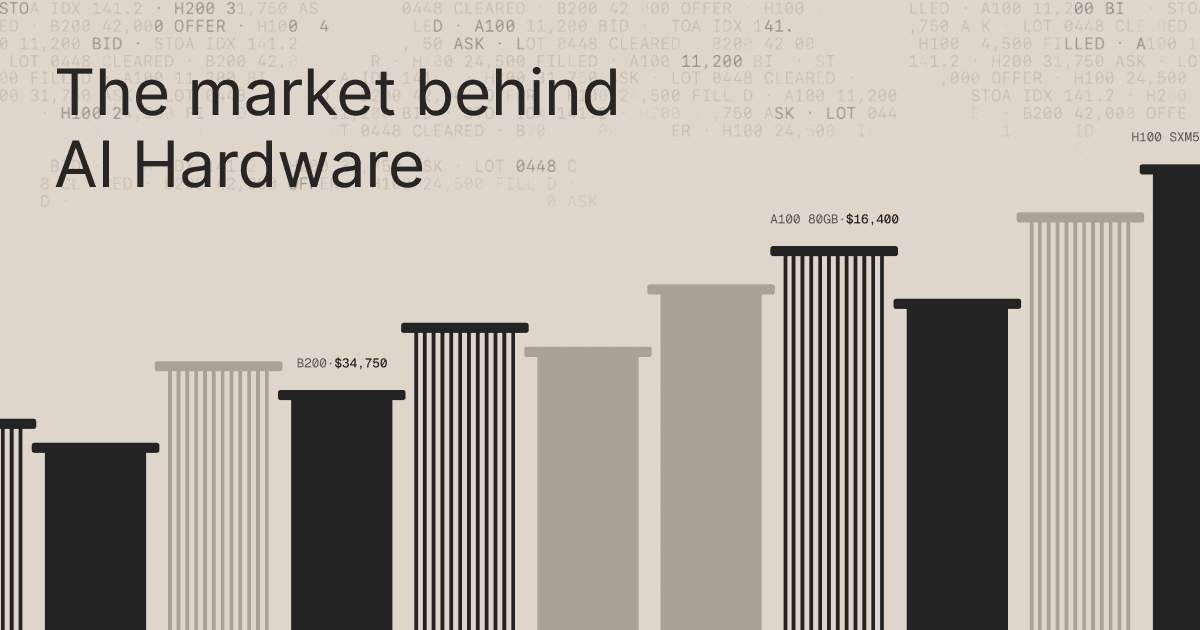
The name also carries connotations of stoicism: calm, rationality, and resilience. In a market often driven by panic buying and FOMO, Stoa's brand promises a more measured, institutional approach. The domain, stoaexchange.com, reinforces the exchange ambition, while the tagline "The market behind AI hardware" positions it as the foundational layer.
However, the name is not immediately descriptive. "Stoa" doesn't tell you it's about GPUs or AI hardware. This could be a risk for a startup trying to attract a broad audience, but it also allows the brand to expand beyond GPUs into other AI hardware or even compute trading. The founders—Berat Celik (CEO), Eren Berke Saglam (CFO), and Kaan Yigit (CTO)—have backgrounds that suggest a blend of finance and technology, which aligns with the market-structure ambition.
The hard part: liquidity, trust, and the path to becoming the 'market layer'
Stoa's biggest challenge is the classic chicken-and-egg problem of marketplaces: it needs liquidity to attract participants, but participants need liquidity to justify joining. The $300M+ in RFQs in the first month is a strong start, but RFQs are not trades—they are requests. Converting those into executed deals is the real test.
Trust is another hurdle. The site emphasizes "verified counterparties" and "firm quotes," but verification is only as good as the process behind it. Stoa will need to invest heavily in vetting dealers and enforcing settlement standards to build the institutional confidence it courts.
There's also the question of whether a blind-bid auction is the right mechanism for a market where relationships and speed matter. Some buyers may prefer to negotiate directly with a trusted dealer rather than expose their demand to a wider field. Stoa's answer is that the blind bid protects buyers from overpaying, but it remains to be seen if the market agrees.
Finally, Stoa faces competition from incumbents like brokers and cloud marketplaces, as well as potential entrants like NVIDIA itself, which could decide to formalize its own allocation market. But if Stoa can establish itself as the reference price for GPUs, it could become the "market layer" it aspires to be—the place where AI hardware is priced, traded, and financed.
For now, Stoa is a promising bet on a market that is desperate for structure. The question is not whether the market needs a price-discovery layer—it clearly does—but whether Stoa can build the trust and liquidity to make it stick.