Impact-Site-Verification: 41b53a0c-6d04-458b-a457-fe9e29acde1a

AI & Machine Learning·Undisclosed··6 min read

Transformer Lab

Autonomous AI researcher that turns months of PhD-level work into days.

NN

NewName Editorial

Editorial Team

Transformer Lab product image 1
Transformer Lab product image 2

Science runs on a loop: read the literature, form a hypothesis, run experiments, analyze, write up. For a human PhD student, one pass can take months. Transformer Lab, a Kitchener-Waterloo startup, claims its autonomous agent Primus can run that same loop thirty times faster. The company says that in a 30-day period, Primus produced more than 30 complete papers, each answering a question never addressed before, across fields as varied as LLMs, seismology, physics, crystallography, and biology. Some findings, they add, have already been cited in published research from labs like DeepMind.

That claim is audacious. But the product itself is real: Primus is now live, onboarding users from a waitlist, and the website shows a working project dashboard with stages, compute usage, and source papers. This isn't a vaporware demo. The question is whether an autonomous agent can genuinely produce research that stands up to scrutiny, and what that means for the human researchers it aims to assist.

The research loop, compressed

The scientific method is a loop: read, hypothesize, experiment, analyze, write. Primus automates that loop. The website describes it as "the world's first fully autonomous AI researcher available to everyone." It hypothesizes, reads millions of papers, codes, runs experiments on real compute, learns and iterates, and writes the final paper. The company claims this runs 30× faster than human speed. In a 30-day run, Primus produced over 30 papers on questions never answered before, spanning LLMs, seismology, physics, crystallography, and biology. Some findings have been cited in research from labs like DeepMind, though specific citations aren't provided.

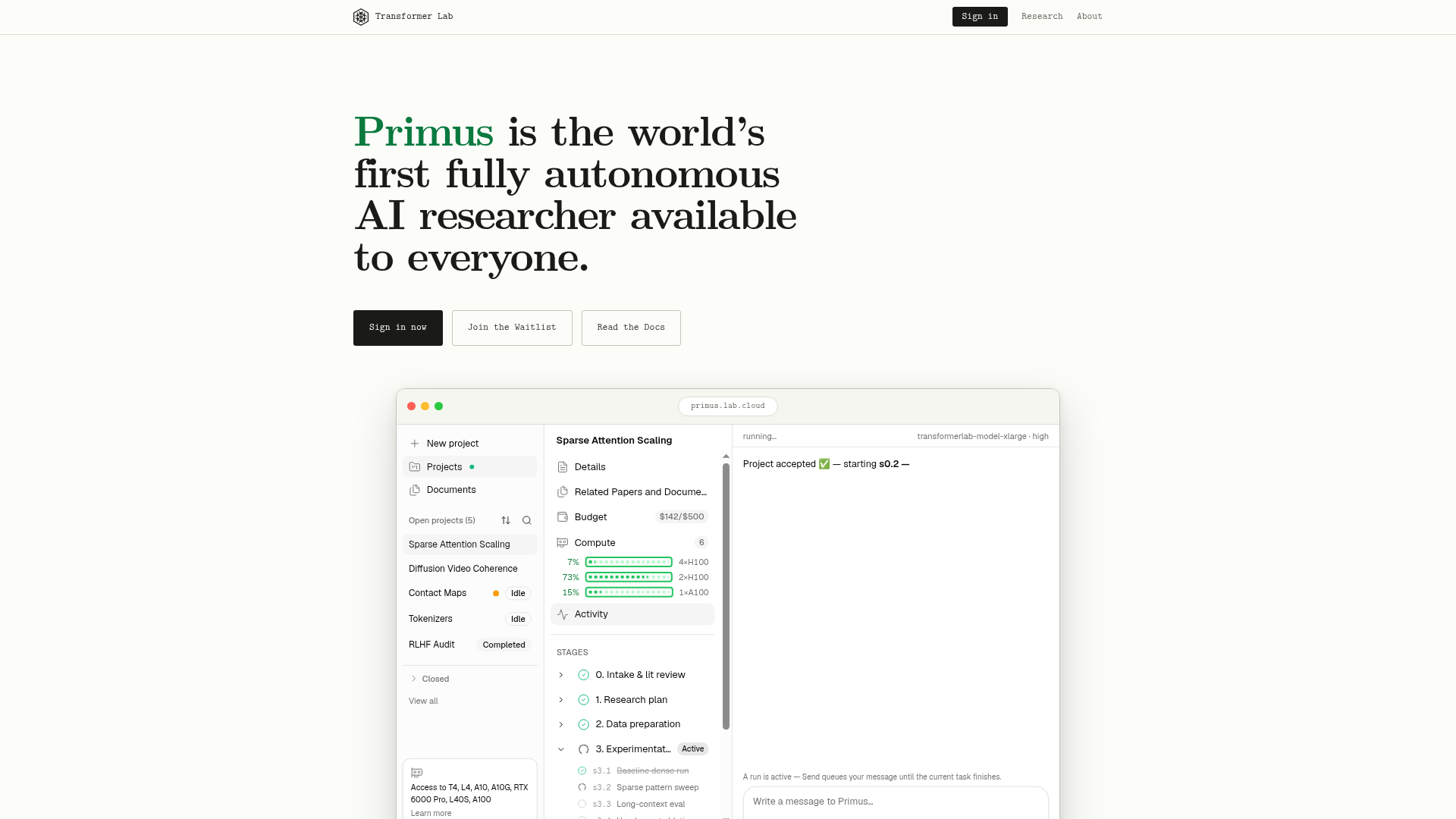
The promise is not just speed but autonomy. Primus is designed to work independently, not as a copilot. The interface allows users to "nudge" the agent, but a note says "A run is active — Send queues your message until the current task finishes." This design choice signals that Primus is meant to be a researcher, not an assistant.

Inside a Primus project: from lit review to final report

The dashboard reveals how Primus structures a project. Each project moves through stages: intake and literature review, research plan, data preparation, experimentation, evaluation and analysis, and write-up. A sample project, "Sparse Attention Scaling," shows a budget of $142 out of $500, compute usage split across 4×H100, 2×H100, and 1×A100, and an active experimentation stage with sub-tasks like "baseline dense run" and "sparse pattern sweep." The agent also pulls in source papers — 18 for that project, including classics like Reformer and FlashAttention — and displays them as markdown files.

This is more than a chat interface. Primus autonomously hypothesizes, codes, runs experiments, iterates, and delivers a final paper. The interface allows users to "nudge" the agent, but a note says "A run is active — Send queues your message until the current task finishes." So the agent works independently, and human intervention is queued, not immediate. That's a deliberate design choice: Primus is meant to be a researcher, not a copilot.

The compute question: who pays for 30 papers?

Running experiments requires hardware, and the website lists access to T4, L4, A10, A10G, RTX 6000 Pro, L40S, and A100 GPUs. The project dashboard shows a budget tracker, suggesting users fund compute per project. For the "Sparse Attention Scaling" project, the budget is $500, with $142 spent so far. That's a concrete detail: research costs money, and Primus makes that visible.

But the claim of 30 papers in 30 days raises a question: how much compute did that require? The site doesn't disclose the total compute cost. If each paper costs, say, $500 in GPU time, that's $15,000 for 30 papers — a bargain compared to a PhD stipend, but still a significant investment. The company's gradual onboarding, citing "limited GPU capacity," suggests compute is a bottleneck. For now, Primus is not a free tool; it's a paid research service, though pricing isn't publicly detailed.

What Primus can actually be asked to do

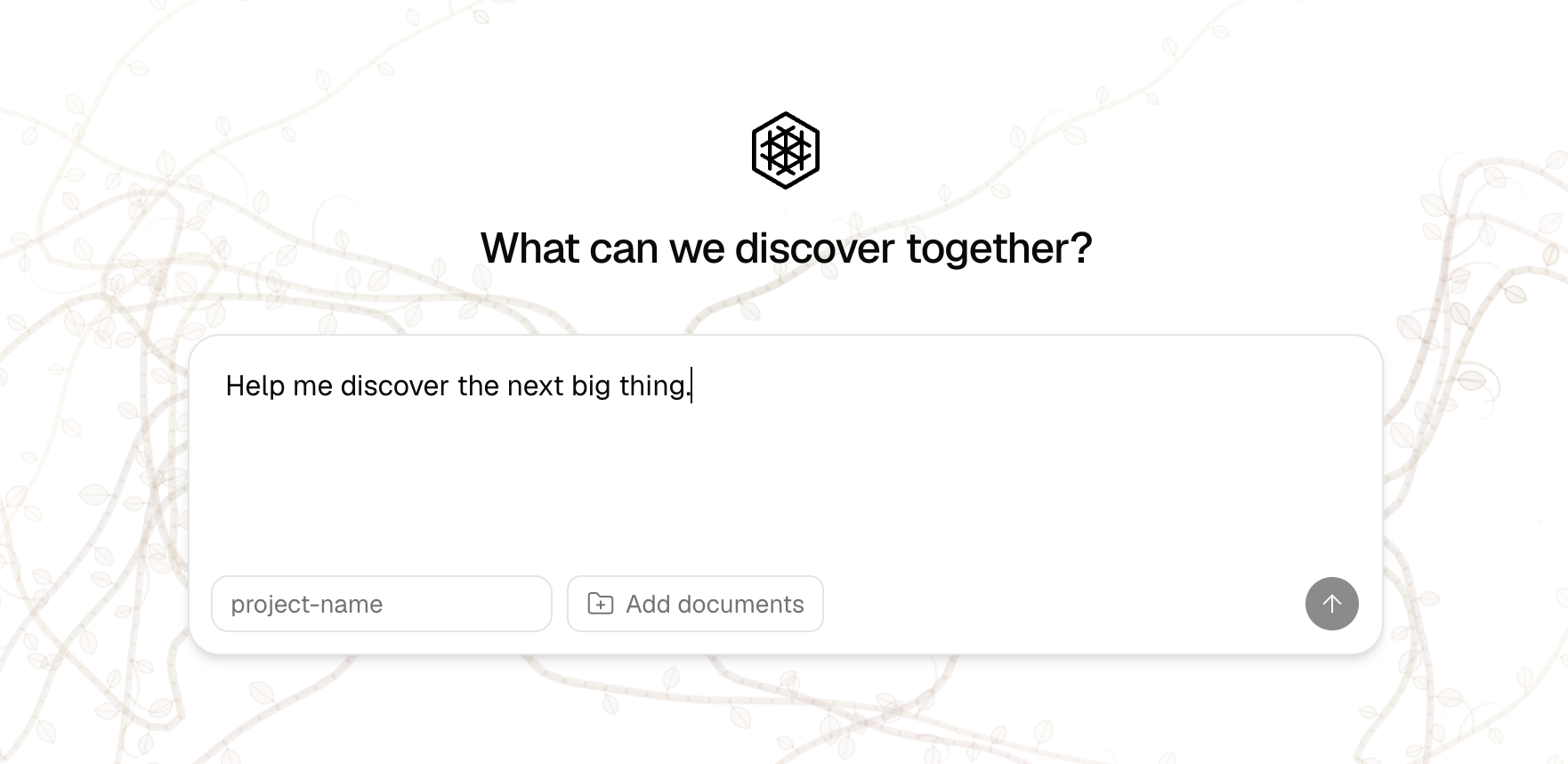
The website lists example prompts that reveal the intended scope. Users can ask Primus to fine-tune a model (e.g., "fine-tune gpt-oss-120b into a specialist at predicting clinical outcomes"), write a Triton kernel for MoE inference, extend an existing paper, port a model to MLX, explore a new domain like wind farm sensor data, or even "invent something better" than the transformer. These are not trivial tasks; they require deep ML expertise and significant engineering effort.

Primus is positioned as a tool for "anyone" — the tagline says "available to everyone" — but the examples assume a technical audience. A wind farm operator might not know what a Triton kernel is. Still, the promise is that you can describe a research goal in plain language, and Primus will handle the implementation and write-up. That's a powerful proposition for teams that lack in-house ML researchers.

The name and the promise: a lab on the cloud

The company name, Transformer Lab, evokes both the transformer architecture and a physical lab. The domain, lab.cloud, reinforces the idea of a cloud-based research facility. The product name, Primus, means "first" in Latin, suggesting primacy in autonomous research. The branding is coherent: this is a lab that runs experiments, not a chatbot. The visual identity, with images of Katherine Johnson and Nikola Tesla, connects to a lineage of scientific discovery. The name "Transformer Lab" is specific enough to signal ML focus, but broad enough to encompass future research domains beyond transformers.

However, the name also carries risk. "Transformer" is a technical term that may not resonate with non-ML audiences, and "Lab" suggests a physical place, which could confuse. But for the target audience of researchers and engineers, the name works: it signals both the technology and the scientific mission.

Open questions: verification, reproducibility, and the human role

Primus's biggest challenge is trust. The site claims its papers are "complete" and answer "questions never answered before," but there's no public peer review. The company says findings have been cited by DeepMind, but without specific citations, that's hard to verify. For a tool that automates research, reproducibility is critical: can another lab replicate Primus's experiments? The dashboard shows source papers and compute usage, which is a start, but the final reports are not publicly available on the site (only titles and thumbnails).

There's also the question of human oversight. Primus is autonomous, but the interface allows nudges and queued messages. That suggests a hybrid model: the agent does the heavy lifting, but humans can steer. The "RLHF Audit" project, listed as completed, hints that the team is thinking about alignment. Still, the long-term vision is clear: "We are on a mission to accelerate science by rethinking the entire research journey using AI." If Primus delivers on its promise, it could democratize research, but it also raises concerns about the role of human researchers and the integrity of automated findings.

For now, Transformer Lab is starting with ML, but the ambition is broader. The site says "We're starting with tools for machine learning," implying future domains. If Primus proves itself, it could become a standard tool for research labs, startups, and even individual scientists. But the evidence is still thin: 30 papers in 30 days is a bold claim, and the real test will be whether those papers hold up under scrutiny. Until then, Primus is a fascinating experiment in automating the most human of activities — the pursuit of knowledge.