Impact-Site-Verification: 41b53a0c-6d04-458b-a457-fe9e29acde1a

AI & Machine Learning··7 min read

Understudy

Distill your production usage into specialized models you own—cutting cost and latency without sacrificing quality.

NN

NewName Editorial

Editorial Team

Understudy product image 1
Understudy product image 2

The AI industry has spent two years arguing about whether to use frontier APIs or open weights. Understudy's answer is that you should use neither—at least not all the time. Instead, the company proposes a third path: distill your own production usage into specialized models that you own, trained on the traces of your own workflows. It's a deceptively simple idea with profound implications for cost, latency, and control.

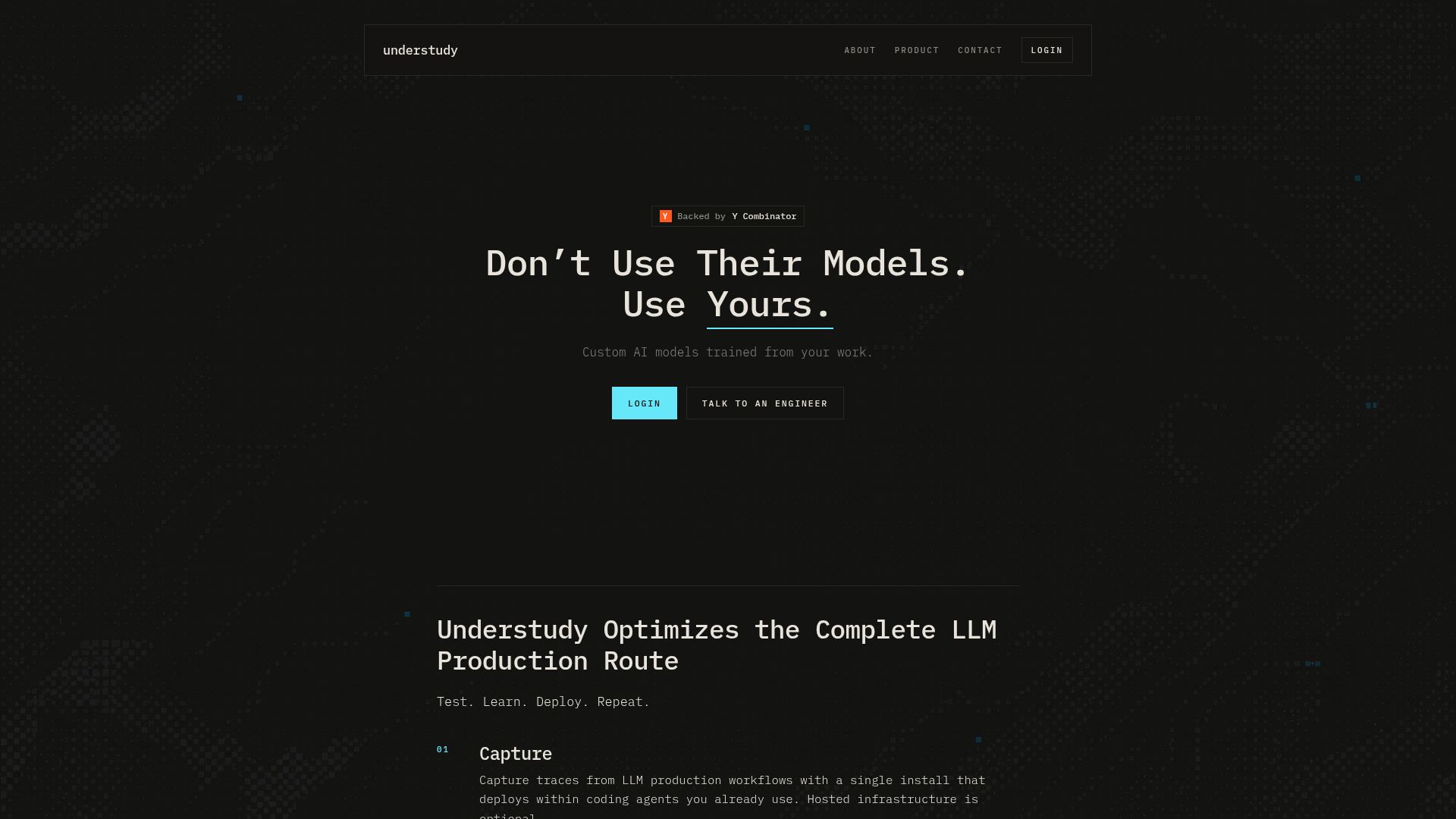
Understudy, a Y Combinator-backed startup in private preview, calls itself "the self-optimizing inference cloud." The tagline is careful: it's not a model provider, not a fine-tuning service, but a system that optimizes the entire production route for repeated LLM work—prompts, schemas, tool-call adapters, reasoning mode, token caps, scorers, retry policy, batching, context compaction, parsers, model choice, and serving path. The company's pitch is blunt: "Don't Use Their Models. Use Yours."

This article digs into how Understudy works, what its benchmarks actually show, and why the name "Understudy" captures a strategic position that could reshape how companies think about LLM procurement.

The Ownership Argument in an API-First AI World

Most companies today rent intelligence by the token. They call GPT-4, Claude, or Gemini, pay per million tokens, and accept that the model weights, the fine-tuning data, and the serving infrastructure belong to someone else. Understudy's core argument is that this is a poor long-term trade for high-volume, repetitive workloads. If your agents are classifying messages, choosing tools, filling structured arguments, or repairing malformed calls thousands of times a day, you're paying frontier prices for tasks that don't need frontier intelligence.

The alternative Understudy offers is ownership. The company's FAQ is explicit: "The goal is to hand off prompts, evaluators, routing rules, and specialist model weights that your team can serve on Fireworks, Bedrock, Vertex, or your own GPUs." That's a radical departure from the API-centric model. Instead of renting a model, you graduate to owning a model—one that is specialized to your domain, your data, and your quality bar.

This is not just a cost play. It's a control play. You own the weights, so you control the deployment. You own the training data, so you control the IP. And you own the evaluation criteria, so you control what "good" means. For companies in regulated industries or with sensitive data, this could be the difference between using AI and being able to use AI.

Inside the Loop: Capture, Evaluate, Train, Deploy

Understudy's website outlines a four-step loop: Capture, Evaluate, Train, Deploy. It's a closed loop that compounds over time.

Capture is the entry point. A single install deploys within the coding agents you already use—think CLI, MCP server, skills, and a local workbench. It captures traces from your production LLM workflows. Hosted infrastructure is optional, which is a smart concession to privacy-conscious teams.

Evaluate turns those traces into a benchmark. You set a success bar, and every future model switch must meet or exceed it in A/B testing. This is crucial: Understudy doesn't just throw a smaller model at your problem; it forces the replacement to prove itself against your own historical performance.

Train is where the magic happens. You fine-tune a new model on prompts and weights you always own. You start locally and scale into cloud-hosted processes as you see success. The training data comes from your production traces, so the model learns your specific patterns, edge cases, and quality definitions.

Deploy is the payoff. You only deploy the new model when it beats the held-out eval. You serve it wherever you want—Fireworks, Bedrock, Vertex, or your own GPUs. And critically, production data feeds back into training, so the model gets better over time. The loop is self-optimizing.

This is a fundamentally different workflow from what most teams do today. Instead of prompt engineering on a fixed frontier model, you're iterating on a model that is yours. The eval is not a generic benchmark; it's your own production data. That's a powerful flywheel.

The Benchmarks That Matter: Sonnet 4.6 vs. a Fine-Tuned Qwen

Understudy publishes three case studies on its site, and they're refreshingly concrete. The first is an agentic task where an Understudy-ladder model scored 0.630 on a held-out eval, versus Sonnet 4.6's 0.557 and a baseline open model's 0.400. That's a 13% higher eval score than Sonnet, at 25% of the cost. The second is a latency comparison: Sonnet 4.6 took 1.935 seconds, while an Understudy route using a Qwen3-8B tuned to match Sonnet performance took 369ms—a 5.2x reduction in latency, with 6.0x lower measured token cost.

The third is a cost comparison on a sentiment analysis task. An Understudy post-trained 30B open model labeled 39,962 comments at $2.82, versus $12.48 for Sonnet and $139.63 for Opus. That's 4.4x lower cost than Sonnet and 50x lower than Opus.

These numbers are impressive, but they come with caveats. The comparisons are against Sonnet 4.6, which may not be the latest frontier model by the time you read this. And the tasks are specific—agentic tool use, latency-sensitive routing, and sentiment analysis. Understudy doesn't claim to beat frontier models on every task; it claims to beat them on the tasks where you have enough production data to train a specialist. That's a reasonable scope.

The key takeaway is not the absolute numbers but the pattern: for repeated, well-defined workloads, a distilled model can match or exceed frontier quality at a fraction of the cost and latency. That's the economic argument for Understudy.

When Frontier Models Still Win

Understudy is not anti-frontier. The FAQ is clear: "Keep the frontier model where premium capability changes the outcome." For tasks that require open-ended reasoning, creative writing, or novel problem-solving, a frontier model is still the right tool. Understudy's value is in the routine, high-volume operations that don't need that premium capability.

The company's positioning is nuanced. It's not a replacement for GPT-4 or Claude; it's an understudy—a model that steps in when the star is overkill. That's a smart way to frame it. It acknowledges the frontier's superiority while carving out a massive niche for cost-sensitive, latency-sensitive, and privacy-sensitive workloads.

This is also where Understudy's target customer comes into focus. The site says it's looking for "production LLM workflows where cost or latency is starting to hurt and the people who know what good looks like are not on an ML team." That's a specific profile: domain experts who can review outputs but don't want to become ML engineers. Understudy's workbench is designed for them.

The Name as a Position: Understudy, Not Replacement

The name "Understudy" is a masterstroke of positioning. An understudy is a performer who can step into a leading role when needed, but who isn't the star. That's exactly what the product does: it provides a cheaper, faster, specialized model that can substitute for a frontier model in routine scenarios, but it doesn't try to be the star.

The name also carries a subtle implication of readiness and reliability. An understudy is always prepared, always ready to perform. Understudy's models are trained on your own production data, so they're ready for your specific tasks. The name suggests a supporting role that's essential to the show's success.

The domain, understudylabs.com, reinforces the experimental, lab-like vibe. The company is in private preview, working with design partners to refine the process. The name "Labs" suggests research and iteration, which fits the capture-evaluate-train-deploy loop.

From a branding perspective, Understudy is memorable and evocative. It's a word everyone knows, but in a new context. It's not a made-up name or a generic tech term; it's a metaphor that instantly communicates the value proposition.

What's Missing and What's Next

Understudy is in private preview, so there's a lot we don't know. The site doesn't disclose pricing, team size, or specific technical details about the training process. The benchmarks are promising but limited to a few use cases. The company hasn't published a public roadmap.

What's clear is the direction: Understudy is betting that the future of AI is not about choosing between frontier and open models, but about owning your own specialized models. The self-optimizing loop is a compelling vision—one that could give companies a strategic advantage in cost, latency, and control.

The risks are real. Training your own models requires data, expertise, and infrastructure. Understudy's promise is to abstract away the ML complexity, but that's a hard problem. The company will need to prove that its loop works at scale, across diverse workloads, and that the models it produces are genuinely reliable.

For now, Understudy is a name to watch. If it succeeds, it could redefine how companies think about LLM procurement. If it fails, it will be a cautionary tale about the difficulty of owning your AI stack. Either way, the question it raises—"Why rent intelligence when you can own it?"—is one every AI-heavy company should be asking.