Ventorah
Browser-native CFD with BYO pricing: run virtual wind tunnels on any 3D model without a license server.
NewName Editorial
Editorial Team
The computational fluid dynamics (CFD) market has a dirty secret: the tools that define it are trapped in a 1990s commercial model. A single ANSYS Fluent license can cost tens of thousands of dollars per year, requires a certified workstation, and demands days of training before a new engineer produces a meaningful result. Meanwhile, the hardware needed to run a decent mesh has become commodity, and open-source solvers like OpenFOAM have reached a quality level where they can match commercial codes on many external aerodynamics problems. The gap between the capability of the underlying physics and the accessibility of the software is enormous. Ventorah, a browser-native CFD platform launched by Kavan Shah, is a direct bet that this gap is the market's biggest inefficiency.
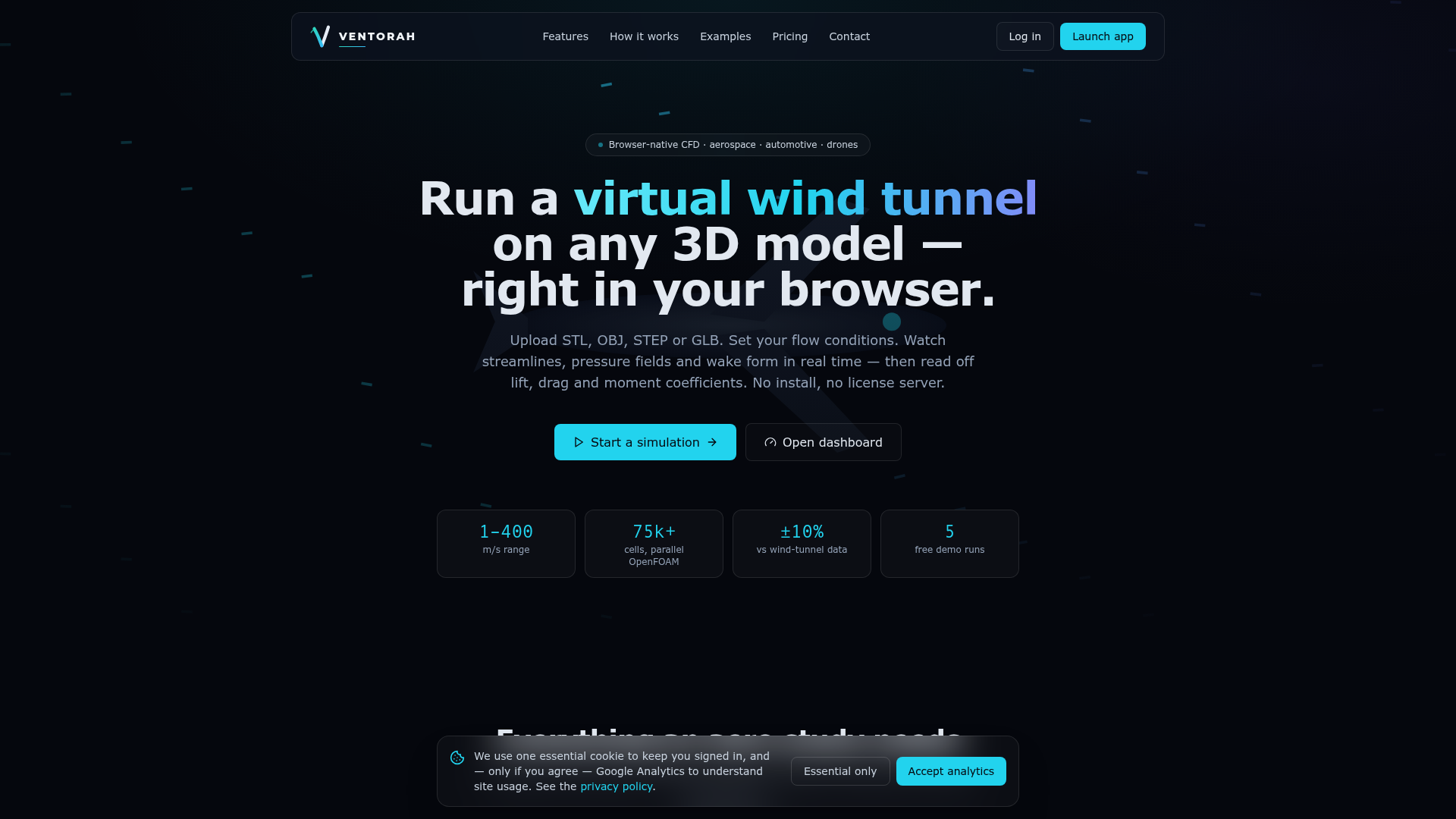
Ventorah's pitch is simple: upload an STL, OBJ, STEP, or GLB file, set your flow conditions, and watch streamlines, pressure fields, and wake formations animate in real time. Then read off lift, drag, and moment coefficients. No install, no license server, no GPU cluster of your own. The platform wraps OpenFOAM's snappyHexMesh and simpleFoam solvers in a Docker container, runs them in parallel on cloud infrastructure, and streams residuals back to a WebGL viewer in the browser. For a market that has long accepted the friction of desktop software and per-seat licensing, this is a structural shift in how aerodynamic analysis is consumed.
The CFD Access Problem: Why Aerodynamics Is Still a Specialist's Game
Aerodynamic analysis is not a niche discipline—it's a critical input for drones, electric vehicles, wind turbines, and even consumer products like bicycles and sports equipment. But the tools have historically been gated by cost and expertise. A single ANSYS Fluent license can cost $20,000 or more per year, and even then, the user must understand mesh generation, turbulence models, and convergence criteria. The result is that CFD is outsourced to specialist consultancies or reserved for late-stage product development, when design changes are expensive.
OpenFOAM, the open-source solver that Ventorah uses, has been a viable alternative for over a decade, but it has a steep learning curve: it's command-line driven, requires Linux familiarity, and demands manual setup of mesh dictionaries and solver parameters. For a drone startup or a small automotive supplier, the cost of hiring a CFD specialist—or the time cost of learning OpenFOAM—is often prohibitive. Ventorah's wedge is to abstract away that complexity, offering a guided workflow that takes a 3D model and returns engineering results in minutes, not days.
From STL Upload to Converged Solution: Ventorah's Browser-Native Workflow
Ventorah's core workflow is a four-step pipeline that mirrors the traditional CFD process but removes the environmental friction. First, the user uploads geometry in a range of formats—STL, OBJ, STEP, IGES, GLB, or FBX—which renders instantly in a WebGL viewer. Second, they configure the virtual wind tunnel: wind speed, direction, fluid properties, turbulence model, and mesh resolution. Third, the solver runs, and the user watches residuals stream back in real time. Fourth, they inspect coefficients, charts, and flow fields, and export a CSV or PDF report.
The platform includes a full post-processing suite: streamlines, velocity vectors, pressure and velocity contours, vorticity, wake visualization, and flow separation animations. It also offers interactive charts for lift-vs-angle, drag-vs-speed, and pressure histograms, plus a comparison tool that puts two runs side by side. This is not a toy—it's a complete pre/solve/post workflow that covers the majority of external aerodynamics problems.
A notable feature is the AI aero assistant, which allows users to ask questions like "Why is drag high?" and receive explanations and design recommendations. This is a differentiator in a market where even advanced tools like SimScale lack natural-language interfaces. The assistant is built on Claude, and in the BYO tier, users can connect their own API key, reducing the marginal cost of AI queries to zero.
The BYO Pricing Wedge: Undercutting SimScale and the Legacy License
Ventorah's pricing model is the most strategically interesting part of the business. It offers three tiers: a free demo with 5 simulations, a $5/month "Bring-your-own" tier where users connect their own Claude API key and optionally their own OpenFOAM worker, and a $50/50-credits Pro tier that includes managed solves and the full AI suite.
The BYO tier is a clever wedge. It effectively decouples Ventorah's software from the cost of compute and AI inference, allowing the company to charge a nominal subscription fee while users bring their own resources. This undercuts SaaS rivals like SimScale, which charges hundreds of dollars per month for comparable cloud CFD, and it makes the platform accessible to hobbyists and students who would never consider a commercial license.
The Pro tier, at $1 per credit, is still significantly cheaper than SimScale's Professional plan (around $500/month for 10,000 core-hours). For a drone startup running 50 simulations a month, Ventorah's cost is trivial compared to a full-time CFD engineer or a commercial license. The pricing reflects a belief that the market is ready for a utility-based model, where users pay for what they consume, not for a seat.
OpenFOAM Under the Hood: The Validation Story and Its Limits
Ventorah's backend is OpenFOAM, specifically snappyHexMesh for meshing and simpleFoam for steady-state incompressible flow. The company claims validation against published wind-tunnel data, citing a sphere drag coefficient within ~10% of experiment at Re 2×10⁵. This is a reasonable accuracy for engineering estimates, though it's far from the fidelity of high-order methods used in certification-grade analysis.
The platform explicitly states "Engineering estimates · not for certification use" in its footer. This is an honest limitation: for regulatory approval (e.g., FAA or EASA certification), companies will still need higher-fidelity simulations or physical wind-tunnel tests. But for early-stage design exploration, concept comparison, and educational purposes, ±10% accuracy is often sufficient to make design decisions.
The use of OpenFOAM also means Ventorah inherits its limitations: it's steady-state RANS, so it won't capture transient phenomena like vortex shedding or stall hysteresis. Users needing those capabilities would have to look elsewhere. However, for the target market of drones, automotive add-ons, and consumer products, steady-state drag and lift estimation is the core need.
Who Pays for Browser CFD: Drone Startups, Automotive R&D, and the Hobbyist Long Tail
Ventorah's target customers are not the aerospace primes that have dedicated CFD teams. They are the long tail of engineers and makers who need aerodynamic insight but lack the budget or expertise for traditional tools. This includes drone startups optimizing frame drag, automotive R&D teams evaluating spoiler designs, and even hobbyists building model aircraft.
The free tier and low-cost BYO tier are designed to capture this market. By offering 5 free demo runs, Ventorah lowers the barrier to trial. Once a user sees the value of a converged solution with lift and drag coefficients, the upgrade path to Pro is a natural next step. The AI assistant also serves as a retention hook, providing value that goes beyond raw simulation output.
However, the long tail is a challenging market to monetize at scale. Hobbyists may never pay, and small startups may churn after a few simulations. The real revenue opportunity lies in converting the most engaged users—those who need regular simulation as part of a design cycle—into Pro subscribers or enterprise contracts. The current pricing is aggressive, but it's a classic land-and-expand strategy.
The Hard Ceiling: Accuracy, Certification, and the Road to Enterprise Trust
The biggest risk to Ventorah is the ceiling imposed by its solver and positioning. For enterprise adoption, CFD tools must offer not just convenience but defensible accuracy. Ventorah's own validation shows ~10% error on a sphere, which is acceptable for conceptual design but not for final sign-off. The company's disclaimer that results are "engineering estimates" will prevent it from displacing ANSYS or STAR-CCM+ in regulated industries.
To move upmarket, Ventorah would need to add higher-fidelity solvers (e.g., LES or DES), transient analysis, and a path to certification-grade results. This is a significant engineering lift, and it's unclear whether the current team has the resources. Alternatively, Ventorah could position itself as a front-end for a broader simulation platform, partnering with or acquiring a solver provider.
Another constraint is the lack of public documentation and a roadmap. The website is a single page with no blog, docs, or changelog, which may signal an early-stage product. For enterprise buyers, this is a red flag. However, for the target market of individual engineers and small teams, the product's immediacy may outweigh these concerns.
In the next 3–5 years, the CFD market will continue to shift toward cloud and browser-based delivery, driven by the same forces that transformed CAD (think Onshape). Ventorah is early, but it faces competition from established players like SimScale, which already offers browser-based CFD with a more mature platform. Ventorah's differentiation lies in its BYO pricing and AI assistant, but it will need to expand its feature set and build trust to move beyond the long tail. If it can do that, it has a real chance to become the default virtual wind tunnel for the next generation of hardware engineers.