Impact-Site-Verification: 41b53a0c-6d04-458b-a457-fe9e29acde1a

AI & Machine Learning·Seed··5 min read

Impact Drones

Containerized drone interception for civilian infrastructure — matching the interceptor to the threat.

NN

NewName Editorial

Editorial Team

Impact Drones product image 1
Impact Drones product image 2

The math of air defense is broken, and Impact Drones is the first company to say it out loud on a landing page. Hostile drones are cheap—often under $50,000—while a single legacy effector can cost over a million. That's a ratio that makes no sense for defending a substation or a data center. Impact Drones, a Y Combinator S26 batch company, is betting that the answer isn't a bigger missile but a smarter, cheaper, and more deployable system: containerized interceptors that sit on-site and launch on demand.

The broken math of air defense

Impact Drones' homepage leads with a stark cost comparison: one legacy effector at $1,000,000+ versus hundreds of hostile UAS at under $50,000 each. The implication is clear: traditional air defense was designed for a different era, when threats were few and expensive. Today, a swarm of cheap drones can overwhelm a system that was built to stop a handful of aircraft. The company's thesis is that defending civilian infrastructure requires a fundamentally different economic model—one where the defender's cost per engagement is closer to the attacker's.

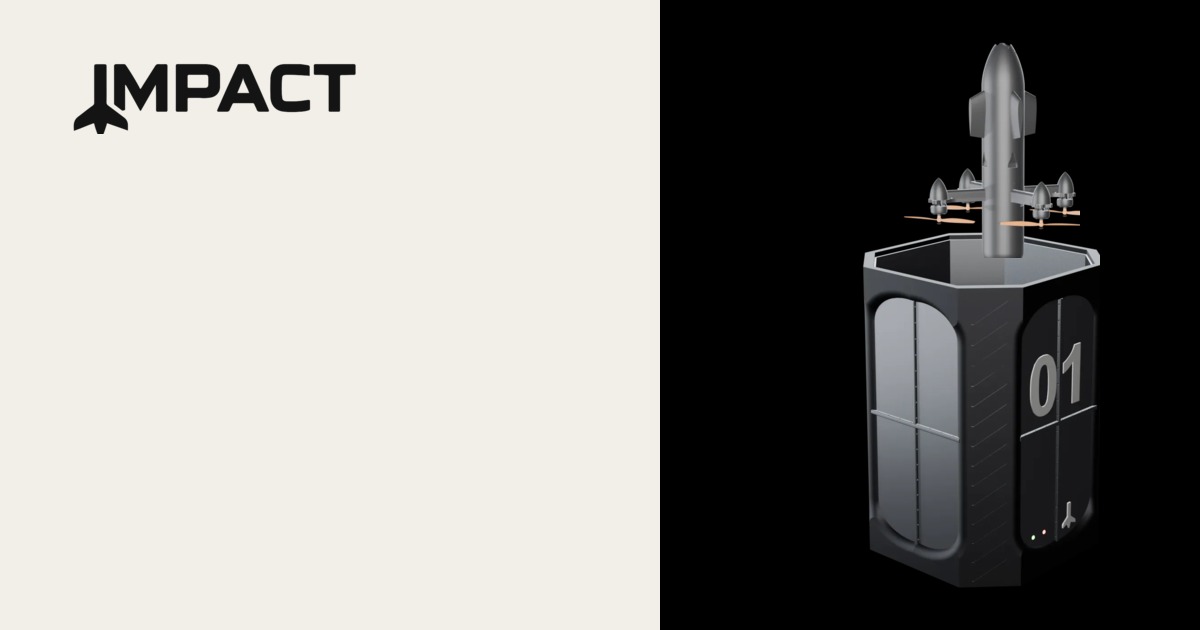
This is not just a pricing argument; it's a strategic one. Legacy systems are also physically massive and operationally complex. They require runways, radar arrays, and trained crews. Impact Drones offers a containerized alternative that can be dropped near a data center or power plant, ready to deploy in seconds. The container is the product—it turns air defense into a logistics problem, not a construction project.

Two interceptors, one sky: HUNTER and SABLE

No single airframe can cover every threat. Impact Drones' answer is a two-interceptor system. HUNTER is the close-range point-defense interceptor, designed for slow, low-flying threats that swarm a site. It's out of the box in seconds and autonomous to the intercept. SABLE is the pursuit interceptor: a turbine-powered delta airframe that chases fast movers and long-range threats before they reach the perimeter.

This pairing is a deliberate design choice. HUNTER handles the immediate, chaotic threats—the quadcopters that appear suddenly over a fence line. SABLE extends the defensive envelope, engaging threats that would otherwise have time to strike. Together, they cover the 'whole sky' over a site, a claim that implies a level of integration that is rare in this space.

The names themselves are telling: HUNTER and SABLE evoke precision and aggression, not the sterile alphanumerics of military hardware. This is branding that speaks to a civilian buyer—a data center operator or airport manager—who wants to feel protected, not intimidated.

A container, not a base: the deployment philosophy

The container is the core innovation. Instead of building a permanent defense installation, Impact Drones ships a self-contained system that can be positioned 'where the threat flies.' The website shows it next to high-density server racks, high-voltage substations, and airport aprons. The message is: this is a product you can buy and place, not a program you have to lobby for.

This deployment model has significant implications. It lowers the barrier to entry for organizations that would never have considered air defense before. It also makes the system scalable—add more containers to cover more assets. And it aligns with the 'as a service' framing in the company's tagline: 'Air Defense as a Service for Civilian Infrastructure.' The container is the physical manifestation of that service.

Where the threat lives: data centers, grids, and airports

Impact Drones targets three verticals: data centers, energy grids, and airports. Each has a distinct vulnerability profile. Data centers concentrate billions in compute and the power feed to match—a single drone strike could disrupt service for thousands. Energy grids are exposed, high-value nodes; a substation is a soft target that can cause cascading blackouts. Airports are uniquely sensitive: a single drone sighting can halt operations for hours, as seen in multiple incidents worldwide.

For each vertical, Impact Drones positions the interceptor as a 'box on the perimeter' that closes the low-altitude gap. This is a compelling pitch because these facilities already have physical security—fences, guards, cameras—but they have no defense against drones. The container fills that gap without requiring a major infrastructure overhaul.

The name says 'impact' — but what does it really promise?

The name 'Impact Drones' is a double entendre. On one hand, it refers to the physical impact of an interceptor hitting a hostile drone. On the other, it promises 'impact' in the sense of making a difference—protecting critical infrastructure. The name is short, memorable, and action-oriented, fitting for a startup that wants to be seen as a disruptor.

The domain, impact-drones.com, is clean and direct. It's not clever or abstract; it tells you exactly what the company does. That's a strategic choice. In a category full of acronyms and military jargon, 'Impact Drones' stands out for its clarity. The Y Combinator backing adds credibility, and the 'S26' batch label signals to investors and early adopters that this is a vetted company.

However, the name also carries a risk. 'Impact' is a common word, and 'drones' is a crowded category. The name doesn't immediately convey 'air defense' or 'interception.' It could be mistaken for a drone delivery or photography company. The tagline helps, but the name alone might not set the right expectations.

What we don't know yet

Impact Drones is at the seed stage, with pilot deployments planned for Q3 2026. The website is thin on technical details—no specs on radar range, intercept success rates, or system cost. There's no pricing page, no case studies, and no team bios. The 'about' and 'blog' pages are 404s, which suggests the company is still building out its public presence.

What we do know is that the company has a clear thesis, a coherent product concept, and a target market that is underserved. The containerized, two-interceptor approach is a novel answer to a real problem. But whether it works in practice—whether the interceptors can reliably stop drones in real-world conditions—remains to be seen. The proof will come with the pilot deployments.

For now, Impact Drones is a company to watch. It has identified a genuine gap in the market and is building a product that could fill it. The name, the branding, and the containerized approach all point to a startup that understands its customer and its mission. The next step is execution.