OS3
Semi-humanoid hardware and a video-trained brain for physical labor, unified as one system.
NewName Editorial
Editorial Team


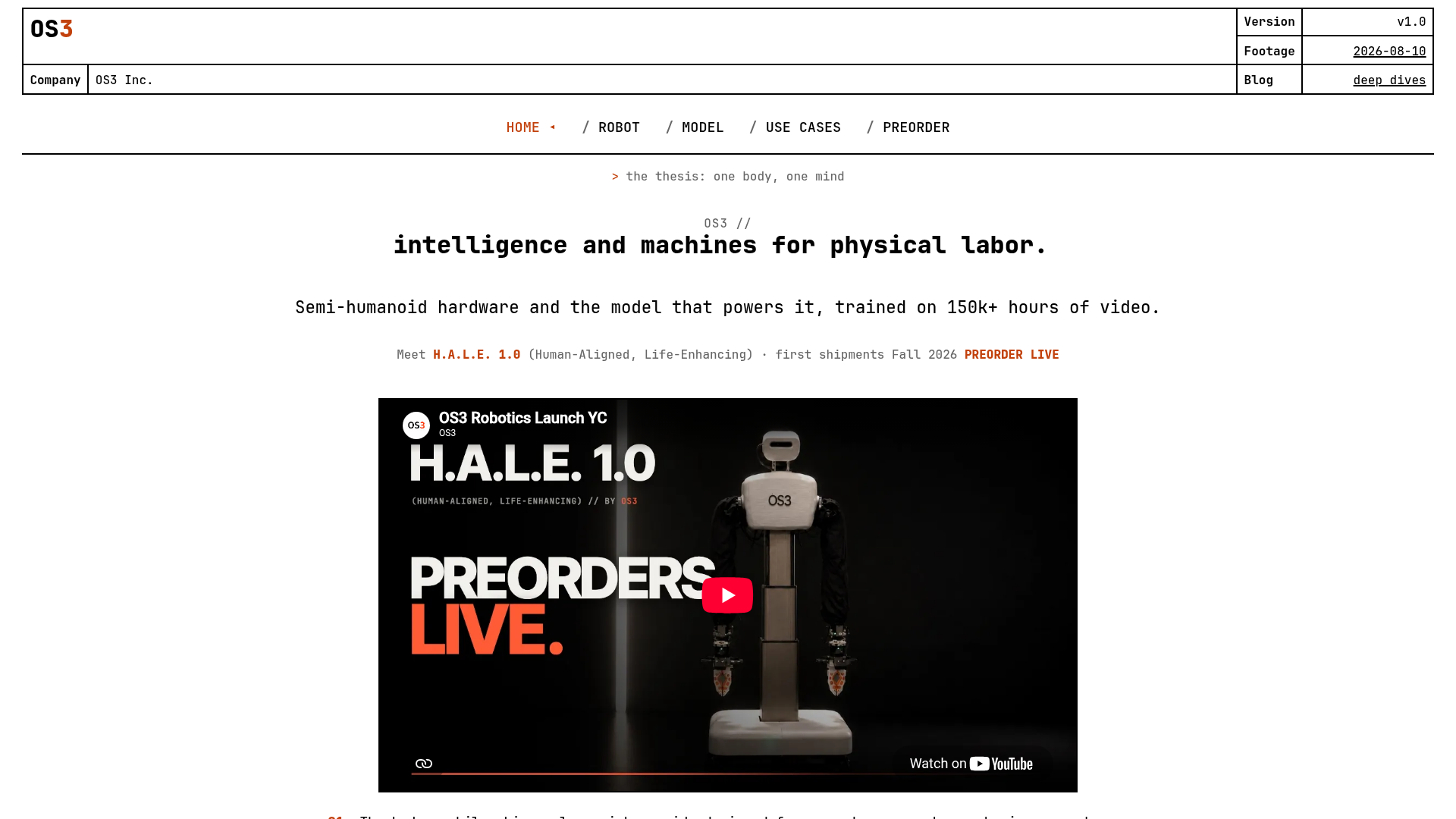
OS3's homepage states its thesis in four words: "one body, one mind." That is not a marketing slogan; it is a design constraint. The company is developing semi-humanoid hardware and the model that powers it, trained on more than 150,000 hours of video. Preorders for its first unit, H.A.L.E. 1.0, are live, with shipments promised for Fall 2026. The ambition is not to build a general-purpose robot, but to automate physical labor—hospitality, biotech labs, warehouses, mechanical work, grocery and retail—with a system that learns the way a human does: by living.
The 'one body, one mind' bet
Most robotics startups fall into one of two camps: they build a versatile body and bolt on a third-party brain, or they train a clever model and leave the hardware to someone else. OS3 rejects that split. The company's thesis is that physical labor requires a tight coupling between the body and the mind—a semi-humanoid form factor (mobile, bimanual) and a planner-executor model that reads a task and carries it out. The website describes the body as "designed for everyday use and your business needs," and the brain as "a planner that reads the task, an executor trained on 150k hours." That coupling is the product. The name OS3 itself—short, numeric, almost like an operating system version—reinforces the idea of a unified system rather than a collection of parts.
What 150,000 hours of video actually buys
The training data is the core asset. OS3 claims a model trained on 150,000+ hours of video, plus 2,000+ real-world tasks and reinforcement learning that targets failure modes (per the blog's upcoming "Model: Training the two-system brain" post). That scale of video data is not trivial; it suggests a focus on imitation learning from human demonstrations, which is how you teach a robot to fold a towel or pipette a sample without writing a line of code for each motion. The number is specific, but the company does not disclose the source of that video—whether it is proprietary, licensed, or scraped from public sources. That matters for reproducibility and for trust, but the ambition is clear: give the robot a large enough sample of human physical behavior, and it can generalize to new tasks in the same environment.
H.A.L.E. 1.0: a name that carries the thesis
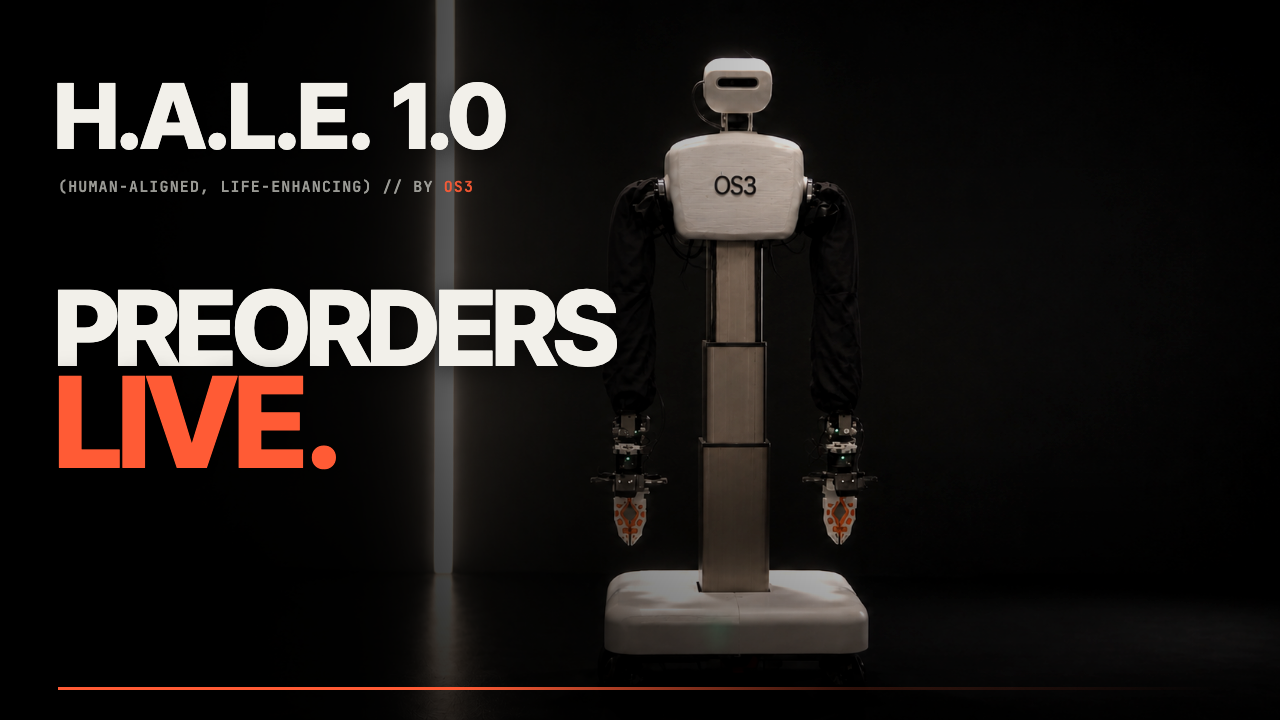
The hardware is named H.A.L.E. 1.0, which OS3 expands as "Human-Aligned, Life-Enhancing." That is a loaded name. It signals safety and collaboration—a robot that works alongside humans, not in a cage. It also echoes the famous HAL 9000 from 2001: A Space Odyssey, a reference that invites both awe and unease. The name is a deliberate choice: it positions the robot as an assistant that enhances human work, not a replacement. Whether the product lives up to that promise is an open question, but the naming is coherent with the company's stated goal of automating physical labor in human-centric environments like hospitality and retail.
The deployment loop as a moat
OS3's third pillar is the loop: "deployments expose failures, RL targets them, units get better." This is a classic data flywheel, but for physical labor it is especially potent. Each robot deployed in a real warehouse or lab generates failure data that can be fed back into the model via reinforcement learning. Over time, the system improves not just in the lab but in the messy, unpredictable conditions of actual work. That is a moat—if OS3 can ship enough units and keep them learning, competitors will have to play catch-up on both hardware and data. The company is backed by Y Combinator (it launched at YC), which gives it early credibility and access to a network of potential pilot customers.
Where OS3 fits in the physical labor stack
Physical labor automation is a crowded space. On one end are single-purpose machines (dishwashers, conveyor belts). On the other are humanoid robots like Figure or Tesla Optimus, which aim for general-purpose humanoid form. OS3 sits in the middle: semi-humanoid, meaning it has a torso, arms, and a mobile base, but not necessarily legs or a full human shape. That is a pragmatic choice. Legs are hard, and many physical tasks—shelf stocking, lab work, packaging—do not require them. A wheeled base is cheaper and more reliable. OS3's use cases reflect that: hospitality, biotech and labs, warehouse, mechanical work, grocery and retail. These are environments where a mobile bimanual robot can navigate and manipulate objects without needing to climb stairs or balance on two legs.
The company's positioning is also notable for its focus on "physical labor" rather than "robots." That language frames the product as a solution to labor shortages and dull, dirty, dangerous jobs—not as a tech novelty. It is a B2B pitch, aimed at business owners who need to get work done, not at robotics enthusiasts.
Open questions and honest risks
OS3 is still early. The website lists preorders, but there is no pricing, no technical specification sheet, and no independent verification of the 150k-hour training claim. The blog promises deep dives into the control stack and the training pipeline, but only one post is live so far (on hardware, "From tokens to torque"). The company does not disclose its team size, funding amount, or existing customers. That is normal for a pre-seed startup, but it means the public evidence is thin. The biggest risk is execution: building a reliable semi-humanoid robot that can survive a shift in a busy warehouse is hard. The second risk is the data: 150k hours of video is a lot, but if it is not diverse enough, the model will fail in the field. The third risk is the name: H.A.L.E. invites comparisons to HAL 9000, and if the robot makes a mistake, that reference will come back to haunt it.
Still, OS3's thesis is compelling. By coupling the body and the mind, and by training on real-world video, it is attempting to build a system that learns physical work the way humans do. If the deployment loop works, each unit gets better, and the moat deepens. For businesses in hospitality, labs, and warehouses, OS3 is worth watching—and preordering, if you are willing to bet on a Fall 2026 delivery. The name says it all: this is not a robot, it is an operating system for physical labor.