Vozmi
Turn a single sentence into a fully produced song and synchronized music video — no skills required.
Vozmi
Submitted by the team
The Creator Economy's Missing Audiovisual Pipeline
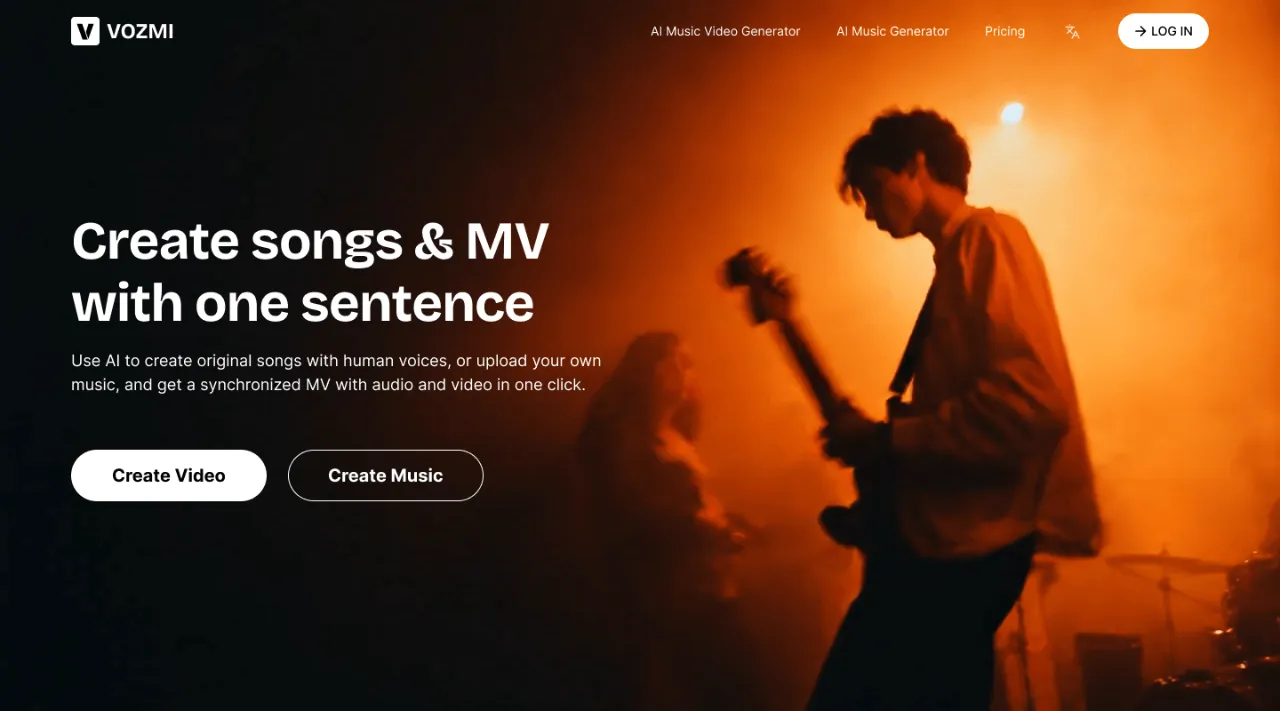
The creator economy has a production bottleneck that most tooling ignores: music and video are still separate workflows. A TikTok creator can generate a beat with Suno, then jump to Runway or Pika for visuals, then manually sync the two in CapCut — a process that eats hours and demands a patchwork of subscriptions. Vozmi's thesis is that this fragmentation is a structural failure, not a user preference. By chaining AI music generation, vocal synthesis, and video generation into a single three-step pipeline, Vozmi is attacking the most time-consuming part of short-form content production: the alignment of audio and visual.
The wedge is the music video itself. While AI music generators have matured rapidly, the output is often a static audio file — useless for the visual-first platforms where creators actually monetize. Vozmi's differentiator is not just generating a song from a sentence, but generating a matching music video with beat-synced scenes, timed lyrics, and character lip sync. This is a fundamentally different product category from a music generator; it's an audiovisual content engine.
From Prompt to Music Video: Vozmi's Three-Step Workflow
The core workflow is deceptively simple: write a sentence, compose a song, generate a music video. But the underlying mechanics are more complex than a typical text-to-music tool. Vozmi combines specialized music, voice, image, and video models into a single orchestrated pipeline — the user never sees a model switch, only a continuous creation flow.
The first step, text-to-song, is the foundation. Users can input a prompt like "a melancholic indie ballad about rain" or paste full lyrics. Vozmi's music generator handles composition, arrangement, and vocal synthesis, offering a choice of natural male or female vocals and one-line genre switching. The platform's homepage showcases a full-length track, "Paper Lantern Rain," complete with verse-chorus-bridge structure, dual male/female vocals, and production-ready mixing — evidence that the output quality targets commercial viability, not just novelty.
The second step — the music video generator — is where Vozmi diverges from competitors. The platform claims audio-reactive sync, meaning visuals move with the beat, and lyrics are timed to the vocals. It also supports consistent characters across scenes, multiple visual styles, and built-in lip sync for any on-screen singers. This is a significant technical challenge: maintaining character consistency across generated frames is a known weakness in video models, and Vozmi's promise of "consistent characters" suggests either a proprietary control mechanism or a careful prompt-engineering layer.
Finally, high-resolution export prepares the output for professional use. This is a deliberate signal to creators who need platform-ready files for YouTube, Instagram Reels, or TikTok, rather than low-res previews.
The Competitive Landscape: Suno, Udio, and the Video Gap
Vozmi's closest competitors are AI music generators like Suno, Udio, and Stable Audio. These platforms have solved the text-to-music problem with impressive fidelity, but they stop at audio. A creator who wants a music video must export the track and then use a separate video generation tool like Runway, Pika, or Sora, followed by manual editing in CapCut or Premiere. This workflow is not only time-consuming but also technically demanding — syncing beats to cuts, aligning lyrics to vocals, and maintaining visual consistency are skills that most creators don't have.
Vozmi's all-in-one approach directly attacks this friction. Instead of a pipeline of tools, it offers a single output: a finished music video. This is a meaningful value proposition for the lower end of the creator market — hobbyists, small brands, and social media influencers who need quick, polished content without a production team.
However, the incumbents are not standing still. Suno has introduced video features, and Runway's Gen-3 is increasingly capable of audio-conditioned video generation. The risk is that Vozmi's differentiation erodes as point solutions converge. But there's a counterargument: the integration itself is the product. Vozmi's advantage is not any single model, but the orchestration layer that makes the combined workflow feel like magic. If Vozmi can maintain a superior user experience, it can defend its niche even as underlying models improve.
Commercial Rights and the Monetization Imperative
For creators, the critical question is: who owns the output? Vozmi's FAQ states that "usage rights depend on your plan and the source material you provide," and that "content generated under eligible plans can be published and monetized." This is a standard approach in the AI generation space, but it's also a potential landmine. If a user generates a song from a prompt that resembles a copyrighted melody, the rights become murky. Vozmi's terms likely include a disclaimer that users are responsible for the originality of their inputs, but the legal landscape for AI-generated music is still unsettled.
The commercial-use angle is Vozmi's strongest lever for retention. A free tier that produces watermarked or non-commercial output, paired with a paid tier that unlocks monetization, is a proven freemium model. The key is whether the paid tier is priced low enough to attract hobbyists but high enough to sustain the company. Public materials do not disclose pricing, but the "start for free, no credit card required" call-to-action suggests a low-friction entry point.
Unit Economics and the Consumer GTM Motion
Vozmi's go-to-market is consumer-first, with a self-serve web app and a three-step workflow designed for zero learning curve. The GTM motion relies on organic discovery through AI tool directories — the website displays badges from There's An AI For That, AI Tool Fame, and SimilarLabs — and viral sharing of generated videos. This is a low-cost acquisition strategy that suits a launch-stage startup, but it also means Vozmi must compete for attention in a crowded space.
The unit economics depend on the cost of inference. Generating a music video requires multiple passes through music, voice, image, and video models, which is computationally expensive. If Vozmi's pricing doesn't cover these costs, the business model will struggle. The company likely uses a credit-based system, where each generation consumes credits, and paid plans offer more credits and higher resolution. This is a common pattern in AI generation tools, but it also creates a tension: users want unlimited creation, but the marginal cost of each video is non-trivial.
A more sustainable path is to target professional creators and small agencies who need high volumes of content. If Vozmi can offer a bulk credit package with commercial rights, it can build a recurring revenue base. The challenge is moving upmarket without losing the consumer simplicity that defines the product.
Risks and the Road to a Sustainable Category
The biggest risk Vozmi faces is commoditization. The underlying AI models are improving rapidly, and the barriers to entry are falling. If Suno or Runway adds a one-click music video feature, Vozmi's differentiation evaporates. To survive, Vozmi must build a brand and a community around its workflow — becoming the default tool for AI-generated music videos, not just another option.
The second risk is legal. The music industry has already sued AI music generators for copyright infringement, and video generation adds another layer of risk. Vozmi must ensure its models are trained on licensed data or defend fair use in court. This is an existential threat that could shut the company down regardless of user demand.
Finally, there's the question of whether the market for AI-generated music videos is large enough to sustain a standalone product. The creator economy is vast, but most creators don't need full music videos — they need short clips for social media. Vozmi's value proposition is strongest for musicians and storytellers who want a visual companion to their songs. If Vozmi can expand into adjacent use cases — lyric videos, promotional clips, personalized gifts — it can grow the category. But if it remains a niche tool, it may be acquired by a larger platform seeking to round out its creative suite.
In the next 3-5 years, the AI creation stack will consolidate. Vozmi's bet is that the integration layer is where the value accrues, not the individual models. If it can execute on that vision, it has a chance to become the Canva of music videos — the default tool for non-professionals. If not, it will be a footnote in the AI gold rush.