Yuma AI
Action-taking AI agents that resolve eCommerce support across chat, social, and voice
NewName Editorial
Editorial Team
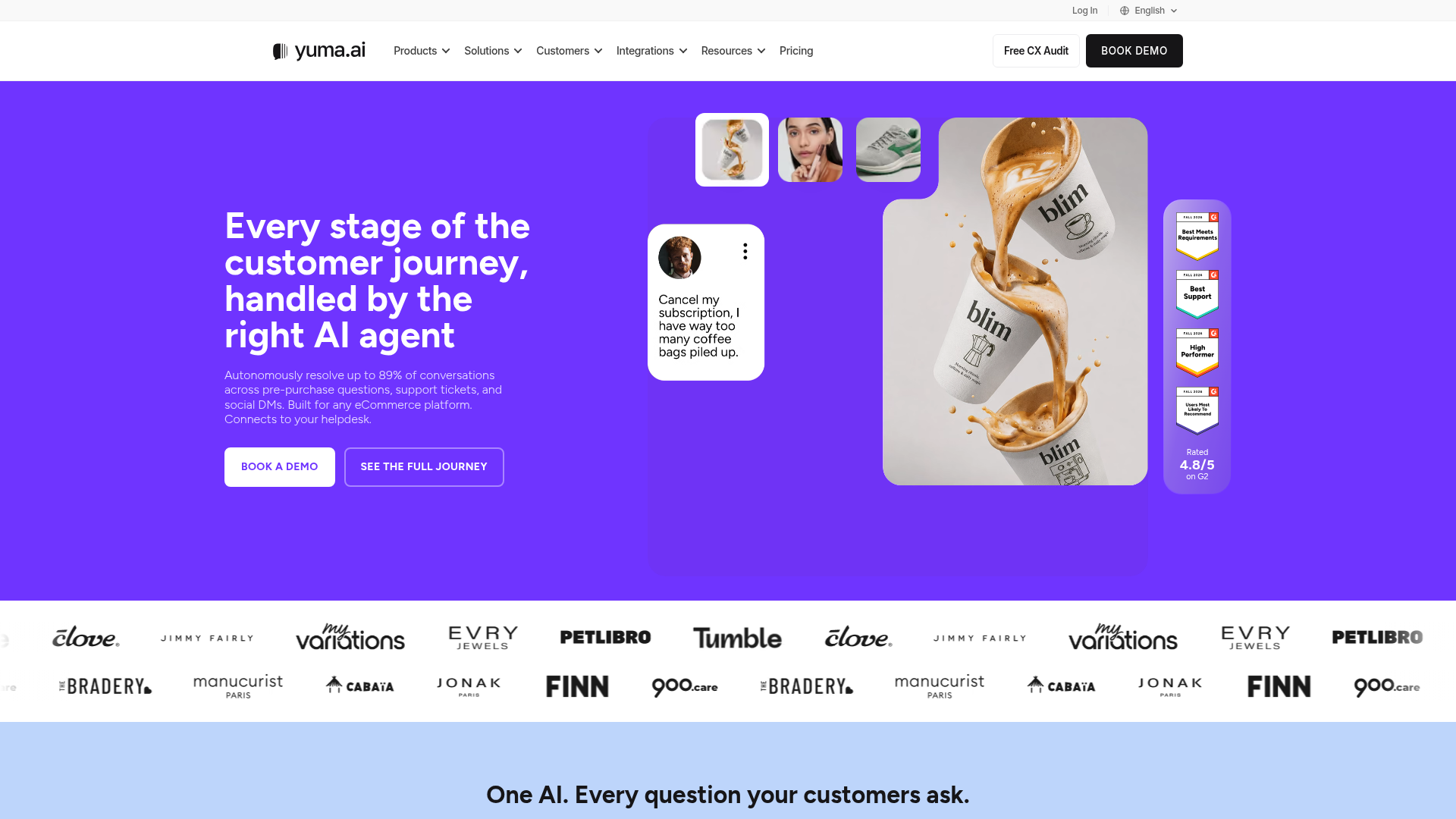
The eCommerce support software market has spent a decade optimizing the wrong metric. Chatbots got faster, helpdesks got prettier, and first-response times fell — yet the underlying cost of a support organization barely moved, because the majority of tickets still required a human to actually do something: issue the refund, edit the address, cancel the subscription, process the return. Yuma AI's thesis is that the next durable advantage in this category belongs not to the vendor with the best language model, but to the vendor that can safely execute the action behind the conversation. That is a workflow problem dressed as an AI problem, and it reframes the entire competitive landscape.
The Real Bottleneck in eCommerce Support Isn't Response Time — It's Resolution
Most support automation is measured on deflection: did the bot stop the customer from reaching a human? That metric is easy to game and frequently hostile to the customer. Yuma's public positioning is deliberately different — it claims autonomous resolution of up to 89% of conversations, framed around taking actions rather than sending replies. The distinction matters commercially. A deflected ticket that ends with the customer still needing a refund is a deferred cost, not a saved one, and it usually returns as a second contact, a chargeback, or churn.
The structural friction in eCommerce support is that the work is fragmented across systems. A single WISMO ("where is my order") question requires live data from the storefront (Shopify or equivalent), the carrier (DHL and others), and the helpdesk. A cancellation requires the subscription platform. A return requires the returns policy plus the order record. Traditional chatbots answer from a knowledge base; they cannot reach into these systems. Human agents can, but at a fully loaded cost per contact that scales linearly with order volume. Yuma's wedge is to collapse the answer and the action into one automated step.
Inside the Action Layer: How Yuma Turns a Chatbot Into a Workflow Engine
Yuma describes agents that "plug into your helpdesk" and handle WISMO, returns, refunds, cancellations, subscription changes, and address edits end to end. The public site shows the agent reading live Shopify, DHL, and helpdesk data to answer a delayed-order question, and detecting a subscription cancellation request to offer a delivery delay instead. That is not a retrieval-augmented FAQ bot; it is an orchestration layer sitting on top of commerce and logistics APIs, with the helpdesk as the system of record.
Two architectural choices stand out. First, integration breadth is the product. Yuma advertises being "built for any eCommerce platform" and connecting to the helpdesk, which means the engineering effort is concentrated in connectors, permissioning, and idempotent action execution — the unglamorous work that determines whether an AI agent is trustworthy enough to let issue refunds. Second, the company emphasizes that the AI "follows your process and shows its work," implying an audit trail and policy adherence layer rather than a black-box model. For a brand letting software move money, that traceability is the actual purchase criterion.
One Handbook, Three Fronts: Why Pre-Purchase, Post-Purchase, and Social Share a Single Brain
Yuma's most differentiated claim is organizational, not technical: one AI across pre-purchase (Sales AI), post-purchase (Support AI), and social DMs (Social AI), governed by a unified "Handbook" that defines rules for agents across every channel. Most competitors sell these as separate products with separate configuration surfaces, which forces brands to maintain parallel knowledge bases and inconsistent brand voices.
The commercial logic is that a shopper's question does not respect internal org charts. A sizing question that goes unanswered becomes a return; a return that is handled badly becomes a public social complaint. Yuma cites a 10% reduction in support tickets when Sales AI runs alongside Support AI, and up to +18% revenue per visitor from pre-purchase answers in A/B tests. Those are vendor-reported figures and should be treated as directional, but the mechanism is coherent: answering compatibility, sizing, and ingredient questions before purchase reduces both returns and downstream contacts. The single-Handbook design is what makes that loop operable without doubling the admin burden.
The Voice Expansion and the Channel-Coverage Land Grab
Yuma Voice, positioned as "your AI support agent now answers the phone," extends the same Handbook to telephony. This is strategically significant because voice is the channel most resistant to automation and the one where incumbent helpdesk AI is weakest. Phone support is expensive, hard to staff, and historically the last refuge of the human agent. If Yuma can bring its action layer to voice, it closes the last major coverage gap and makes the "every stage of the customer journey" claim literal rather than aspirational.
It is also the hardest execution problem the company has taken on. Voice adds latency constraints, interruption handling, and telephony compliance on top of the existing integration and policy challenges. Public materials do not disclose voice resolution rates, pricing, or which regions are live, so the maturity of this channel is genuinely uncertain. The strategic read is that voice is a land-grab move: whoever owns the phone channel for mid-market eCommerce brands will have a defensible position as competitors race to match channel coverage.
Competing Against Helpdesk-Native AI, Point Chatbots, and Human BPO
The competitive field splits into three camps. First, helpdesk incumbents — Zendesk, Intercom, Gorgias, and similar — are embedding their own AI agents. Their advantage is distribution and native data access; their constraint is that they are incentivized to keep the ticket as the unit of work, and their AI tends to be strongest inside their own walled garden. Yuma's counter-position is being helpdesk-agnostic and action-first, which lets it serve brands that do not want to rip out their existing stack.
Second, point-solution chatbots and FAQ bots compete on price and speed of setup but generally cannot execute refunds, cancellations, or address edits. They are the substitute Yuma is explicitly arguing against with "resolve, don't just respond." Third, and most underrated, is human BPO and offshore support — the true incumbent for most mid-market brands. BPO scales linearly, carries quality variance, and is exactly what a 63% cost-savings claim is designed to displace. Yuma's risk is that BPO is flexible and relationship-driven in ways software is not, and brands with complex or high-empathy products may resist full automation.
The Deflection Economics: Why 89% Automation Is a Pricing Argument, Not a Feature
The numbers Yuma publishes — 89% automation, 63% cost savings, 150K+ tickets per month, first response from 24 hours to 12 minutes — are marketing claims, not audited benchmarks, and buyers should validate them against their own ticket mix. But their function is clear: they convert the product from a per-seat software line item into an outcome-based business case. If a brand can model cost per contact before and after, the pricing conversation shifts from "what does the license cost" to "what is the payback period."
Yuma does not publish list pricing on its site; it routes prospects through a free CX audit and a demo request, which signals a sales-assisted, quote-based motion rather than pure self-serve. That fits a buyer who needs integration scoping and a business case before signing. The unit economics that matter are on Yuma's side: each incremental integration and each Handbook rule amortizes across all customers on that platform, so gross margins should improve with scale — provided the action layer stays reliable. A single high-profile mis-issued refund is the kind of event that can stall an entire category's adoption.
Where the Category Goes Next — and What Could Cap Yuma's Run
The direction of travel is clear: support AI is converging from "answer" to "act," and from single-channel to omnichannel, with voice as the frontier. Yuma is positioned well for that shift because it built the action and rules layers first rather than bolting them onto a chatbot. Over the next three to five years, expect consolidation pressure from helpdesk incumbents bundling AI for free, and expect buyers to demand audited resolution rates and liability terms for autonomous actions.
The realistic constraints on Yuma are threefold. Integration maintenance is a treadmill — every Shopify, carrier, and subscription-platform API change is a potential outage. Trust is fragile and asymmetric, since automation failures are more visible than automation savings. And the mid-market eCommerce segment it targets is cyclical, exposed to consumer spending and to brands that may themselves be acquired or shut down. None of these are fatal, but they mean Yuma's growth will be gated less by model quality than by operational reliability and reference-able proof. The company that wins this category will be the one brands trust to touch the money.