Impact-Site-Verification: 41b53a0c-6d04-458b-a457-fe9e29acde1a

AI & Machine Learning··6 min read

Zaplar

An autonomous operating system that replaces the fragmented hotel tech stack with one intelligent platform.

NN

NewName Editorial

Editorial Team

Zaplar product image 1
Zaplar product image 2
Zaplar product image 3

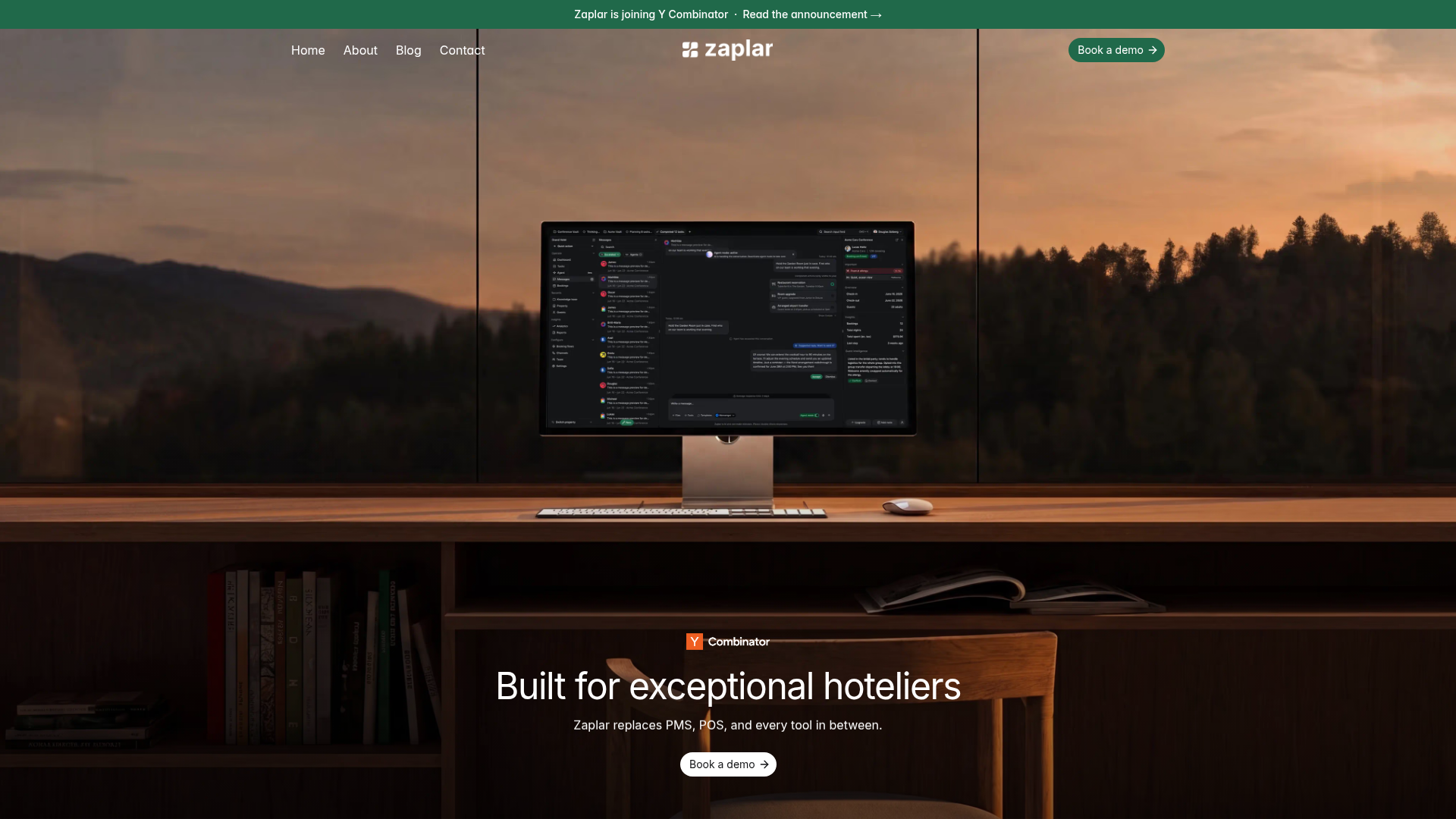
Zaplar is not another property management system. It's a bet that the entire hotel tech stack—PMS, POS, booking engine, messaging, guest intelligence—can be replaced by a single, AI-native platform that doesn't just store data but understands it. The company's pitch is bold: a system that "can understand and run hotel operations," acting like a great operator would. If it works, it could end the era of disconnected tools that force hotel staff to spend hours reconciling data. If it doesn't, it's another ambitious AI project in a notoriously conservative industry.

The 400-hour problem hiding in the back office

Zaplar's website leads with a statistic that should make any hotel operator wince: 400+ hours lost per manager every year just switching between systems. That's nearly 10 full work weeks. The company also claims that up to 19% of operating costs are wasted on duplicated admin and re-entry, and that 40% of guest spend never makes it into the guest profile. These numbers are specific, and they point to a real pain: hotel software has historically been a patchwork of point solutions, each with its own database, login, and workflow.

A front desk agent might have to check availability in the PMS, confirm a spa booking in a separate system, and update a restaurant reservation in yet another tool. The result is constant context-switching, manual data entry, and missed upsell opportunities. Zaplar's thesis is that this fragmentation isn't just annoying—it's a structural cost that erodes the guest experience and the bottom line.

The company's answer is consolidation. Instead of integrating best-of-breed tools, Zaplar wants to replace them with one system that covers property management, point of sale, messaging, booking, and guest intelligence. It's a classic platform play, but with an AI twist: the system is designed to complete work on its own.

Why hotel software never learned to think in space

Most hotel software is essentially a database with a user interface. It stores reservations, room statuses, and guest profiles, but it doesn't understand the physical reality of the property. A room isn't just a status code; it's a space with a location, a view, a bed configuration, and a housekeeping schedule. An event isn't just a booking; it involves a room layout, catering needs, and vendor coordination.

Zaplar is introducing a feature called "Zaplar Spatial," which uses "Spatial Reasoning" to reason about the physical properties of a hotel. This is a differentiator. Instead of treating rooms and spaces as abstract data points, the system can understand how they connect. For example, if a guest books a room, the system can automatically coordinate housekeeping, notify the front desk, and even suggest an upgrade based on the guest's profile and the room's availability.

This spatial awareness is what enables the system to "act the way a great operator would." A great operator knows that a late checkout in one room might delay housekeeping for the next guest, or that a wedding in the ballroom will increase demand for valet parking. Zaplar aims to encode that operational intuition into software.

The company's blog post on housekeeping scheduling hints at the underlying technology: constrained optimization. This is a mathematical approach to finding the best schedule given constraints like room availability, staff shifts, and cleaning times. It's a far cry from the manual spreadsheet-based scheduling that many hotels still use.

The autonomy contract: what runs itself, what waits for approval

Zaplar's promise is autonomy, but it's not a hands-off system. The company is careful to emphasize that "your team has full control." The system surfaces suggested actions, and staff review and approve them in one click. This is a crucial design choice. Hoteliers are notoriously wary of technology that makes decisions without human oversight, especially when it comes to guest-facing interactions.

The autonomy contract is simple: Zaplar plans, coordinates, and completes routine work autonomously around the clock, but every action is reviewable and reversible. This is a middle ground between a fully automated system and a traditional tool that requires manual input for every task. It's designed to build trust over time, as the system demonstrates that its suggestions are sound.

The company's values page reinforces this: "Autonomy with oversight," "Full transparency," and "Built for operators." These aren't just buzzwords; they're a response to the fear that AI will replace human judgment in hospitality. Zaplar's positioning is that the software handles the administration, freeing hoteliers to focus on the guest.

From PMS to POS: one system, every surface

Zaplar's product suite covers the full spectrum of hotel operations:

  • Property Management System (PMS): The core system for managing reservations, room assignments, and billing.
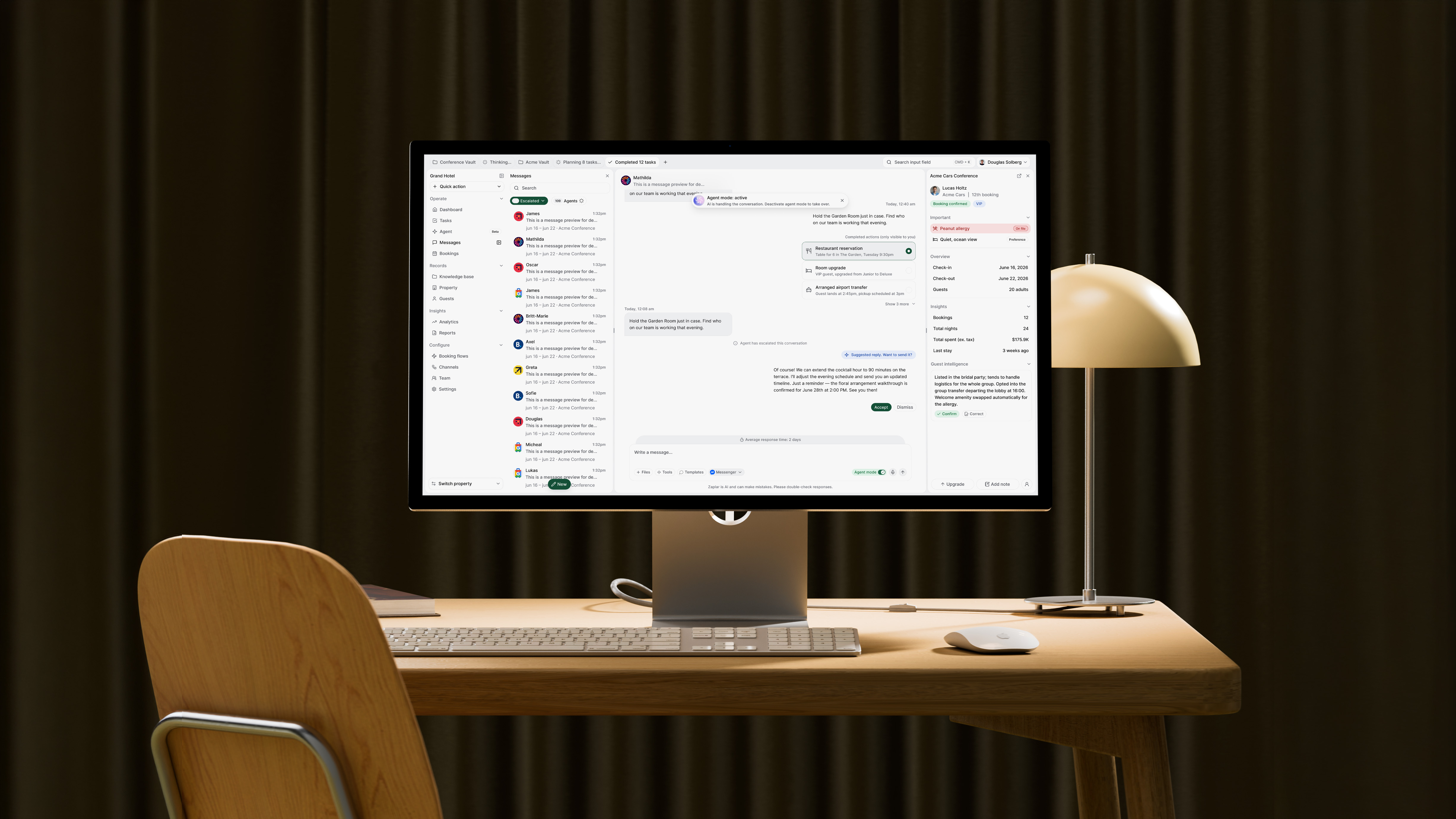
  • Messaging: A unified inbox for guest communications across email, OTAs, and other channels, with an optional "agent mode" for automated conversations.
  • Booking Engine: A customizable direct booking experience designed to drive upsells and reduce OTA commissions.
  • Point of Sale (POS): Payment processing for restaurants, bars, and other on-site venues.
  • Guest Intelligence: A system that analyzes guest data to provide personalized recommendations.
  • Zaplar Spatial: The spatial reasoning layer that ties everything together.

This is an ambitious scope. Most hotel tech companies focus on one niche, like PMS or revenue management. Zaplar is trying to be the operating system for the entire hotel. The risk is that doing everything means doing nothing well, especially in a market where established players like Oracle Hospitality and Amadeus have deep integrations and loyal customer bases.

But Zaplar's AI-native approach could be a wedge. Legacy systems are often decades old, with codebases that predate the cloud. They weren't designed to handle the complexity of modern hotel operations, let alone reason about them. Zaplar, built from the ground up with AI, has the potential to leapfrog these incumbents.

The name that sounds like a zap, not a legacy suite

The name "Zaplar" is short, punchy, and memorable. It evokes speed and energy—a "zap"—and the "-ar" suffix gives it a tech-forward feel, similar to "Radar" or "Sonar." It's a far cry from the staid, descriptive names of legacy hotel software like "Opera" or "Fidelio." The name signals a new generation of hotel tech: agile, intelligent, and built for the future.

The domain, zaplar.com, is clean and brandable. It's not a descriptive domain like "hoteltech.com," but that's a deliberate choice. Zaplar is building a brand, not just a product. The name is distinctive enough to stand out in a crowded market, and it avoids the genericism that plagues many SaaS products.

One potential issue is that the name doesn't immediately convey what the company does. "Zaplar" could be anything from a fintech app to a gaming platform. But in a market where most hotel software names are forgettable, Zaplar's ambiguity is a feature, not a bug. It forces the company to tell its story, which it does well through its website and content.

What's still unproven

Zaplar is a young company, and its claims are bold. The website doesn't disclose specific customer names or metrics, and the company is still in the Y Combinator batch (Summer 2026). The biggest open question is whether the system can truly deliver on its promise of autonomy without creating new problems.

For instance, what happens when the AI makes a mistake? The company says everything is reviewable, but in a fast-moving hotel environment, staff might not always have time to scrutinize every suggestion. There's also the question of integration with third-party systems like OTAs and channel managers. Even if Zaplar replaces the PMS and POS, it still needs to talk to the outside world.

Another concern is the sales motion. The company's blog post "We Don't Cold Email Hotels" describes driving three hours to walk into hotel lobbies. This is a high-touch, relationship-driven approach that could be hard to scale. But it also reflects a deep understanding of the market: hoteliers are busy people who trust personal relationships more than cold outreach.

Ultimately, Zaplar's success will depend on execution. The vision is compelling, and the technology is promising. But the hotel industry is conservative, and legacy systems are deeply entrenched. Zaplar will need to prove that its autonomous approach not only works but delivers measurable ROI—like reducing admin time, increasing direct bookings, and capturing more guest spend. If it can do that, it might just replace the hotel tech stack for good.