83 Sciences
Turn discarded lab data into papers, patents, and process improvements.
NewName Editorial
Editorial Team
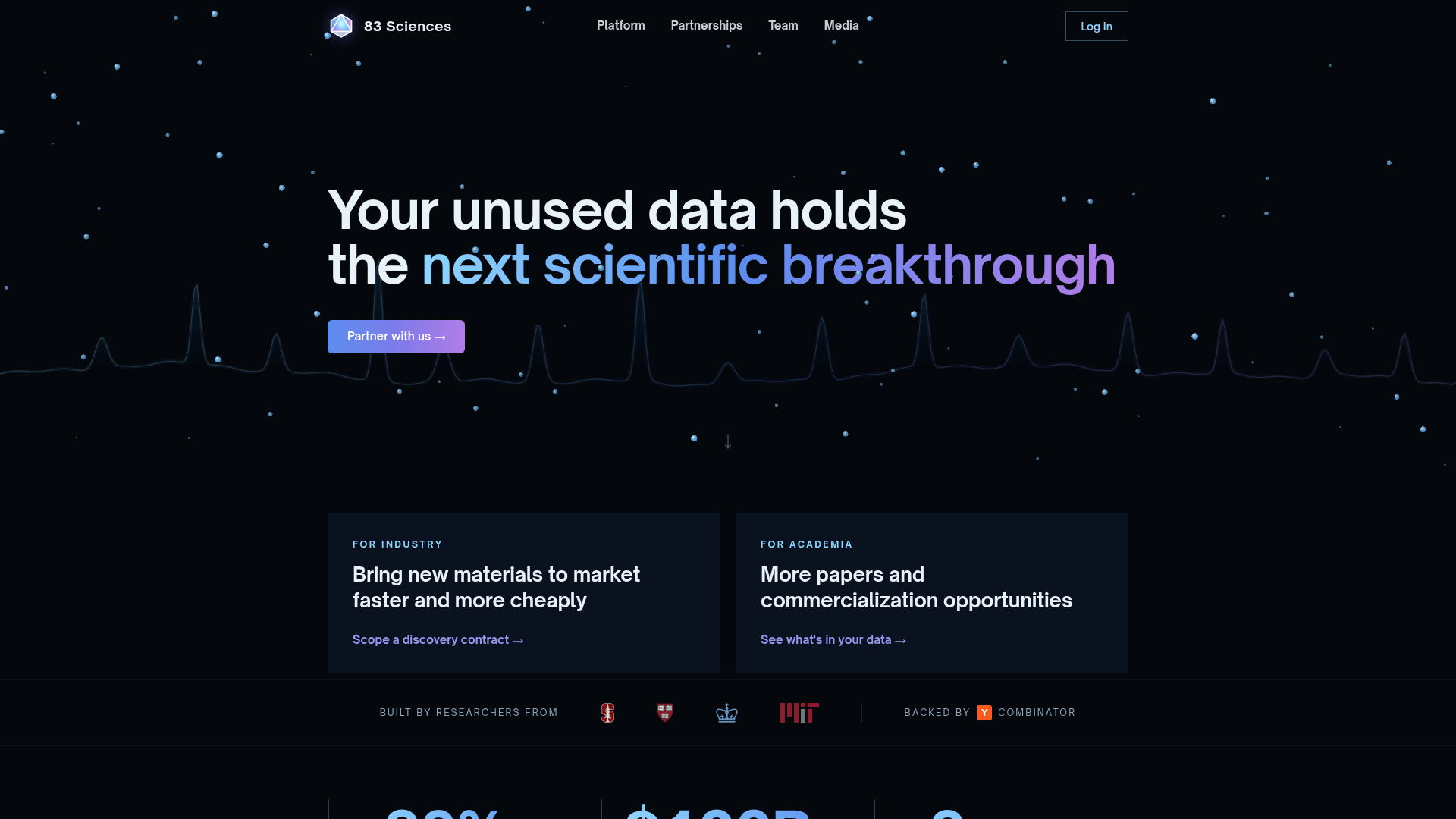

Materials science runs on data that mostly disappears. Labs generate enormous volumes of experimental output—instrument readings, failed runs, process tweaks, even voice notes from researchers—and the overwhelming majority of it never makes it into a paper, a patent, or a process model. 83 Sciences, a Y Combinator-backed startup built by researchers from Stanford, Harvard, Columbia, and MIT, has built a business around that waste. The company's thesis is blunt: if you can capture, structure, and learn from the data that labs currently discard, you can help industry bring new materials to market faster and help academics publish more. The site claims that 83% of experimental data is discarded, and that over $100B in R&D value is lost each year as a result. Those are big numbers, and they frame the entire product.
The 83% that never makes it into a paper
The name 83 Sciences is a direct reference to that 83% figure. It is a naming choice that works because it is a thesis, not a metaphor. The company is not called "Discovery AI" or "Materials Intelligence." It is called 83 Sciences, a constant reminder of the inefficiency it exists to fix. The name is also a subtle challenge to the academic publishing system: if most experimental data never gets published, then the literature itself is a biased sample. 83 Sciences wants to be the repository for the other 83%.
The company targets a specific set of verticals: energy storage, critical minerals and metals, catalysis and chemicals, life sciences solid forms, and semiconductors. These are all areas where process optimization and scale-up are slow, expensive, and heavily reliant on empirical trial-and-error. In each of these fields, the data that could improve manufacturing performance is often locked in lab notebooks, instrument files, or the memories of researchers who have moved on.
From voice notes to a queryable agentic record
The product has three layers. The first is streamlined research: effortless capture and structuring of data, from voice notes to instrument output. This is not just a data entry tool; it is designed to fit into the messy reality of a working lab. A researcher might dictate a note about a failed synthesis, or an instrument might generate a raw output file. 83 Sciences aims to capture all of it, without requiring a rigid data-entry workflow.
The second layer is what the company calls a "scientific brain": a structured, queryable agentic record of every experiment. The word "agentic" is important. This is not a static database; it is a system that can reason over the accumulated record, understand failures, and propose optimized process conditions. For example, if a lab has run hundreds of variations on a catalyst synthesis, the agentic record could identify the conditions that most consistently produced a desired outcome, even if those conditions were never explicitly written down in a final report.
The third layer is the outcome: papers, patents, and commercialization. This is where 83 Sciences differentiates itself from a pure data-management tool. It does not just store data; it moves the partner toward a concrete result. For academics, that means co-authored manuscripts. The site claims that in less than two months, the company can turn a partner's discarded data into a co-authored manuscript. For industry, it means process improvements, scale-up support, and potential patents.
Why the agentic record is the core asset
The "scientific brain" is the heart of the product, and it is worth examining why. In materials science, the difference between a successful scale-up and a costly failure often lies in subtle process conditions: temperature ramps, mixing rates, impurity levels, aging times. These are rarely captured in a final paper, which typically reports only the optimized recipe. The agentic record, by contrast, captures the full exploration space, including the failures. That is exactly the data a machine learning model needs to learn robustly.
By structuring this data and making it queryable, 83 Sciences creates an asset that appreciates over time. Every new experiment adds to the record, and the model improves. This is a classic data network effect, but applied to a domain where data is traditionally siloed and discarded.
The two-sided flywheel: industry scale-up and academic credit
The business model is two-sided. For industry, 83 Sciences offers discovery contracts to improve manufacturing performance at scale. The value proposition is clear: faster time-to-market, lower R&D cost, and better process yields. For academia, the company offers a path to more publications and commercialization opportunities. This is a clever incentive alignment. Academics are rewarded for sharing their data with publication credit, while industry gets access to a richer dataset than any single lab could generate.
The two sides reinforce each other. Industry contracts generate real-world process data that can be fed back into the platform. Academic collaborations generate novel experimental data and the credibility that comes with peer-reviewed publications. The company's claim of turning discarded data into a co-authored manuscript in under two months is a strong signal of how tightly it integrates with academic workflows.
Where 83 Sciences sits in the vertical stack
The vertical focus is a deliberate choice. Materials discovery is a broad field, and a general-purpose AI platform would struggle to deliver value in any single domain. By focusing on energy storage, critical minerals, catalysis, solid forms, and semiconductors, 83 Sciences can build domain-specific models and workflows. These are also sectors with high strategic importance and significant R&D budgets, which makes the commercial case stronger.
For example, in energy storage, the need for better battery materials is urgent. In critical minerals, process efficiency directly impacts supply chain economics. In semiconductors, materials purity and process control are existential. These are not academic curiosities; they are industrial pain points.
The honest limits of the pitch
The pitch is compelling, but it rests on several assumptions. The first is that the discarded data is actually valuable. Not all experimental data is worth capturing; some is noise, some is redundant, and some is the result of poorly designed experiments. 83 Sciences will need to show that its models can extract signal from the mess.
The second is that academics will be willing to share their data, even with publication credit. Lab culture is competitive, and data is a form of intellectual capital. The company will need to build trust and demonstrate that the credit is real and timely.
The third is that the two-month manuscript timeline is sustainable at scale. If that claim holds, it is a powerful differentiator. If it slips, it could undermine credibility.
None of these are fatal objections, but they are the reasons why 83 Sciences is a bet, not a sure thing. The company is betting that the 83% is a goldmine, and that it can build the tools to mine it. The name is a constant reminder of the scale of the opportunity—and the scale of the challenge.