Impact-Site-Verification: 41b53a0c-6d04-458b-a457-fe9e29acde1a

AI & Machine Learning·Series A··5 min read

Biorce

Biorce's Aika: the explainable AI operating system for clinical trial development

NN

NewName Editorial

Editorial Team

Biorce product image 1

Clinical trials are notoriously slow, expensive, and paper-heavy. A single protocol amendment can cost millions and delay a drug's path to market by months. Yet the industry has relied on point solutions—separate tools for protocol design, feasibility, patient recruitment, and regulatory submission—that don't talk to each other. Biorce, a Series A startup, is making a bold claim: it has built the first operating system for clinical development, and it's powered by explainable AI.

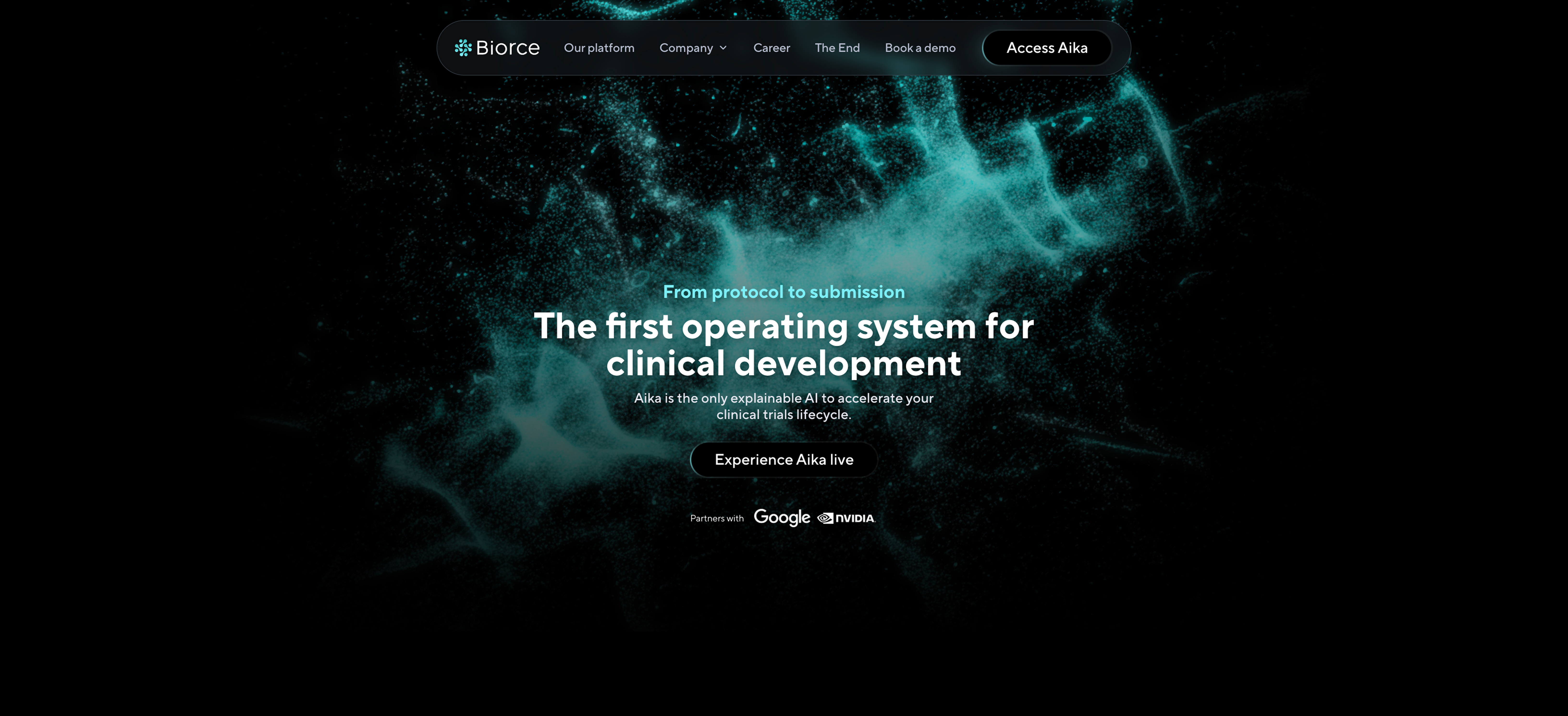
The company's product, Aika, is positioned not as another SaaS tool but as a new operating model for the entire trial lifecycle. The website's language is telling: "From protocol to submission," "the first operating system for clinical development," and "a new operating model for clinical development that will shift how trials are run." This is not incremental improvement; it's a rebranding of how clinical trials should be orchestrated.

The operating system claim that could change clinical trials

Calling a product an "operating system" is a heavy claim. In tech, an OS manages hardware and software resources, providing a foundation for applications to run. Biorce is borrowing this metaphor to suggest that Aika doesn't just automate a single step—it governs the entire trial lifecycle, from protocol design to regulatory submission. The website lists eight stages: Protocol Design, Feasibility, Patient Identification, Budgets, Contracts, Monitoring, Regulatory, and Submission. This is a horizontal play, aiming to replace the patchwork of specialized tools with a single, integrated platform.

The ambition is clear: if Aika can truly orchestrate all these stages, it could become the system of record for clinical development. But the claim also invites skepticism. Operating systems are notoriously hard to build and even harder to displace. Legacy systems like Veeva and Medidata have entrenched positions. Biorce is betting that a new generation of AI-native tools, with explainability baked in, can disrupt the status quo.

From protocol to submission: what Aika actually orchestrates

Aika's end-to-end scope is its primary differentiator. Instead of focusing on one pain point, Biorce is attacking the entire workflow. The website highlights AI-accelerated protocol creation, feasibility, and alignment. It also mentions automation across budgets, contracts, and monitoring. This is a comprehensive suite that aims to reduce friction between stages—a common source of delays and errors.

The product's name, Aika, is notable. It's short, memorable, and carries a hint of "AI" and "ka" (perhaps evoking "kaizen," the Japanese philosophy of continuous improvement). The name positions the product as an intelligent agent, not just a database. Biorce's choice to give the product its own identity, separate from the company, suggests they see Aika as a brand in its own right.

Why amendment prevention is the quiet killer feature

Among the promised benefits, "50% fewer protocol amendments" stands out. Protocol amendments are changes to the trial design after it has started. They are costly, time-consuming, and can introduce inconsistencies. The website claims that Aika "helps to avoid amendments as regulatory expectations are secured in the design-phase." This is a powerful value proposition: if Aika can catch potential issues before the trial begins, it saves sponsors millions and accelerates timelines.

This feature is likely the most compelling for clinical teams. It addresses a deep pain point that generic AI copilots don't touch. By embedding regulatory knowledge into the design phase, Aika is not just automating—it's preventing future problems. This is the kind of concrete benefit that can justify the investment in a new platform.

The explainability bet: no black boxes in regulated medicine

In regulated industries, AI is often met with suspicion. Regulators and clinicians need to understand why an AI made a certain recommendation. Biorce addresses this head-on with the tagline "Governed AI. Faster clinical development." The website emphasizes "100% explainable decisions" and "Explainable outputs. Full automation with review processes and human oversight."

This is a strategic bet. By making explainability a core feature, Biorce is positioning itself as the safe choice for risk-averse organizations. The website even states, "Running trials without AI means slower, costlier outcomes that become increasingly difficult to defend." This frames AI adoption as a necessity, and Biorce's explainable approach as the responsible way to do it.

However, "100% explainable" is a strong claim. In practice, AI models, especially deep learning, can be difficult to interpret. Biorce's approach likely involves rule-based systems or model-agnostic explanations, but the website doesn't provide technical details. This is a point of uncertainty that potential customers will want to probe.

The numbers behind the pitch: 60%, 70%, 50%

The website prominently features three statistics: 60% reduction in costs, 70% faster clinical development workflow, and 50% fewer protocol amendments. These are attributed to "empirical research conducted by Biorce." This is a red flag: self-reported numbers without independent validation should be taken with caution. The methodology is not disclosed, and the sample size is unknown.

That said, these figures are attention-grabbing. If even a fraction of these improvements are realized, the ROI for a sponsor running multiple trials would be substantial. The website also includes a "Clinical savings calculator" that estimates minimum potential savings based on the number of trials and organization type. For example, a single trial might yield $32,275,000 in savings. This is a powerful sales tool, but the underlying assumptions are not transparent.

What the name 'Aika' signals and what it hides

The name "Aika" is a clever piece of branding. It's short, easy to pronounce, and suggests intelligence (AI) and action (ka, as in kaizen). It also avoids the generic "trial" or "clinical" terms that clutter the category. The company name, Biorce, is less distinctive—it sounds like a biotech company, which it is, but it doesn't convey the AI focus. The website's domain, biorce.com, is clean and professional.

However, the branding also hides some risks. The term "operating system" may overpromise, especially for a Series A startup. Building an end-to-end platform is a massive undertaking, and the website's feature descriptions are repetitive and thin in places (e.g., "AI-accelerated protocol creation, feasibility, and alignment" is repeated verbatim for multiple sections). This suggests the product may still be early-stage, and the marketing is ahead of the actual capabilities.

In summary, Biorce's Aika is an ambitious attempt to redefine clinical trial software as an AI-native operating system. Its focus on explainability and amendment prevention addresses real industry pain points. The bold claims and savings calculator are compelling, but they need independent validation. For sponsors and CROs looking to modernize their workflows, Aika is worth a demo—but with eyes open to the gaps between promise and proof.