Cosmic Robotics
Earth-first autonomous construction robots, with a Mars city as the long-term vision.
NewName Editorial
Editorial Team


Cosmic Robotics wants to build a city on Mars. But the company's own website spends more time talking about solar farms and data centers than red rocks and habitats. That's not a contradiction — it's the smartest thing about the company.
Most hard-tech startups with a space-age vision lead with the fantasy. Cosmic Robotics leads with the boring stuff: utility-scale solar and hyperscale data centers. The tagline — "Autonomous construction on Earth and beyond" — puts Earth first, and that ordering is a deliberate strategy. The company is betting that the way to earn the right to build on Mars is to prove the economics of autonomous construction on Earth's most demanding job sites.
The Mars pitch is a distraction from the real product
If you strip away the Mars city imagery, Cosmic Robotics is a construction robotics company. The website copy is explicit: "Robotic equipment for the world's critical infrastructure. The first frontier: solar and data centers." The Mars vision is the north star, but the product is a robot that places solar panels and works alongside human crews.
That's a classic de-risking move. Mars is a nice story for press releases and recruiting, but it's not a near-term revenue stream. The company is saying, in effect: we'll prove we can build the most mundane, high-volume infrastructure on Earth, and then we'll take that capability off-planet. The Mars city is the brand halo; the solar farm is the business.
Solar farms and data centers: the proving ground for autonomy
Why solar and data centers? Because they are the two fastest-growing categories of infrastructure that are also highly repetitive and standardized. A solar farm is thousands of identical panels placed in a grid. A data center is a massive shell with predictable structural components. These are the kinds of sites where autonomy can actually work today, not in some speculative future.
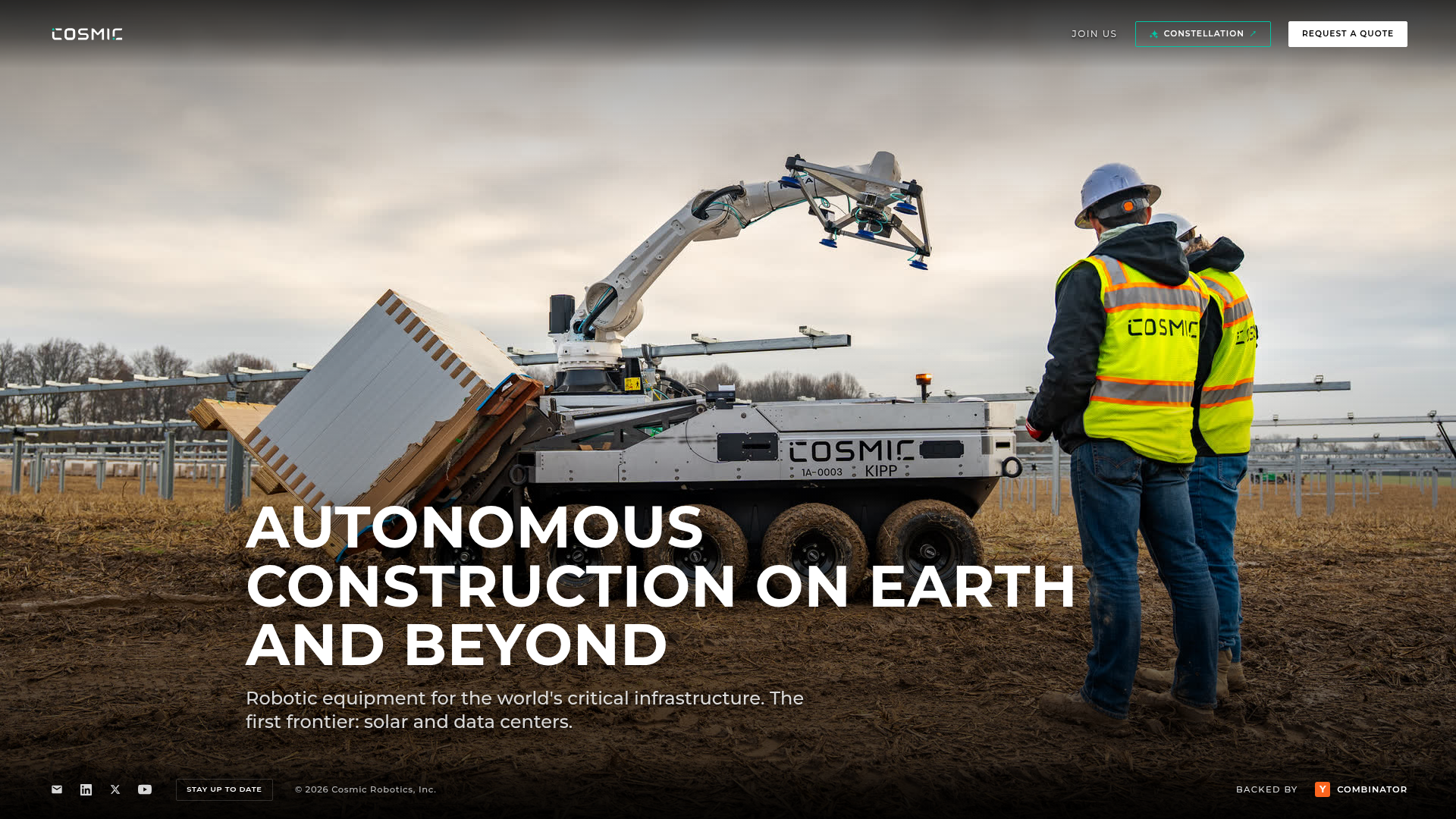
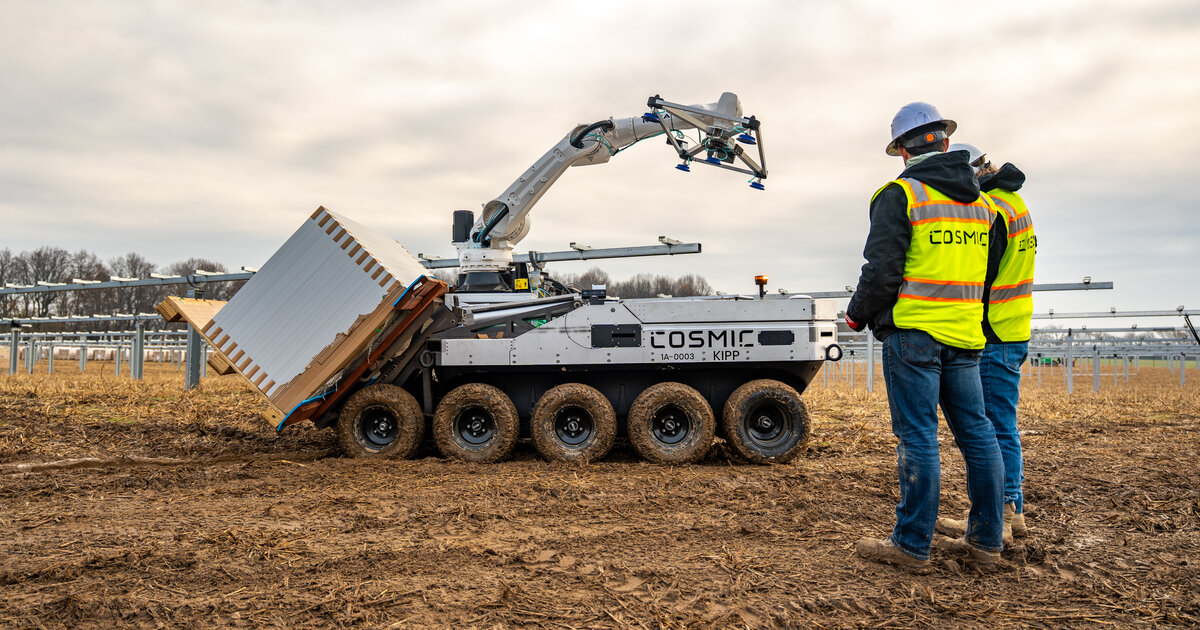
The company's hero image shows a Cosmic robot placing a solar panel alongside a crew in the field. That's a telling image: the robot is not replacing the crew, it's working with them. The near-term product is not a fully autonomous site — it's a robot that handles the tedious, repetitive part of the job while humans handle the exceptions. That's a more honest and more achievable starting point than a fully unmanned construction site.
What the robot actually does on site
The public materials don't provide a spec sheet. There's no payload capacity, no battery life, no cycle time. But the hero photo and the tagline "Autonomous construction" suggest a machine that can move, place, and perhaps fasten components with minimal human intervention. The focus on solar panel placement implies a robot that can handle delicate, heavy, and precise tasks — panels are fragile and must be aligned correctly.
The website also mentions "hyperscale data centers," which hints at a broader capability: moving large structural elements, perhaps concrete or steel. But without more documentation, we can only infer. The company is clearly in an early stage, with a Y Combinator backing and a modest web presence. The absence of technical details is not necessarily a red flag — it's typical for a company that's still in the prototype or pilot phase.
The Earth-first strategy as a de-risking move
Cosmic Robotics is making a bet that autonomy is a business problem, not a physics problem. The hardest part of construction robotics isn't the robot — it's the integration with existing workflows, safety regulations, and cost structures. By focusing on solar and data centers, the company can iterate quickly on real job sites, gather data, and refine the product without waiting for a Mars mission.
This is also a clever way to attract talent and capital. The Mars vision is compelling enough to draw engineers who want to work on something ambitious, while the Earth-first focus gives investors a credible path to revenue. Y Combinator's backing suggests the company has convinced early believers that the technology can be built and sold.
But the strategy carries risks. The construction industry is notoriously conservative, and autonomous equipment has to clear high safety and liability bars. The company will need to prove not just that the robot works, but that it works reliably enough to be trusted on a live site. And the Mars vision, while inspiring, could become a liability if the Earth business doesn't take off — investors may lose patience with a company that talks about Mars but struggles to ship a solar panel robot.
What's missing from the public story
Cosmic Robotics is thin on public details. There's no pricing page, no documentation, no technical specifications, and no team bios. The website is essentially a landing page with a hero image, a tagline, and a request for a quote. That's typical for a YC-backed company at an early stage, but it means we're working with limited evidence.
The company's name is a bold statement. "Cosmic" signals the Mars ambition, while "Robotics" is the product category. It's a name that would be hard to live down if the company pivoted to purely terrestrial construction. But for now, it matches the dual identity: Earth-first, but with cosmic ambitions.
What's clear is that Cosmic Robotics is positioning itself at the intersection of two massive trends: the global build-out of renewable energy and data infrastructure, and the maturation of autonomous systems. If the company can prove that its robots can cut costs and improve safety on solar farms, the Mars city might be more than a dream. It might be the logical next step.
For now, the company is doing the hard, unglamorous work of building on Earth. That's the right move — and the only way to eventually build on Mars.