Applied Electrodynamics, Inc.
See through walls with millimeter accuracy—WaveSight turns the electromagnetic spectrum into a practical tool for construction, manufacturing, and security.
NewName Editorial
Editorial Team
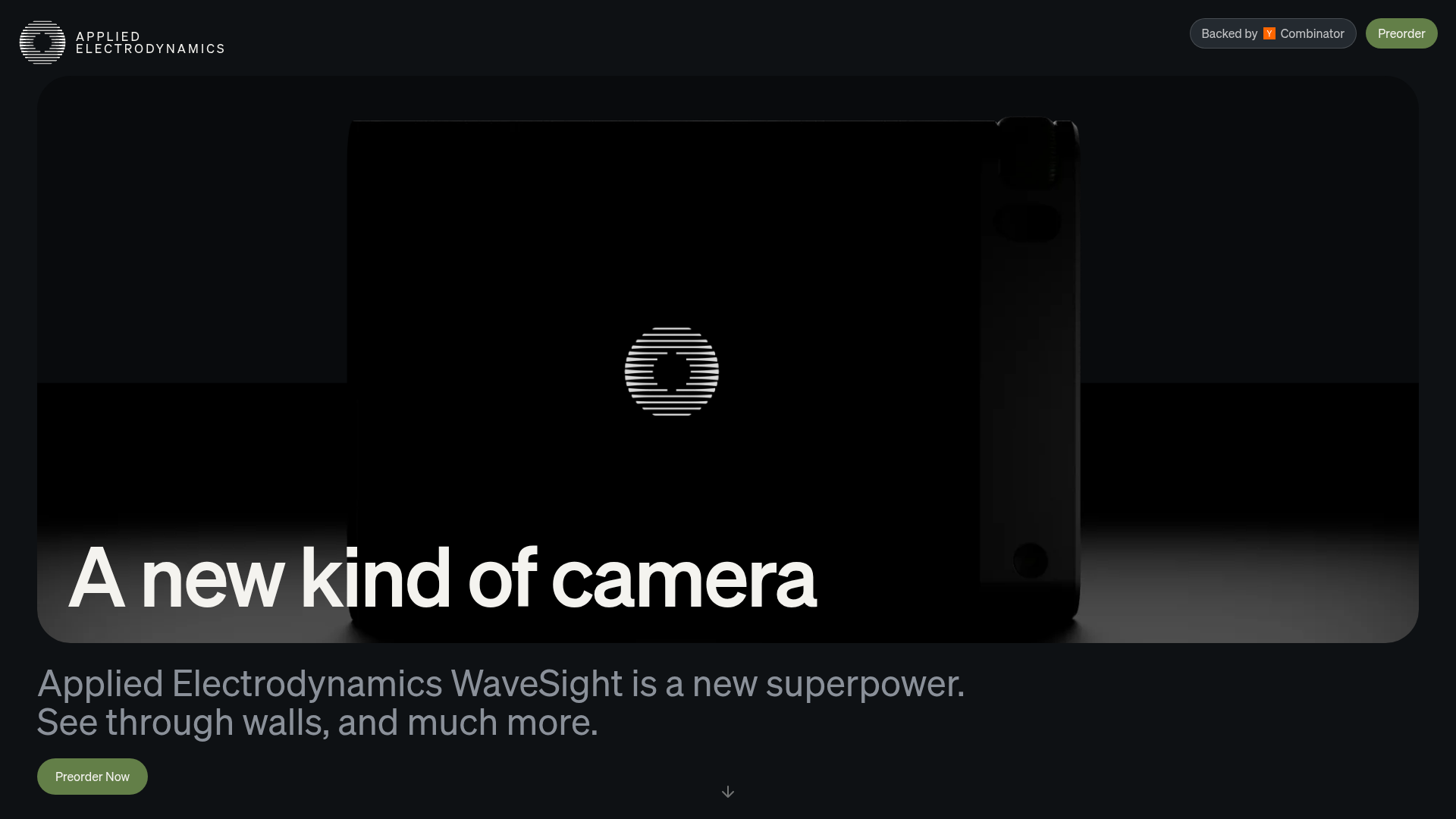
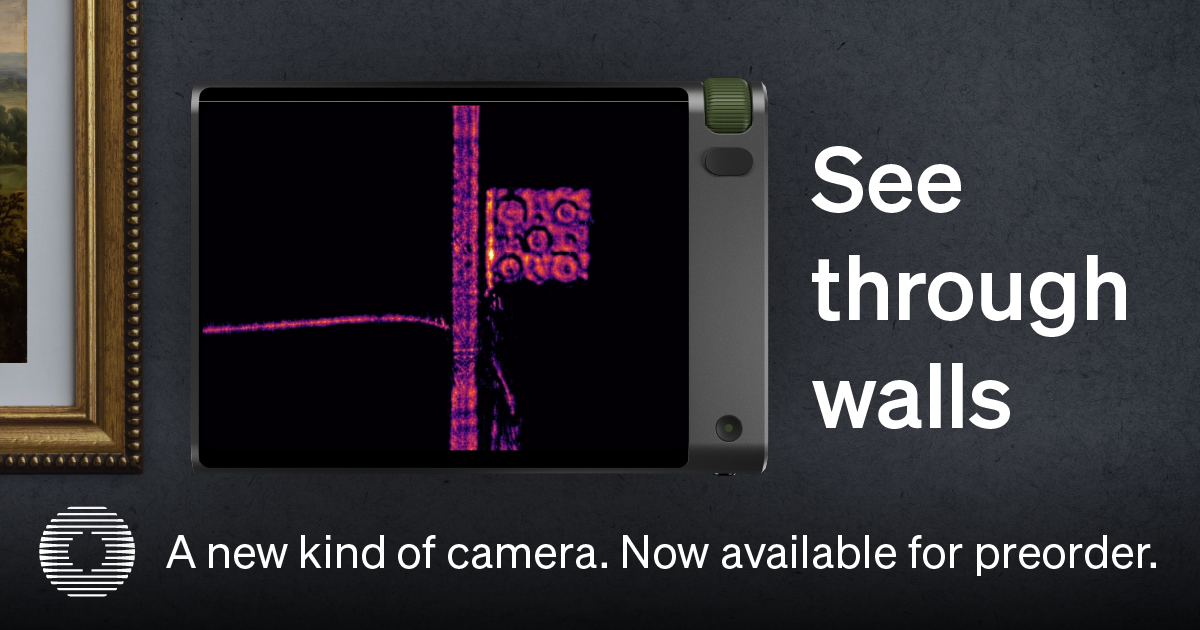
The most interesting thing about Applied Electrodynamics' WaveSight is not that it sees through walls—it's that the company treats the entire electromagnetic spectrum as a design material. Most cameras capture a narrow slice of light. WaveSight, according to the company, is "a new kind of camera" that makes "the physical world machine-readable across the entire electromagnetic spectrum." That phrasing is not marketing fluff; it's a thesis about what hardware can do when you stop limiting yourself to visible light.
The company, backed by Y Combinator and built by engineers from Apple, Google, and MIT, is preordering a device that promises to penetrate surfaces that thermal cameras and LiDAR cannot. If it delivers, it could change how we inspect buildings, manufacture goods, and screen packages. But the gap between a compelling demo and a reliable field tool is wide, and the site's sparse technical details leave many questions unanswered.
The spectrum is the interface
WaveSight's core claim is that it can see through walls. The website shows before-and-after images: an opaque wall exterior, then a scan revealing "elements hidden behind the wall." The company lists four use cases: mapping mechanical, electrical, and plumbing (MEP) systems; pinpointing issues that thermal and LiDAR miss; confirming hidden assembly conditions on manufacturing lines; and screening bags and packages for metallic and non-metallic items.
What's notable is the breadth. This is not a niche tool for one industry. It's a general-purpose imaging device that could serve construction, manufacturing, and security. The common thread is the ability to non-destructively inspect what is hidden. That is a fundamental capability, not a feature.
The phrase "across the entire electromagnetic spectrum" suggests WaveSight uses a range of frequencies, likely including radio or microwave bands, to see through materials. The company does not disclose the specific technology, but the claim of "millimeter accuracy" implies a level of precision that would be valuable for as-built documentation and quality control.
Why walls are the last dark matter of construction
In construction, the phrase "as-built" is often a polite fiction. Buildings are designed in 3D, but what actually gets built can differ in thousands of small ways. Pipes shift, wires take unexpected routes, and walls go up before anyone records the final layout. This is why Building Information Modeling (BIM) is so valuable—and why it's often incomplete. WaveSight positions itself as "the missing link in BIM," offering a way to capture the hidden reality of a building after it's built.
The use case is compelling: instead of relying on blueprints or destructive probing, a contractor could scan a wall and get a millimeter-accurate map of what's inside. That could reduce costly surprises during renovations, help with facility management, and improve safety by avoiding accidental strikes on pipes or wires.
The site's example of "pinpointing issues in no time" suggests that WaveSight can detect problems like leaks or faulty wiring that are invisible to thermal cameras. Thermal imaging is great for temperature differences, but it can't see through a wall to identify the exact location of a leak. WaveSight claims to do that, which would be a significant upgrade.
The inspection workflow that WaveSight replaces
For manufacturing, WaveSight offers "final inspection, anytime, anywhere." The ability to confirm hidden assembly conditions, part presence, and dimensional accuracy without disassembly is a major value proposition. In industries like aerospace or automotive, where components are often enclosed, this could save hours of labor and reduce the risk of damage from inspection.
Traditional inspection methods include X-rays, which require safety precautions and specialized equipment, or ultrasonic testing, which requires contact with the surface. WaveSight promises a non-contact, non-destructive alternative that can be used on the line or in the field. The "anytime, anywhere" phrasing suggests portability, which would be a differentiator.
However, the site does not provide specifics on how WaveSight achieves this. Is it a handheld device? Does it require a power source? What is the resolution? These details are absent, which is common for pre-launch products but makes it hard to evaluate the claim of "millimeter accuracy."
The security angle: beyond metal detectors
Security screening is another application. WaveSight can "screen bags, packages, and deliveries for metallic and non-metallic items, independent of stationary checkpoints." This is a different problem from construction. It requires not just seeing through walls, but identifying objects that might be hidden in a bag or package. The ability to detect non-metallic items, like plastics or ceramics, is something traditional metal detectors cannot do.
The phrase "independent of stationary checkpoints" suggests a mobile solution, which could be useful for security personnel who need to screen items in the field. This could be a valuable tool for law enforcement, military, or event security.
But again, the site does not explain how WaveSight distinguishes between a harmless object and a threat. The before-and-after images show hidden elements, but they appear to be structural, not threatening. The security use case is intriguing but underdeveloped.
What is still behind the wall
The biggest unknown is the actual performance of WaveSight. The website is essentially a landing page with a preorder form. There is no technical specification, no white paper, no independent test results. The company claims to be "built by scientists and engineers who brought you the iPhone and Nest Learning Thermostat" and lists "250+ patents granted," but these are credentials, not proof.
The lack of detail is a red flag for a product that promises millimeter accuracy. Seeing through walls is hard. Doing it with precision requires sophisticated signal processing and a deep understanding of electromagnetic wave propagation. The company may have solved these problems, but the public evidence is thin.
There is also the question of cost. The site does not list a price, only "launch pricing" for preorder customers. If WaveSight is priced like other professional imaging tools, it could be in the tens of thousands of dollars, which would limit its market to large enterprises. If it's priced lower, it could be a disruptive tool for small contractors and security teams.
The preorder as a vote of confidence
The preorder page is the only call to action. It asks users to "register for preorder" to get early access, launch pricing, and product updates. This is a classic Y Combinator approach: gauge demand before building inventory. The company is likely using preorders to validate the market and fund production.
But preordering a product that has not been demonstrated publicly is a leap of faith. The site's before-and-after images are compelling, but they are not proof of real-world performance. A video of a live scan would be more convincing.
Applied Electrodynamics is taking a big swing. If WaveSight works as advertised, it could become an essential tool for construction, manufacturing, and security. If it falls short, it will be another cautionary tale about the gap between demo and product. The company's pedigree suggests they have the technical chops, but the proof will be in the shipping hardware.
For now, the most honest summary is this: WaveSight is a promising idea with a strong team and a clear market need. The preorder is a bet on that promise. Whether it pays off depends on the details the company has not yet shared.