Coverage Cat
Benchmarking frontier AI on insurance tasks, then selling coverage with a licensed broker.
NewName Editorial
Editorial Team


Coverage Cat is not the first insurance startup to put a chatbot on its homepage. It might be the first to publish a leaderboard that grades frontier AI models on how well they can do the job of an insurance agent. That pairing—an open benchmark for machines and a licensed brokerage for humans—makes Coverage Cat a genuinely strange and interesting hybrid.
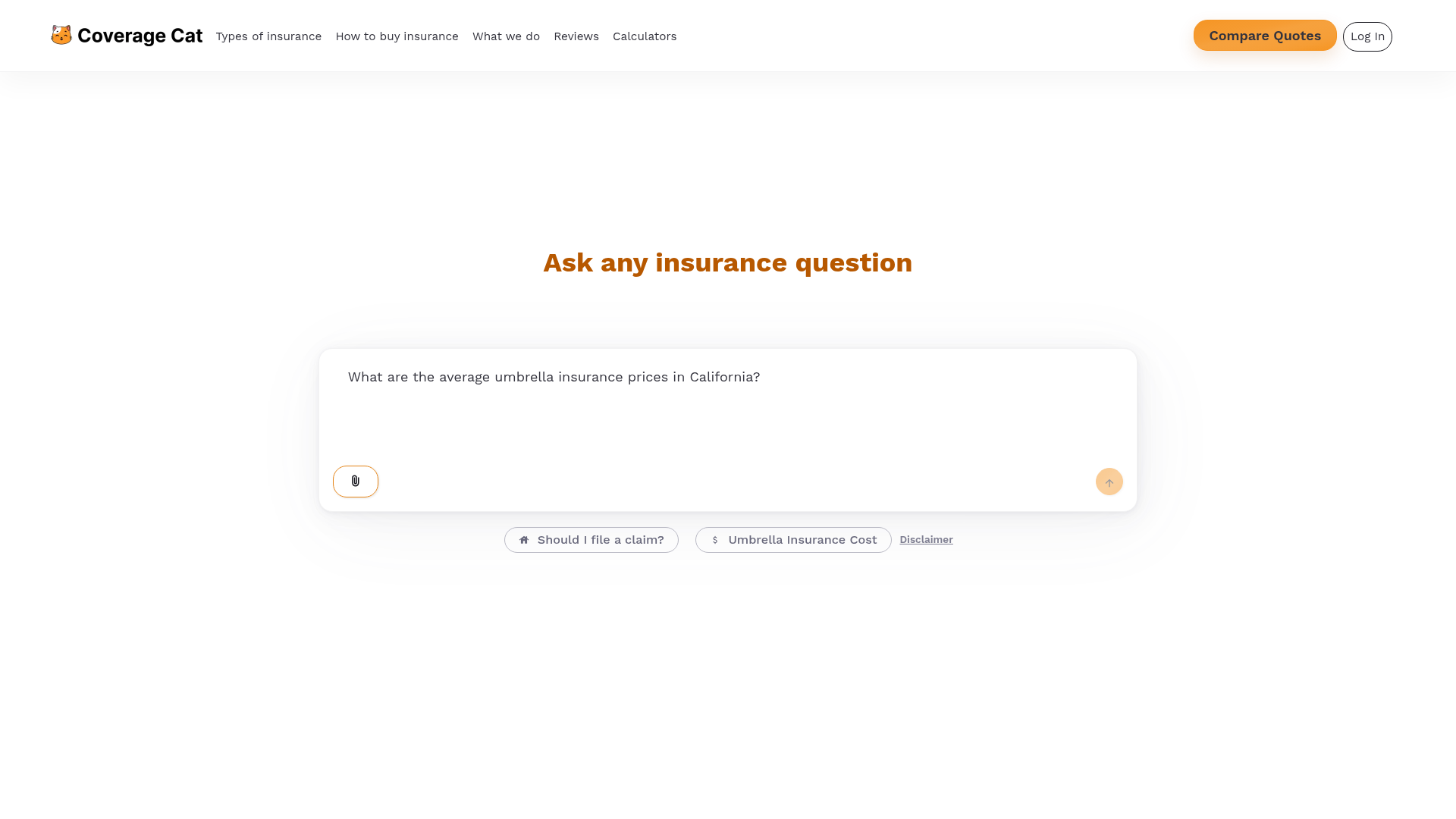
The company's public materials describe it as both an "AI Insurance Leaderboard" and a licensed broker that sells home and umbrella coverage (up to $10 million in liability). The website lets visitors "ask any insurance question" to an assistant, compare quotes, or connect their existing agent. But the most distinctive piece is the AI Skills section, which includes an "AI Insurance Leaderboard" that evaluates how frontier models perform on complex insurance tasks.
The AI Leaderboard: Benchmarking Frontier Models on Insurance Tasks
The leaderboard is the clearest signal of Coverage Cat's ambitions. It appears to grade models like GPT-4 or Claude on tasks that require navigating insurance complexity—things like deciding whether to file a claim, pricing umbrella liability limits, or explaining policy exclusions. The site does not disclose which models are ranked or what the current scores are, but the very existence of such a benchmark is notable.
Most insurance AI tools are black boxes: they promise to answer questions but offer no way to verify their competence. Coverage Cat flips that by publishing a scorecard. It is a way to say, "We don't just claim our AI is good; here is how it stacks up against the frontier." That is a bold move in a category where trust is the currency.
The leaderboard also serves a practical purpose. If you are going to let an AI help you buy insurance, you want to know it can handle edge cases—like a client with a home-based business or a rental property. Coverage Cat is essentially saying: we test for that, and we publish the results.
From Leaderboard to Licensed Broker: The Unusual Hybrid Model
Coverage Cat is not just a benchmark site. It is a licensed insurance broker (or producer) in the United States, with a California entity called Coverage Cat Insurance Services. The website lists license numbers and places coverage with a number of insurance companies, none of which are affiliates.
That means Coverage Cat sits on both sides of the table: it evaluates AI models, and it uses them (or at least offers an assistant) to sell actual policies. The hybrid model is unusual. Most AI insurance tools are either lead generators that sell your information to agents, or they are carriers like Lemonade that underwrite their own risk. Coverage Cat is a broker that uses AI to match you with coverage from other carriers, while also publishing research on how well AI can do that job.
The site emphasizes that it does not sell leads: "No sold leads" appears next to "Licensed insurance broker" and "Tens of thousands of users served." That is a direct jab at the lead-gen model that dominates online insurance. Coverage Cat wants to be the transparent alternative—the one that shows you options even when it does not get paid to sell them.
Why Insurance Is a Hard Test for AI
Insurance is a brutal domain for language models. Policies are dense, state regulations vary, and the stakes are high: a wrong answer about coverage limits or claim filing can cost a customer thousands of dollars. The site's own tools reflect this complexity—there are calculators for home insurance, umbrella liability, and even a "Should I file a claim?" assistant.
Benchmarking AI on these tasks is not just a marketing stunt. It is a serious engineering challenge. A model that can ace a general knowledge test may still fail to understand the nuances of a specific policy form or a state's filing requirements. Coverage Cat's leaderboard, if it is rigorous, could become a reference point for the industry—a way to measure whether AI is actually ready to handle insurance work.
The site does not disclose its methodology, which is a limitation. But the fact that it is attempting this at all puts it ahead of most competitors, who simply claim their AI is "trained on insurance data" without offering any proof.
The Cat Brand: Friendly Name, Serious Compliance
Coverage Cat is a deliberately friendly name in a category full of stern, institutional names like Allstate, State Farm, and The Hartford. The mascot—a cat with an umbrella—signals approachability and protection. It is a brand that says, "Insurance doesn't have to be scary."
But the friendliness is backed by serious compliance. The site lists its license numbers, has a detailed privacy policy, and includes disclaimers about its broker status. The name works because it is memorable and distinct, but it also carries a risk: in a trust-sensitive industry, a whimsical name might be mistaken for a novelty, not a real broker. Coverage Cat counters that with transparency—publishing reviews, license info, and even a leaderboard that shows its work.
The domain, coveragecat.com, is a clean .com that matches the name exactly. That is a small but meaningful signal of polish. The brand is cohesive: the cat is everywhere, from the logo to the tools, and it reinforces the idea that this is a company you can trust to look out for you.
What Coverage Cat Does That a Lead Form Cannot
The site's core promise is "more transparent than a lead form." It offers a quote workspace where you can compare home and umbrella packages side by side, see carrier price ranges, and get a "best fit" recommendation. You can also connect your existing agent, which is a clever way to lower the barrier for users who are not ready to switch.
The calculators are another differentiator. They are not just quote forms; they are decision tools. The "Should I file a claim?" calculator, for example, helps you weigh the long-term cost of a claim against the immediate benefit—something a lead form would never do. These tools position Coverage Cat as a resource, not just a sales funnel.
The site also has a blog, a glossary, and dozens of insurance company reviews. That content is classic SEO bait, but it is also genuinely useful. Coverage Cat is building a moat of information, and the AI leaderboard is the most ambitious piece of that content strategy.
Open Questions: Trust, Transparency, and the Limits of Benchmarking
Coverage Cat's approach is promising, but it raises questions. The leaderboard's methodology is undisclosed, so it is impossible to verify its rigor. The site claims "tens of thousands of users served" and a 100% 5-star Trustpilot rating as of June 2026, but those are self-reported and should be taken with caution.
The bigger question is whether an AI leaderboard actually translates into better customer outcomes. A model that scores well on a benchmark may still fail in the messy reality of a customer's specific situation. Coverage Cat seems to acknowledge this by pairing AI with human brokers—the site says it is a "licensed broker built around price transparency, privacy, and speed."
If Coverage Cat can maintain its transparency—publishing its benchmark methodology, updating the leaderboard, and showing how its AI performs in real sales—it could become a trusted name in the space. If it falls into the trap of vague AI claims, it will be just another chatbot with a cute mascot.
For now, Coverage Cat is worth watching. It is one of the few companies trying to make AI accountability a feature, not a footnote. That is a bet worth following.