Impact-Site-Verification: 41b53a0c-6d04-458b-a457-fe9e29acde1a

AI & Machine Learning·Unknown··6 min read

Enact

Post-training infrastructure that turns robotic failures into targeted data and evaluations.

NN

NewName Editorial

Editorial Team

Enact product image 1

Robotics models are notoriously brittle. They can master a simulation, ace a lab demo, and then stumble on a slightly different table height or an unexpected shadow. The common response is to throw more pre-training data at the problem — more hours of video, more simulated environments. But Enact, a Y Combinator-backed startup from Stanford, is betting that the real bottleneck is not pre-training. It's post-training: the targeted data and evaluations that turn a model that mostly works into one that reliably works in the real world.

The post-training gap in physical AI

Large language models have a well-established post-training pipeline: after pre-training on vast corpora, they undergo instruction tuning, RLHF, and safety evaluations to align them with human intent. Physical AI — robots that perceive and act — has no equivalent. A robotic model might be pre-trained on diverse sensor data, but it still needs to be adapted to specific tasks, environments, and edge cases. That adaptation requires data that is not just abundant but targeted: demonstrations of the exact skill, recovery behaviors when things go wrong, and evaluations that prove the model handles those situations.

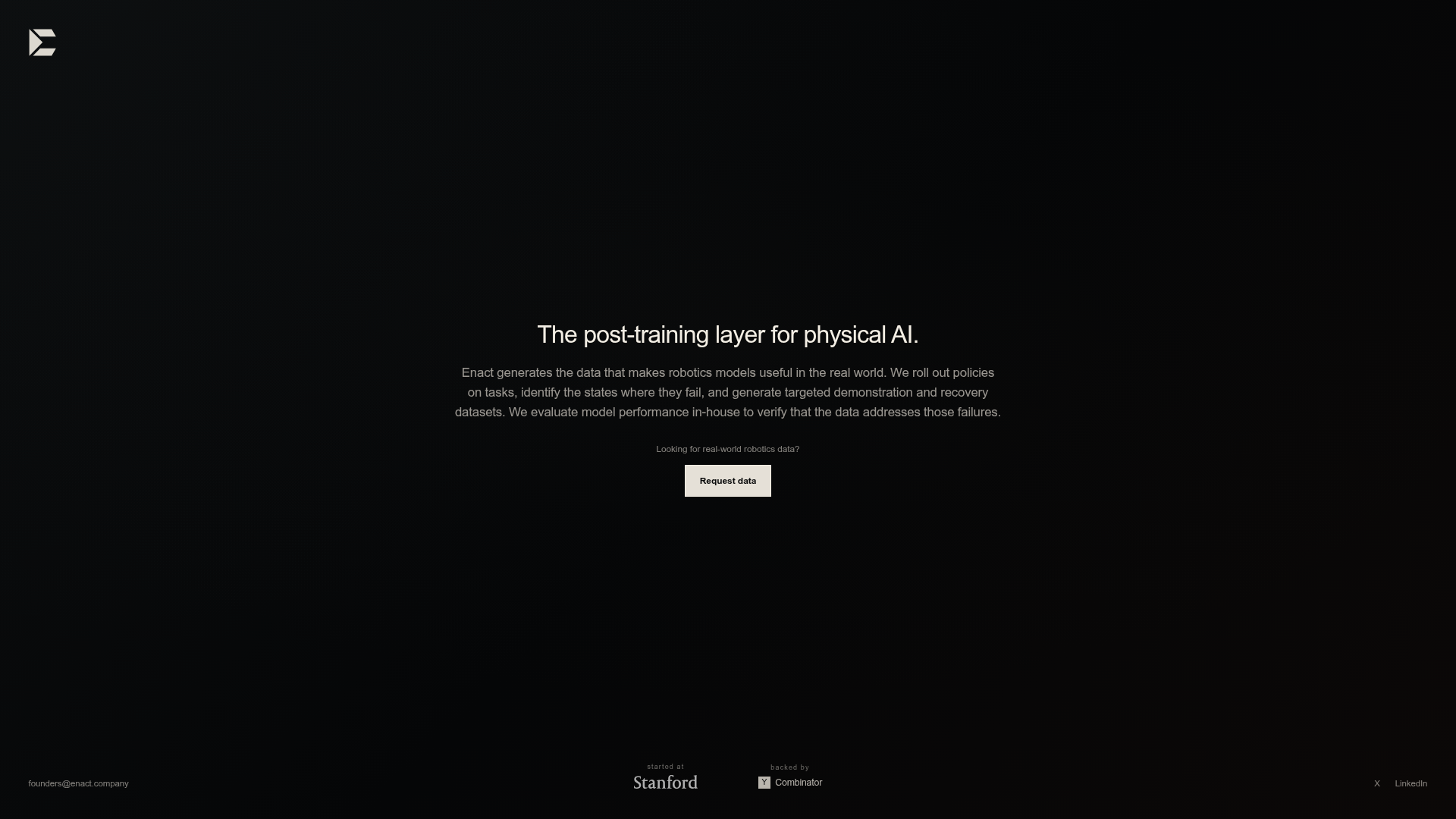
Enact's website states its mission plainly: "We roll out policies on tasks, identify the states where they fail, and generate targeted demonstration and recovery datasets." This is a post-training loop, not a data dump. The company doesn't just sell generic robotics data; it sells a process that starts with real-world deployment and ends with verified improvement.

How Enact finds the failure states

The core of Enact's approach is a failure-driven data generation cycle. Instead of hoping that a model generalizes from static datasets, Enact actively deploys policies on real tasks. During these rollouts, the system identifies the specific states where the model fails — a gripper missing an object, a path planner getting stuck, a recovery action that doesn't work. These failure states become the blueprint for generating new data.

For each failure, Enact generates two types of data: demonstrations (how to do the task correctly) and recovery datasets (how to get back on track after a mistake). This is a significant departure from typical data collection, which often focuses on success cases. By targeting failures, Enact ensures that the model learns not just the happy path but also the edge cases that cause real-world deployments to break.

The company's website emphasizes that this data is "targeted," a word that carries weight in a field where data quality often matters more than quantity. A model that has seen thousands of successful grasps but never a slip is still likely to fail on a slippery surface. Enact's data generation directly addresses that gap.

Why in-house evaluation matters for robotics data

Data is only half the equation. Enact also evaluates model performance in-house to verify that the generated data actually addresses the identified failures. This is a critical step that many data providers skip. They sell datasets and leave the evaluation to the customer. Enact, by contrast, closes the loop: it generates data, tests it, and only then claims that the model's reliability has improved.

This in-house evaluation capability is a competitive moat. It means Enact can iterate quickly — if a dataset doesn't fix a failure, they can generate new one and test again. It also gives customers confidence that the data they're buying is not just voluminous but effective. In a market where "we have more data" is a common pitch, "we can prove our data works" is a differentiator.

The evaluation focus also aligns with the broader trend in AI toward evals as a product category. For robotics, though, evals are trickier than for language models because they involve physical interaction. Enact's in-house testing suggests they have the infrastructure to handle that complexity.

The Stanford and Y Combinator signal

The website notes that Enact "started at Stanford" and is "backed by Y Combinator." These are not just badges; they signal a particular kind of credibility. Stanford's robotics and AI programs have produced some of the field's most influential research, and Y Combinator's backing provides not just capital but a network of founders and operators who understand go-to-market.

For a startup in the infrastructure layer, credibility is crucial. Robotics companies are often risk-averse when it comes to adopting new tooling — they need to trust that a data provider understands the nuances of physical AI. The Stanford and YC pedigree helps Enact open doors, but it also raises expectations. The company will need to deliver on its promise of reliability, not just talk about it.

What the name 'Enact' gets right — and the risk

The name "Enact" is a clever piece of branding. It suggests action, making something real, bringing a policy to life. It's a verb, which is fitting for a company that focuses on deployment and real-world performance. The domain, enact.company, is clean and memorable, though the .company TLD is still less common than .com or .ai. For a startup in the AI space, one might expect a .ai domain, but .company reinforces the practical, infrastructure-oriented positioning.

The name also has a subtle double meaning: "enact" can mean to perform or to carry out, which aligns with the idea of rolling out policies. It's not a name that screams "robotics" — it's more abstract, which could be a risk in a crowded market where names like "Robotics AI" or "Physical Intelligence" are more descriptive. But Enact's abstraction might be a strength: it positions the company as a layer that works across different robotics applications, not just one niche.

The risk is that the name is too generic. "Enact" could apply to any company that makes things happen — a project management tool, a legal tech startup, a productivity app. Without the tagline "Post-training infrastructure for robotics models," the name alone doesn't convey the category. This means Enact must invest heavily in brand awareness and rely on its website and marketing to tell the story.

Open questions for Enact's roadmap

Enact's website is minimal, and public materials do not disclose funding amounts, specific customers, or technical details. This is common for early-stage startups, but it leaves several open questions. How does Enact source its initial data? Does it use its own robots, or does it partner with robotics companies? How does it handle the diversity of robotic platforms — a humanoid arm, a drone, a warehouse robot — each with different sensors and actuators? The company's success will depend on its ability to generalize across these domains.

Another question is the business model. Enact offers "real-world robotics data" on request, but it's unclear whether it sells datasets, subscriptions, or services. The post-training infrastructure could be a platform that customers use to generate their own data, or it could be a data-as-a-service offering. The email address on the site suggests a consultative approach, but the long-term model is unclear.

Finally, the competitive landscape is heating up. Other startups and research labs are exploring similar ideas — using failure data to improve robotic policies. Enact's advantage lies in its focus on the full loop: data generation, evaluation, and iteration. If it can execute on that vision, it could become the default post-training layer for physical AI.

For now, Enact is a company to watch. Its thesis is sound, its approach is rigorous, and its branding is thoughtful. The robotics industry is waiting for the equivalent of RLHF for physical AI — Enact might just be building it.