hold your voice
A local-first tool that scans AI drafts, flags 250+ tells, and rewrites in your voice.
NewName Editorial
Editorial Team


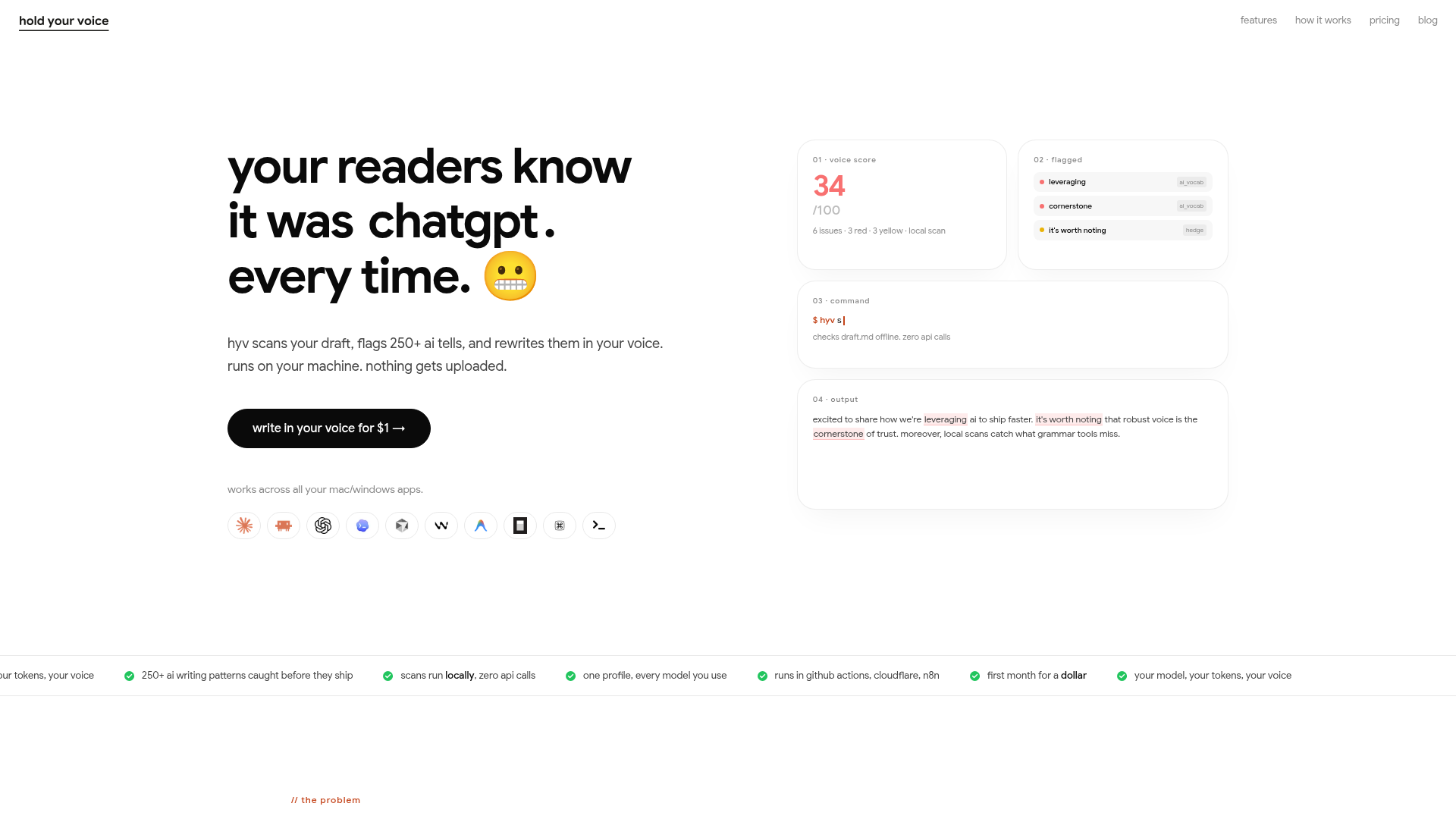
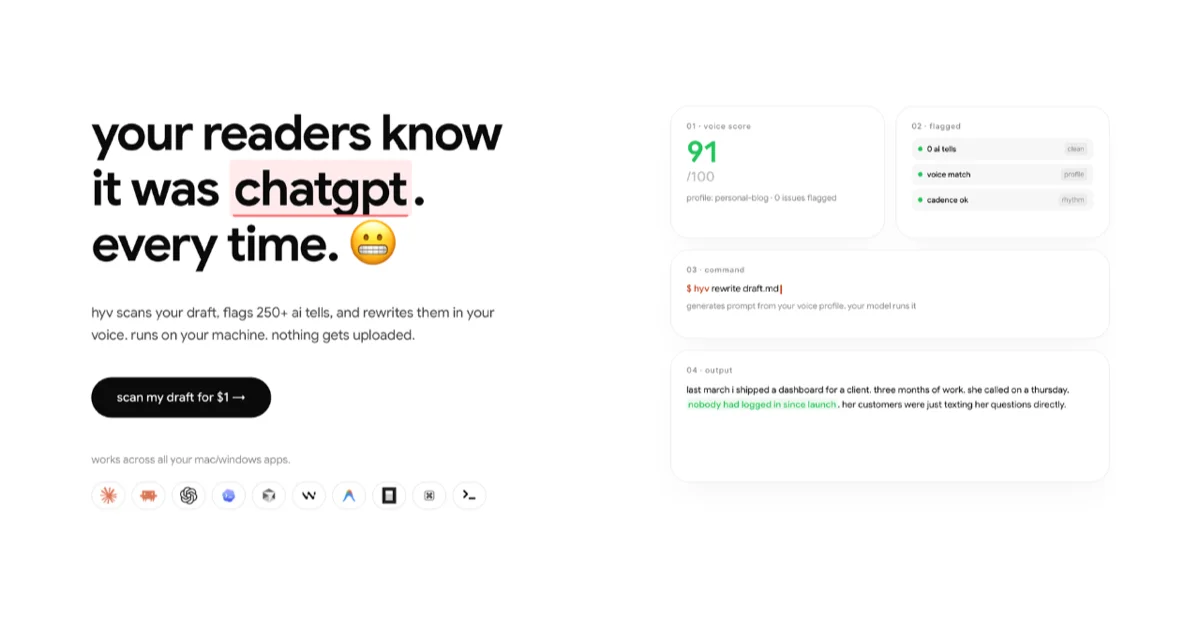
There's a moment every writer knows: you read a sentence you generated with an AI tool, and it's technically fine — but it's not you. It's too formal, too even, too safe. You can't always say why it's off; you just feel it. hold your voice (hyv) is built on the idea that this feeling can be made measurable and fixable. Instead of another AI writing assistant that generates more text, hyv is a scanner and corrector that runs locally, flags the tells that make AI writing sound generic, and rewrites it in your voice. The pitch is blunt: "your readers know it was chatgpt. every time." And the product's bet is that the problem isn't that you use AI — it's that you don't have a way to keep your voice intact while using it.
The quiet problem: voice drift is a feeling before it's a fact
The product's own copy describes the core issue with a kind of diagnostic precision: "you feel the drift — but you can't name it." Voice drift is what happens when a sentence reads wrong, but you can't pinpoint why. It's too formal, too flat, too safe. You rewrite it three times and still aren't sure you got there. There's no benchmark, just instinct. hyv's answer is to give that instinct a number: a voice score out of 100, with specific flags like "ai_vocab" for words like "robust" and "leverage," "hedge" for phrases like "it's worth noting," and "formulaic_connector" for "moreover." The site claims to catch 250+ patterns across vocabulary, rhythm, tone, and structure — including low burstiness (every sentence the same length) and a lack of personal storytelling. This turns an amorphous feeling into a concrete checklist. The example on the homepage shows a generic draft scoring 31/100, then a rewritten version scoring 89/100, with the difference being specific moments, short sentences, and no hedge words.
Why a prompt isn't a voice profile
One of hyv's sharpest arguments is against the common workaround of telling an AI to "write in my voice" via a system prompt. The site includes a chart showing voice match fading from 72% in week one to 38% in week four and 19% in week eight with a static prompt. The claim is that a prompt matches once and fades fast, because it has no memory of your vocabulary evolving. In contrast, hyv's voice profile is built from your actual writing samples, and every accept or reject teaches a "never-list" of patterns you don't want. The site claims the match climbs from 68% to 84% to 93% over the same period. This is a strong narrative: the product isn't a one-shot fix but a system that gets sharper with every edit. The learning loop is the part that makes it sticky — and the part that would be hardest to replicate with a simple prompt.
The local-first bet: zero uploads, 250+ patterns
hyv's most distinctive technical choice is that scans run locally, with zero API calls. The site repeats this in multiple places: "runs on your machine. nothing gets uploaded." For a tool dealing with writing — often private, often unpublished — this is a meaningful trust signal. It also has practical implications: no per-scan costs, no latency, and it works even if you're offline. The tradeoff is that hyv doesn't call its own LLM; instead, it tells your AI app how to rewrite. As the FAQ explains, "hyv tells your ai app how to rewrite. you use your own chatgpt or claude account." This means you pay for your own tokens, but it also means hyv can stay cheap — $1 for the first month, then $9/month, or a $79 lifetime deal. The local-first approach also enables automation: hyv runs in CI/CD, with commands like hyv scan content/ --fail-on-hit that can block merges in GitHub Actions, or hyv watch draft.md for live re-scans while you write. This positions hyv not just as a writing tool but as a quality gate for teams that publish a lot of AI-assisted content.
The workflow: scan, flag, fix, and the learning loop
The product's workflow is refreshingly concrete. Step one: drop in a draft — save your ChatGPT or Claude output to a file, or paste it into the terminal. Step two: run hyv scan to see the AI tells, line by line, with a score and specific flags. Step three: run hyv fix to swap what can be swapped locally, then your AI agent rewrites the rest using your profile. The example on the site shows a generic newsletter draft being transformed into a personal story about a client who never logged in. The key is that you're in control: accept, reject, or reinforce each rewrite, and the profile learns. This loop is what makes the tool more than a one-shot detector. It's also what makes it work across multiple AI apps — the site lists Claude, ChatGPT, Codex, Cursor, Windsurf, and more, and claims "one profile, every model you use." The MCP (Model Context Protocol) integration is auto-on for Cursor, Claude, and Windsurf, which lowers the setup friction.
The name says it: 'hold your voice' as a command and a promise
The name "hold your voice" is a small, deliberate act of branding. It reads as both a command — hold onto your voice, don't let it slip — and a promise: the tool will hold it for you. The lowercase, two-word format feels personal and slightly informal, matching the founder's story: "a solo founder who got tired of shipping ai slop." The domain holdyourvoice.com is clean and memorable, and the name itself is a thesis: the problem isn't AI, it's losing your voice to it. The tagline, "make ai writing sound exactly like you," is specific and benefit-driven. The name also implies a kind of stewardship — your voice is something to be preserved, not just generated. It's a positioning that sets hyv apart from generic "AI writing assistant" tools, which are about speed and volume. hyv is about identity and consistency, which is a more emotional sell.
What's missing and what's next
The site is transparent about some limitations: the free tier is just a $1 first month, and the lifetime deal is $79. There's no mention of team seats beyond the $29/month plan, and the FAQ notes that only the voice profile and learning signals are stored server-side — drafts stay local. What's not disclosed is the technical implementation of the 250+ patterns, or how the voice profile is built from samples. The blog hints at ongoing development, with posts like "how we fixed voice memory so rewrites learn from you," suggesting the learning loop is an active area of work. The product is clearly early-stage, built by one person, and the roadmap is likely to be shaped by user feedback. For now, hyv is a focused tool for a specific pain: making AI writing sound less like AI and more like you. Whether it can scale beyond solo creators to teams remains an open question, but the local-first, profile-driven approach is a genuinely different answer to a problem that every AI-assisted writer knows.