Instance
Automated success detection for robot policies, turning raw rollouts into trusted training data.
NewName Editorial
Editorial Team
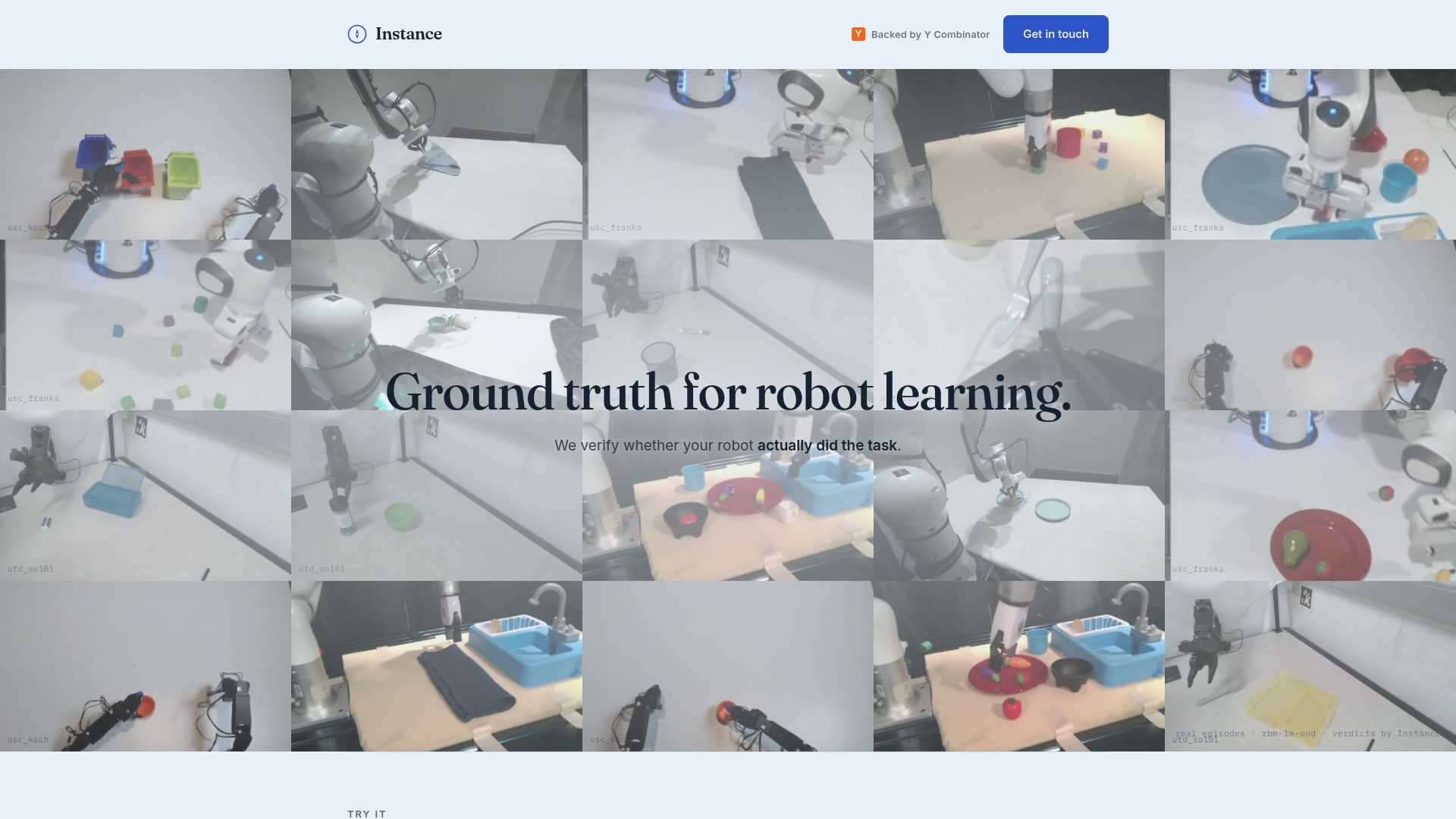
The hardest part of robot learning isn't the neural network. It's the boring, human-heavy work of watching a robot try to fold a towel or stack a cube, deciding whether it actually succeeded, and then resetting the scene for the next attempt. Instance, a Y Combinator-backed startup founded by MIT computer scientists, is attacking that bottleneck head-on with what it calls a "success detector" — an automated verification layer that looks at camera footage and returns a verdict on whether the robot truly completed the task.
The pitch is deceptively simple: instead of humans marking success and failure, Instance's verifier does it automatically. The company's website is full of examples like "Fold the towel in half" or "Put the yellow plate in the sink," each paired with a robot arm from labs like MIT and USC. The tagline — "Ground truth for robot learning" — captures the ambition: to become the trusted source of truth for whether a robot actually did what it was asked.
This is not a flashy robotics demo. It's infrastructure for the messy middle of robot learning, where data quality determines policy quality. And Instance is making a specific bet: that the success detector is the wedge into a much larger data pipeline.
The human bottleneck in robot learning
Robot policies are trained on demonstrations and rollouts, but evaluating whether a rollout succeeded is a manual chore. A human has to watch the video, decide if the robot achieved the goal, and then reset the scene — often physically rearranging objects — before the next episode. This is slow, expensive, and doesn't scale.
Instance's Y Combinator launch description states it plainly: "Today, evaluating a robot policy means humans have to watch the robot roll out, mark success, and reset the scene – we're automating that." The company is not trying to improve the robot's control or perception; it's targeting the evaluation step that happens after the rollout.
The problem is real. In robotics research labs, evaluation is often done by graduate students who spend hours watching videos and ticking boxes. It's tedious, prone to inconsistency, and creates a bottleneck that slows down the entire training loop. If you can't quickly know which rollouts succeeded, you can't filter your data, and your policy training suffers.
Instance's approach is to replace that human judgment with an automated verifier that can process any episode, from any robot, at any camera angle. The website emphasizes "any robot, any camera angle," suggesting a generalizable system rather than one tuned to a specific setup.
What a verdict actually contains
Instance's demo console gives a concrete sense of what the product looks like. It shows a queue of episodes, each labeled with an ID, the robot used (e.g., mit_franka, usc_xarm), and the duration. The user can pick an episode and "run the verifier" to get a verdict.
The verdict is not just a binary success/fail. The website says: "Given a task and camera footage, we return a success verdict with evidence." That word — evidence — is crucial. It implies that Instance's system doesn't just guess; it provides some form of justification for its decision, which is essential for building trust in an automated evaluation system.
The demo also includes a "record" feature for live rollout capture, suggesting that Instance can integrate into a real-time data collection pipeline, not just post-hoc analysis.
This is a step beyond simple binary classification. In robot learning, a success detector needs to understand the semantics of the task — "fold the towel in half" requires a different judgment than "stack the red cube on the gray cube." Instance's examples span a wide range of manipulations: pouring, stacking, folding, placing, separating. The verifier has to handle all of them.
Why the success detector is the wedge
Instance's tagline is "Automated evaluation for robot policies, starting with the success detector." The phrase "starting with" is a tell. The success detector is not the end goal; it's the entry point.
The logic is straightforward: if you can automatically verify whether a robot completed a task, you can then filter your rollouts into trusted data. That trusted data can be used to train better policies, which generate more rollouts, which need more verification. Instance becomes the verification layer in a virtuous cycle.
The website's flow diagram makes this explicit: "raw rollouts → verdicts → trusted data → better policies." Instance positions itself as the layer that turns raw, noisy rollouts into a clean, reliable dataset.
This is a classic wedge strategy: solve one painful problem (evaluation) to become indispensable in a larger workflow (data pipeline). For robotics labs and companies that are scaling up data collection, the success detector could be the first piece of infrastructure they adopt.
The fact that Instance is backed by Y Combinator and founded by MIT researchers with backgrounds at SpaceX, AWS, and NASA JPL lends credibility. These are people who understand both the research side and the engineering side of robotics.
The demo console as a trust device
Instance's website includes an interactive demo console that shows a queue of real episodes and allows users to "verify your own" episodes. This is a smart trust-building move. Instead of just claiming the technology works, Instance lets potential customers see it in action.
The console displays episodes from different robots (mit_franka, usc_xarm, etc.) with tasks like "Put the marker into the pen cup" or "Separate the red and orange cups." Users can run the verifier on any episode and see the verdict.
This transparency is important in a field where trust in automated evaluation is a barrier to adoption. Researchers and engineers are used to human judgment; they need to see that an automated system can be reliable. The demo console is a low-friction way to build that confidence.
It also positions Instance as a tool that works across different robot platforms, which is a key selling point. Robotics labs often have multiple robot arms, and a verification tool that only works on one would be limiting.
The data flywheel Instance is betting on
Instance's long-term bet is that by automating evaluation, it can accelerate the entire robot learning cycle. The company's vision is to become the "verification layer" for robot data, enabling faster iteration and more reliable policies.
The flywheel works like this: better verification leads to better data, which leads to better policies, which lead to more capable robots, which generate more data — and the cycle repeats. Instance wants to be the essential infrastructure in that loop.
There are risks, of course. The success detector itself needs to be accurate and generalizable across different tasks and environments. If it makes mistakes, it could poison the training data. But Instance's focus on evidence-based verdicts suggests they are aware of this challenge.
Another risk is competition: other companies and research groups are working on automated evaluation for robotics. But Instance's early focus on the success detector, combined with its YC backing and strong founding team, gives it a head start.
For now, Instance is a seed-stage company with a clear thesis: the bottleneck in robot learning is not the policy, but the evaluation. By automating the success detector, they aim to unblock the data pipeline and become the ground truth for robot learning. Whether they succeed will depend on how well their verifier performs in the messy, varied world of real robot rollouts. But the direction is smart, and the timing is right.