Impact-Site-Verification: 41b53a0c-6d04-458b-a457-fe9e29acde1a

AI & Machine Learning·seed··6 min read

Liquid Interactive

Liquid Interactive turns static photos into interactive visual assets, betting AI's next interface is visual, not verbal.

NN

NewName Editorial

Editorial Team

Liquid Interactive product image 1
Liquid Interactive product image 2

The dominant interface of the AI era has been the text box. You type, it answers, you type again. But Liquid Interactive, a Toronto-based startup emerging from AXL Venture Studio, is making a different bet: that the next meaningful AI interaction won't be a conversation at all, but a visual object you can grab, rotate, and pull apart.

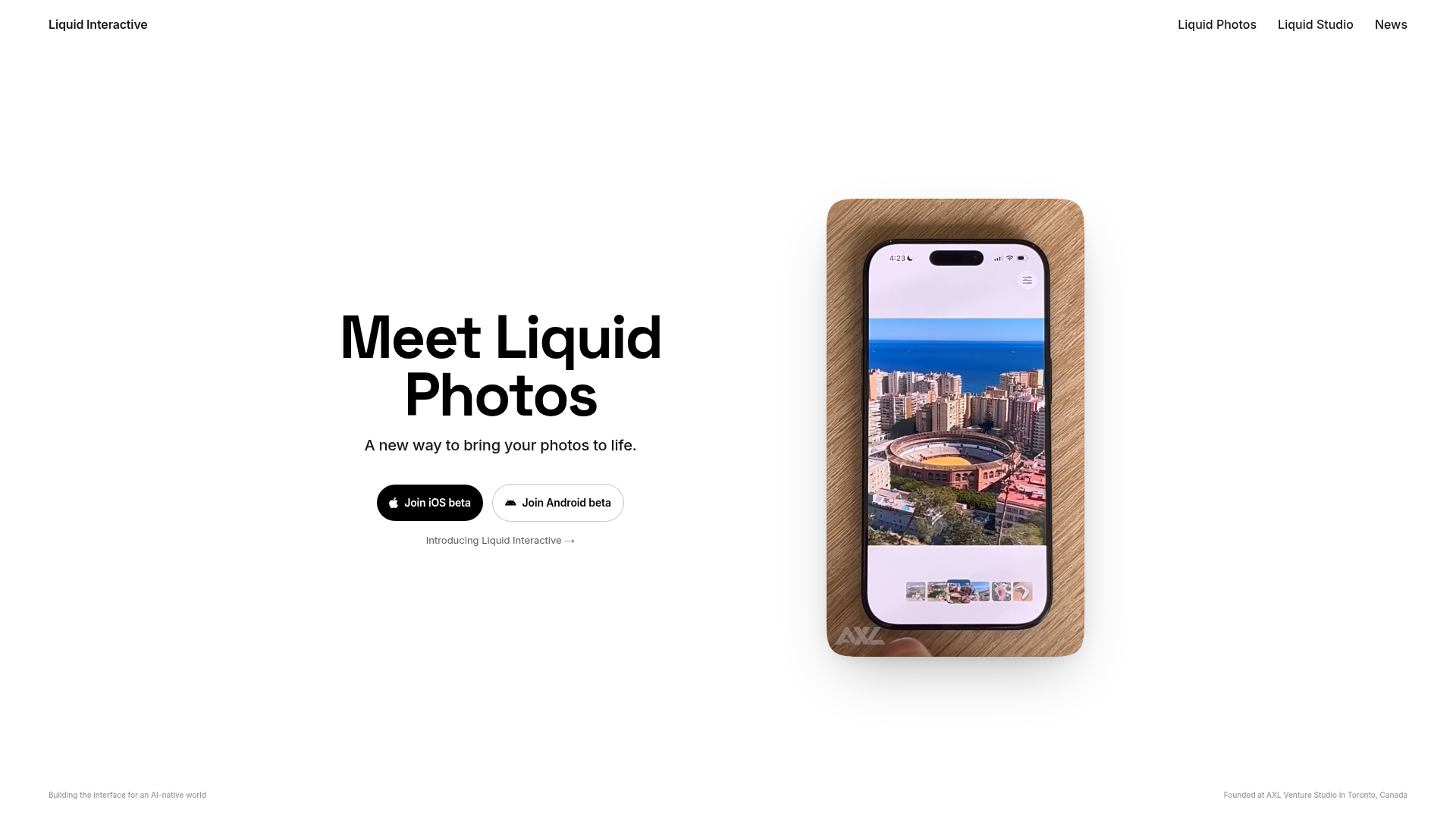
Its first product, Liquid Photos, is a consumer app that applies generative AI to the photos already sitting in your camera roll. The pitch is not to create new images, but to make existing ones behave like living, layered scenes. The company calls this 'changing how people use AI by making visual media more interactive.' It's a phrase that sounds like marketing, but the underlying shift is real: instead of asking an AI to describe or generate, you're asking it to let you reach into a photo and manipulate its components.

This is not another AI photo editor. It's an attempt to build what the company calls 'the interface for an AI-native world' — and that ambition deserves a closer look.

The text-box ceiling

For all the progress in generative AI, the user experience has remained stubbornly linguistic. You prompt, you wait, you iterate. Even image generators like Midjourney or DALL-E are driven by text prompts; the output is a static image, and your control ends at the moment of generation.

Liquid Interactive's founders, Sasha Ivanov and Ben Pearman, previously built Maple Scan, a document-scanning app. That experience taught them where the friction is: users don't want to describe what they want; they want to touch and manipulate the content directly. The text box is a ceiling, not a floor. It limits the kinds of interactions you can have with media, especially for non-technical users who don't think in prompts.

Liquid Photos is a direct response to that ceiling. Instead of typing 'make the background blurry,' you might rotate the photo in 3D space or split it into layers. The AI is doing heavy lifting, but the user's mental model is physical, not verbal.

From Maple Scan to Liquid: a pivot worth parsing

The founding team's background is in utility software, not visual art. Maple Scan was a practical tool for digitizing documents. That might seem like an odd prelude to a generative AI photo app, but it explains the company's focus on interaction over generation.

Maple Scan users were comfortable with a camera-based workflow: point, shoot, and the software processes the image. Liquid Photos extends that logic. The camera roll is your input; the AI is the processing layer; the output is an interactive asset. The pivot from scanning documents to animating photos is less strange when you see it as a move from static capture to dynamic manipulation.

Public materials suggest the company is positioning this as a broader platform, not just a consumer toy. The website lists 'Liquid Studio' alongside 'Liquid Photos,' hinting at a future where businesses create interactive demos and visual assets. But for now, the consumer app is the wedge.

What Liquid Photos actually does to a JPEG

The core promise is simple: take a photo from your camera roll and turn it into a dynamic visual asset. The company's description mentions two specific features: 3D rotation and component splitting.

3D rotation means the photo gains depth. Instead of a flat image, you can tilt it or view it from an angle, as if it were a three-dimensional object. Component splitting is more intriguing: the AI identifies distinct elements in the photo — a person, a car, a tree — and separates them into independent layers. You can then move, hide, or manipulate each component without affecting the rest of the image.

This is not the same as background removal, which is a binary operation. Splitting implies a more granular understanding of scene composition. The AI has to recognize not just what's in the photo, but how the elements relate spatially and semantically. That's a harder problem, and it's where the company's patent claims come in.

The beta is currently available for iOS and Android, though the site doesn't specify a timeline for a full release. The app's success will depend on how well the AI handles the messiness of real-world photos — low light, odd angles, cluttered backgrounds.

The AXL studio effect: speed over polish

Liquid Interactive was founded at AXL Venture Studio in Toronto. AXL is not a traditional VC; it's a studio that builds companies from scratch, providing operational support and capital in exchange for equity. The founders didn't arrive with Liquid Interactive fully formed; they built it inside AXL's system.

This origin story matters for two reasons. First, it explains the speed: the company went from concept to beta relatively quickly, leveraging AXL's infrastructure. Second, it suggests a willingness to pivot. Maple Scan was likely AXL's first bet with these founders; Liquid Interactive is the second. The studio model allows for rapid iteration without the pressure of a standalone seed round.

The tradeoff is that Liquid Interactive is still early. The website is minimal, the product is in beta, and the company's long-term strategy is not fully public. But the AXL backing provides a runway that many solo founders lack.

Naming the shift: why 'Liquid' fits

The name 'Liquid Interactive' is a deliberate break from the 'GPT' and 'AI' suffixes that dominate the space. 'Liquid' suggests fluidity, motion, and adaptability — exactly what the product aims to do to static images. It's a visual metaphor, not a technical one. The name doesn't tell you it's an AI company; it tells you it's an interaction company.

The domain, liquidinteractive.ai, reinforces the AI connection without being generic. It's a brand that could extend beyond photos to other visual media, which aligns with the company's stated goal of making 'visual media more interactive' — not just photos.

The risk is that 'Liquid' is a common word, and the brand might get lost in a sea of similarly abstract startup names. But in the context of AI, where names like 'Anthropic' and 'OpenAI' signal intelligence, 'Liquid' signals something else: tactility. That's a differentiator.

Open questions before the beta wave

Liquid Photos is an intriguing concept, but several questions remain. First, how well does the AI handle real-world photos? The demo features are impressive, but the beta will reveal the failure modes. Second, what's the business model? The site doesn't mention pricing, and consumer photo apps have a history of struggling to monetize. Third, how does this differ from what Apple or Google might build natively? Both platforms have been adding AI photo features, and a standalone app needs a compelling reason to exist.

Finally, the company's ambition to go beyond text-based AI is admirable, but it's a hard sell. Users are conditioned to type. Getting them to manipulate photos in 3D space requires a shift in behavior, not just a new feature.

For now, Liquid Interactive is a bet on a different kind of AI interaction. If it works, we'll stop thinking of AI as a chat partner and start thinking of it as a material we can shape. If it fails, it'll be a footnote in the history of AI interfaces. Either way, it's worth watching.