AISA Sells Free Measurement, Then $10 Credits and WhatsApp Coaching
From Ozan Dagdeviren's psychometrics background to a dual-track conversational assessor: how AISA's free 20–45 minute AI fluency interview, $10 employer credits, and $19/mo WhatsApp coach—not a naming scorecard—turn AI literacy measurement into a hiring and L&D business.
NewName Editorial
Editorial Team
AI literacy vendor marketing still sells multiple-choice badges, self-assessment surveys, and week-long Coursera certificates that test recall. AISA sells those surfaces too—a LinkedIn-ready credential, a leaderboard, persona labels—but the durable bet is quieter. AISA is a conversational AI fluency measurement company whose wedge is a free 20–45 minute interview with an AI named Aisa, and whose revenue is employer assessment credits, certificate unlocks, and WhatsApp coaching subscriptions. Judge it on whether the conversation produces evidence-backed scores you would act on in hiring or L&D—not on whether "AISA" clears a generic brand-naming worksheet.
The insight was psychometrics, not a quiz bank
Ozan Dagdeviren built AISA after living both sides of talent measurement: designing assessments that hold up statistically, and hiring senior technical talent at scale as a recruiter and product leader. His background spans psychometric test design, psychology and sociology (BA), behavioural science, people strategy (author of Startups Grow With People and Creative Hiring—60,000+ copies sold), Head of Product roles scaling products to 1M+ users, and teaching creative problem solving at the European School of Economics in London.
The thesis that stuck, laid out in his April 2026 Medium essay: AI fluency is behavioural, not memorisable. Anthropic's 2026 AI Fluency Index—nearly 10,000 conversations analysed—found the gap between effective and ineffective users is how people prompt, verify, and integrate AI into decisions, not textbook knowledge. The U.S. Department of Labor's AI Literacy Framework (TEN 07-25) defines 25 sub-competencies across five content areas; AISA maps them into 11 scored criteria across five dimensions. AISA claims 93% overlap with Anthropic's observable fluency markers plus four dimensions chat logs alone cannot surface (AI fundamentals, tool landscape, domain application, safety).
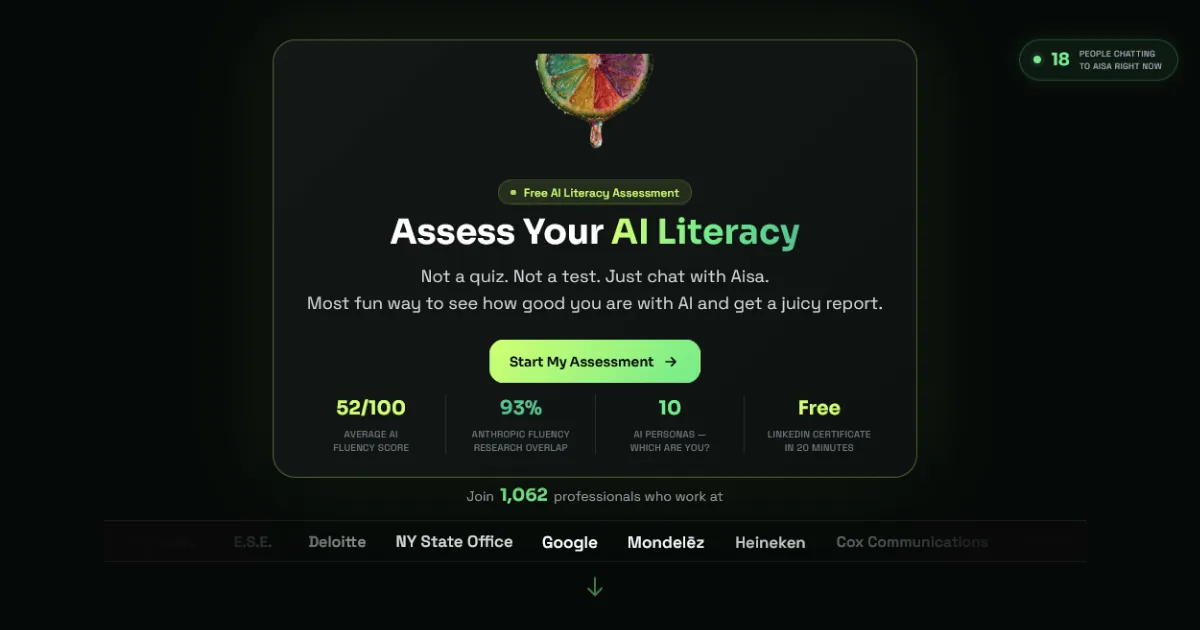
That framing explains why AISA is a conversation, not a question bank. Multiple-choice tests go stale weekly, reward Googling, and cannot probe whether someone iterates on output or accepts the first response. AISA's early data—1,017+ completed assessments as of the published methodology page—shows an average fluency score of 52/100, a real range of 0–98, and only 1.7% reaching Expert tier. Most professionals have blind spots they cannot see without measurement.
Advisors anchor the commercial side: Mehmet Yalcin (Director of Products, The Guardian), Andrew Olaleye (founder, Remarkable AI—1,300+ clients), Tunca Ulubilge (Staff Engineer, Shopify), and Meir Benezra (co-founder, Luka; Agent Experience Design). Featured on Product Hunt, There's an AI for That, Hacker News, and similar launch channels.
Product: dual-track conversation, triple-layer scoring
The assessment architecture is AISA's moat—not a slide about "AI-powered AI."
Track A (Conversationalist) is the only AI the candidate sees. Aisa conducts an adaptive 20–45 minute dialogue (up to 60 if the candidate goes deeper), adjusts to role context—developer, PM, designer, data scientist, or general knowledge worker—and follows up on vague claims with scenarios. Track A does not score anything.
Track B (Evaluator) runs silently on every message, extracting verbatim evidence quotes against the published rubric. Scoring uses three layers (methodology, architecture blog):
- Evidence extraction — per-message scoring with confidence levels; evidence classified as demonstrated > described > managed.
- Confidence-weighted aggregation — multiple evidence pieces blended; consistency weighted over single brilliant answers.
- Holistic calibration pass — a more capable model (Claude Opus) reviews the full transcript and adjusts scores only with disconfirming evidence.
Separating conversation from evaluation avoids the bias of a single model asking and judging the same answers.
Five dimensions, 11 criteria (each scored 1–10 with published behavioural anchors):
| Dimension | Criteria |
|---|---|
| Prompting & Communication | P1 Prompt Design, P2 Iterative Dialogue, P3 Context & Memory Management |
| Critical Thinking | T1 Output Evaluation, T2 Limitation Awareness |
| Technical Understanding | U1 AI Fundamentals, U2 Tool Landscape |
| Workflow & Application | W1 Workflow Integration, W2 Task Decomposition, W3 Domain Application |
| Safety & Responsibility | S1 AI Safety & Responsibility |
Outputs: composite score (0–100), one of 10 AI personas (The Oracle, Architect, Builder, Conductor, Tactician, Enthusiast, Sceptic, Copy-Paster, Dabbler, Bystander), evidence-linked report, optional leaderboard entry (explicit opt-in only).
Anti-gaming is architectural, not proctoring: burst paste detection (<50ms keystroke windows), mid-session style shifts, five-metric AI fingerprinting (correction rate, edit density, message length, formality, uniformity), and consistency probes across varied angles on the same topic. Voice-to-text is detected and not penalised.
Infrastructure: Supabase (PostgreSQL, EU AWS eu-west-1), Vercel edge deployment, TLS encryption, data not sold or used for model training (FAQ privacy).
Business model: free individual flywheel, paid proof and coaching
AISA's revenue logic is a classic measurement-led funnel—free assessment builds trust and viral sharing; employers pay for scale; individuals pay for credentials and ongoing upskilling.
| Segment | What's free | What costs money |
|---|---|---|
| Individual professional | Full conversational assessment; score, persona, strengths/gaps; full deep-dive report with benchmarks and action plan; optional leaderboard | Certificate unlock: $10 one-time (PDF, LinkedIn share, QR verification, 12-month validity) |
| AI Coach (individual) | 7-day free trial after assessment | $19/month (or $14/month annual); WhatsApp coaching from Aisa built on your report; 2 reassessment credits included |
| Employer / L&D | Take the assessment yourself before buying credits | $10 per assessment credit—flat rate at any volume; pay-as-you-go, credits never expire, no subscription |
| Enterprise bundles | Contact sales | Bundled credits, AI Fluency Dashboard (org score, team breakdown, industry benchmarking, board-ready reports), guided kickoff, platform seats |
The individual free tier is deliberate distribution. Professionals experience the product, share personas on LinkedIn, and surface the tool inside companies—then HR buys credits to benchmark teams or screen candidates. Employer-invited assessments include the full report for candidates (no separate unlock)—reducing friction in hiring workflows.
Team use cases (team page): workforce AI readiness benchmarking, department gap analysis, targeted training roadmaps (not generic courses), and pre-interview screening. The pitch: you cannot improve what you have not measured.
Monetization expansion path is clear: assessment credits for B2B volume, certificate for individual credentialing, WhatsApp Coach for retention and upsell. Coaching on WhatsApp meets users where they already chat—no new LMS login required.
Competitors: hiring tools with AI add-ons vs AI-native measurement
AISA positions against general assessment platforms, not Coursera certificates.
| AISA | HackerRank / TestGorilla | HireVue / Sapia | Coursera / Google AI certs | |
|---|---|---|---|---|
| Core focus | AI fluency as primary product | Coding/tests; AI as add-on or absent | Video/async hiring; limited AI depth | Knowledge courses; MC exams |
| Format | Fully conversational, adaptive | MCQ, coding challenges | Video, structured interviews | Fixed curriculum + exam |
| What it measures | 11 behavioural criteria across 5 dimensions | Technical skills, general aptitude | Personality/fit proxies | Theoretical recall |
| Team dashboard | Native AI Fluency Dashboard | Limited AI-specific analytics | Hiring pipeline, not L&D benchmarking | Course completion, not behaviour |
| Anti-gaming | Paste/style/AI fingerprint architecture | Proctoring, plagiarism checks | Partial | N/A (knowledge tests) |
| Certificate | Verifiable, persona-linked, 12-month | Platform badges | N/A | Brand-recognised but behaviour-blind |
| Pricing shape | $10/credit flat; free individual tier | Per-assessment or seat subscriptions | Enterprise contracts | Course fees ($39–$99+) |
Choose AISA when you need standardised, evidence-backed AI fluency data across roles—hiring screen, workforce baseline, or L&D gap analysis—and conversational depth matters more than a Google-able MCQ.
Choose HackerRank or TestGorilla when the hire is primarily software engineering or role-specific technical tests; add AISA only if AI workflow fluency is a separate hiring criterion.
Choose HireVue or Sapia when async video and structured hiring workflows dominate; accept that AI fluency is not the core signal.
Choose Coursera or Google certificates when you need HR-system-recognised credentials for compliance checkboxes—not when you need to know how someone actually verifies ChatGPT output on Tuesday afternoon.
China: global AI fluency benchmark vs domestic cert gravity
AISA's China story is not "AISA 中国." It is cross-border teams and Chinese professionals competing on global AI fluency signals—a different problem from mainland training-certificate bureaucracy.
What AISA does well (出海 / global knowledge workers):
- Chinese AI product teams, indie SaaS founders, and remote engineers targeting US/EU employers increasingly need demonstrable AI fluency, not another internal training checkbox. AISA's free assessment + LinkedIn certificate is low-friction proof.
- The rubric aligns with Anthropic's empirical fluency research and the U.S. DOL framework—frameworks global HR and L&D teams reference in 2026 AI upskilling mandates.
- EU data residency (Supabase eu-west-1) and published privacy policy give GDPR-facing teams a path without building internal assessments.
- Role-adaptive questioning and non-native English calibration (scoring substance over style) matter for bilingual professionals whose AI skill exceeds their interview English.
What AISA does not replace (境内场景):
- Mainland corporate AI training compliance often flows through domestic platforms, government-aligned curriculum, or vendor relationships with 钉钉、飞书、企业微信 ecosystems—not a
.todomain assessment link. - PIPL applies to conversational data containing personal identifiers; EU hosting does not automatically satisfy mainland cross-border transfer reviews for employee assessments.
- Employers optimising for 国内 HR 系统认可的证书 may still prefer 工信部、人社部相关培训项目 or established vendor badges over a startup conversational credential—regardless of measurement quality.
- WhatsApp coaching requires WhatsApp access; WeChat-native coaching is a different channel AISA has not built.
Practical split-stack for Chinese teams:
| Audience | Typical approach | Why |
|---|---|---|
| Global hire / LinkedIn profile | Free AISA assessment + $10 certificate | Verifiable, English-first credential |
| Mainland enterprise L&D | AISA for baseline + domestic vendor for compliance reporting | Measurement vs paperwork |
| Cross-border team (CN eng, US HQ) | Employer credits + Fluency Dashboard | Apples-to-apples AI fluency across offices |
| Individual upskilling | AI Coach on WhatsApp (if accessible) | Personalised gap coaching post-assessment |
Reality: AISA wins the behavioural measurement niche for global AI fluency; mainland enterprise procurement still rewards domestic cert gravity and local platform integration.
The name and domain (briefly—facts beat folklore)
- "AISA" doubles as the product brand and the AI interviewer's name (Aisa)—short, memorable, persona-friendly. Tagline on site: critical-thinking AI skill measurement.
aisa.touses Tonga's.toTLD—a domain hack ("go to AISA") rather than the.aimany AI startups chase. Trade-off: less instant AI-category signaling, but the name carries the AI adjacency.- The old showcase template spent pages on TLD scorecards. The business fact: distribution runs through assessment quality and LinkedIn sharing, not domain extension theology.
What to verify before your team standardizes on it
-
Validity for your use case. Run five hiring managers through the assessment; compare scores to how those managers actually use AI weekly. AISA publishes rubrics and a self-audit against AERA/APA/NCME standards—but your org still needs face validity.
-
Employer vs individual pricing. Your candidates get full reports when you invite them; self-serve individuals pay $10 for certificate unlock. Budget both credit lines and certificate expectations in employer branding.
-
Conversational bias. Articulate candidates may score higher than equally skilled quiet ones. Review evidence quotes in reports, not just composite numbers.
-
Certificate shelf life. Credentials expire at 12 months—appropriate for fast-moving AI tooling, but plan re-assessment cycles for L&D tracking.
-
China audience split. Mainland employee assessments may need domestic compliance review regardless of how strong the conversational rubric reads in English.
AISA's competitive edge is not the loudest slide in an "AI upskilling" webinar. It is psychometrics-grade conversational measurement with a free individual wedge, $10 employer credits, and WhatsApp coaching retention—built by someone who has designed hiring assessments and recruited 200+ senior engineers. Price the measurement first; verify the evidence quotes match how your team actually works with AI before you replace a multiple-choice checkbox with a persona label.