EasyChef Sells Pantry-First Recipes, Not Another Search Engine
EasyChef.ai flips recipe apps: input pantry ingredients first, get AI meals matched to diet, equipment, and cuisine—€2.99/mo or €29.99/yr after a 3-day iOS trial. 1,000+ home cooks; Android coming soon.
NewName Editorial
Editorial Team
Most recipe apps start with a dish you saw on Instagram, then send you shopping. EasyChef inverts the flow: tell it what's already in your kitchen, and it generates meals that use those ingredients—filtered by diet, cookware, and cuisine. Judge it on whether it actually reduces grocery runs and waste for your household—not on whether "EasyChef" wins a generic .ai naming contest.
Product philosophy: waste reduction as the business hook
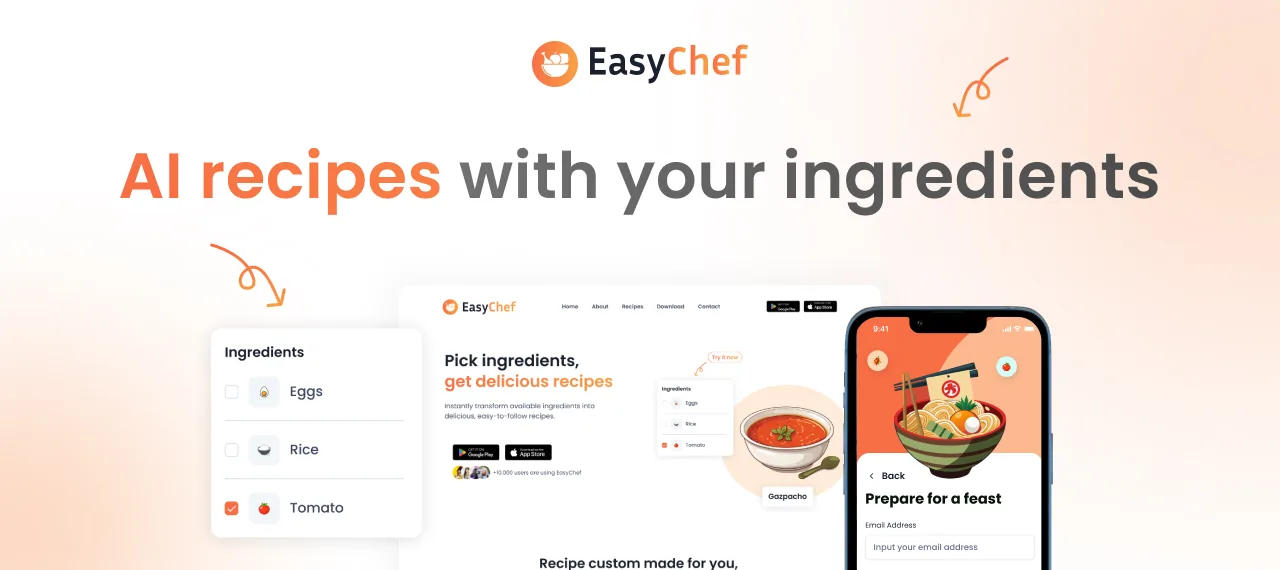
EasyChef's homepage frames the job plainly: "Never wonder what's for dinner again" and "Save money by reducing food waste" (easychef.ai). The workflow is three steps:
- Select ingredients you have and want to use.
- Browse AI-generated recipes matched to preferences.
- Cook from step-by-step instructions.
Core modules beyond generation (site):
| Module | User job | Revenue tie-in |
|---|---|---|
| Pantry inventory | "What can I cook tonight?" | Habit loop—empty pantry = churn |
| Recipe discovery | Global cuisines + diet filters (gluten-free, paleo) | Subscription justifies personalization depth |
| Collections | Save repeat dinners | Retention |
| Smart shopping lists | Recipe → organized grocery run | Bridges cooking → purchase (future affiliate?) |
| Equipment awareness | No air-fryer recipes if you only have a microwave | Reduces failed cooks → bad reviews |
The FAQ states EasyChef uses "advanced AI" to analyze pantry inputs—standard consumer positioning without model disclosure. The differentiation is constraint satisfaction (ingredients + tools + diet), not gourmet photography.
Business model: freemium subscription on mobile
Pricing is explicit on the site (FAQ):
- iOS: 3-day free trial, then €2.99/month or €29.99/year.
- Android: listed as "coming soon" on the marketing site.
- Social proof: "Join 1,000+ home cooks" and 4.5★ App Store callout.
Revenue mechanics:
- Subscription via Apple IAP (15–30% platform fee)—typical for consumer food apps.
- SEO content flywheel: blog section "Discover latest recipes generated" with newsletter signup—organic acquisition for long-tail recipe queries.
- No disclosed VC/funding—reads as indie/bootstrapped consumer app.
Unit economics at €2.99/month need volume: ~10k subscribers ≈ €30k/month gross before Apple's cut and inference costs. AI recipe generation has marginal cost per request; pantry-first apps live or die on daily opens, not one-off novelty.
Competitive positioning: ingredient-first vs browse-first
| EasyChef | Yummly / Allrecipes | SuperCook / MyFridgeFood | Mealime / Paprika | |
|---|---|---|---|---|
| Core bet | AI meals from pantry + equipment | Browse/search catalog | Checkbox ingredient match | Meal plans + lists |
| AI depth | Marketed AI generation | Some personalization | Rule-based match | Limited |
| Pricing | €2.99/mo (iOS) | Freemium + ads/premium | Free web | Subscription tiers |
| Sweet spot | Waste-conscious home cooks | Recipe discovery | Quick free matching | Organized planners |
| Weak spot | Generic brand name; Android lag | Not pantry-native | Shallow personalization | Not waste-first story |
Choose EasyChef when you want generated recipes from what's on hand, with diet + cookware constraints, and you'll pay ~€30/year to skip takeout indecision.
Choose SuperCook when free checkbox matching is enough.
Choose Mealime when planned weekly menus matter more than empty-fridge improvisation.
China and market context
EasyChef prices in euros and leads with Western global cuisines (Mexican, Indian, etc.). For Chinese users, the gap is obvious: pantry taxonomy (生抽、郫县豆瓣、冷冻饺子) and wok/stir-fry equipment profiles differ from the app's implied Western pantry. A mainland team building 下厨房-style inventory AI would localize ingredient ontologies and 美团/叮咚 shopping integrations—EasyChef's current GTM is EU/global App Store, not 小程序.
Food-waste narrative resonates globally—China's 反食品浪费法 and urban young couples cooking at home—but payment and discovery still run through iOS 订阅 vs domestic super-apps. Treat EasyChef as a reference for pantry-first product design, not a turnkey China launch.
Distribution, retention, and AI cost structure
EasyChef's acquisition loop is deliberately low-friction: homepage "Try it now" pushes App Store download; blog recipes (e.g., Gazpacho from eggs/rice/potato/tomato) demonstrate output quality for SEO; newsletter signup captures emails for weekly generated recipes. Product Hunt launch (referenced in prior coverage) fits the indie consumer app playbook—spike installs, then retention decides ARR.
Retention hinges on pantry logging habit. Unlike meal-kit subscriptions (HelloFresh) that ship ingredients, EasyChef must re-open the app when fridge contents change. Push notifications for "you can cook X tonight" are the obvious upgrade— not visible on marketing site but structurally necessary at scale. Collections and shopping lists increase switching cost: once your "weeknight rotation" lives in EasyChef, migration to SuperCook hurts.
AI inference economics: each generation call has marginal cost. At €2.99/month, heavy users (daily generation) compress margins unless batching/caching common ingredient tuples (eggs+rice+tomato) is implemented server-side. The 3-day trial filters tourists from subscribers—standard mobile subscription psychology. Android launch doubles TAM; delay cedes Google Play "what's for dinner" queries to rivals.
Boundary vs HelloFresh and Mealime
HelloFresh sells ingredient delivery + recipes—high ARPU, high logistics. EasyChef sells zero-logistics decision software—lower ARPU, harder retention. Mealime sells planned weekly menus + unified shopping lists for planners; EasyChef sells what's in the fridge tonight for improvisers. Yummly post-Whirlpool skews appliance ecosystem; EasyChef stays lightweight mobile-first for renters with non-standard pantries who still want less waste.
Product Hunt and ASO keywords like "leftover recipes" and "what to cook with eggs" are natural SEO long-tail—the homepage Gazpacho demo embodies this. Failure mode: users log pantry once, never update, recipes drift from reality—product needs expiry reminders or barcode scan (not promised on site today).
App Store economics and churn triggers
At €2.99/month after Apple's cut, EasyChef needs high trial-to-paid conversion and low refund rates. Food apps churn when users meal-prep successfully for two weeks then revert to takeout—pantry logging feels like homework. Collections that store "Tuesday pasta" reduce re-generation cost and increase LTV. Shopping list export is the bridge to grocery affiliate revenue (not disclosed today) without becoming a delivery logistics company.
Competitor SuperCook remains free web checkbox matching—EasyChef must justify AI personalization and equipment filters in the paywall. Mealime owns planner personas; EasyChef should not chase weekly menu charts—it dilutes the empty-fridge wedge. Android delay is strategic risk: Play Store "AI recipe from ingredients" queries fill with incumbents while iOS niche grows slowly at 1,000+ users claimed.
Domain note
Product lives at easychef.ai—descriptive compound on .ai, signaling AI without being the whole story. Functional naming aids SEO but competes with generic "easy chef" queries.
Verify before you subscribe
-
Trial cancel path. Confirm iOS subscription management before day 3 if you're testing casually.
-
Pantry honesty. Recipes are only as good as ingredients you log—test with a deliberately incomplete pantry.
-
Equipment filter. Verify it respects your actual tools (e.g., no-oven households).
-
Android wait. Don't buy a family plan assumption if your household is Android-only.
-
Waste math. Track one week of grocery spend vs baseline—marketing savings should show up in fewer impulse runs.
EasyChef competes on inverting the recipe app funnel: ingredients first, AI second, subscription third. Win by becoming the app opened before opening 美团 or DoorDash; lose if users paste once and revert to TikTok recipes. The .ai domain is signal, not moat—execution is pantry accuracy and retention.