Emphere Sells Remediation, Not CVE Dashboards
From Uber security tickets to AI2 Incubator: how Ankit Kumar and Pallav Gupta's remediation engine—not another scanner—maps your Dockerfile layers to a managed supply chain, filters up to 95% unreachable CVE noise, and ships Cosign-signed rebuilds against Chainguard's migration model.
NewName Editorial
Editorial Team
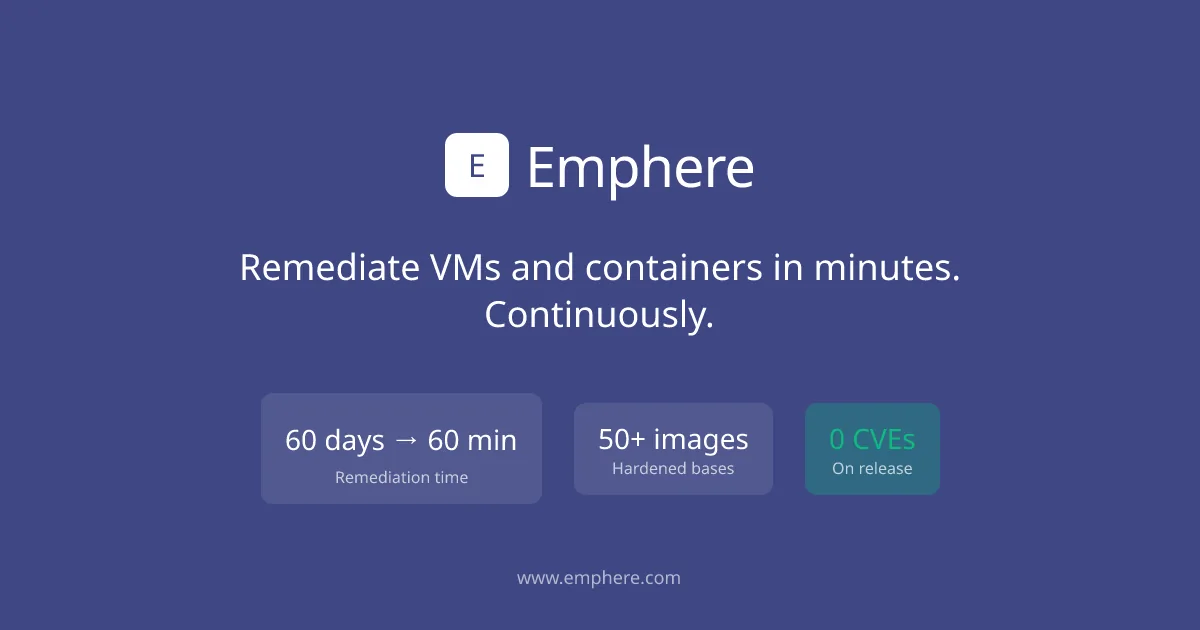
Container security marketing still sells scan reports: Trivy tables, Jira tickets, sprint backlog that never shrinks. Emphere sells reachability slides too—but the durable bet is quieter. Emphere is an automated vulnerability remediation engine for container supply chains: it maps your existing Dockerfile layers to a managed base-image graph, rebuilds OS and runtime dependencies from source when upstream releases land, validates compatibility and trust, then pushes Cosign-signed images to your registry. Judge it on whether fixable CVEs disappear without your team becoming the patch queue—not on whether "Emphere" clears a generic brand-naming worksheet.
The insight was the handoff, not another scanner SKU
Ankit Kumar (CEO) and Pallav Gupta (CTO) met as roommates at Northeastern University and spent the next decade on opposite sides of the same broken workflow. Kumar spent six years in security at Uber—securing cloud infrastructure across Uber and every company it acquired, opening the tickets. Gupta built large-scale systems at CarGurus and Twitter, closing the tickets that consumed engineering cycles never budgeted for security work.
They founded Emphere in 2025, spun out of Seattle's AI2 Incubator at Pier 70, and announced $2.1 million in pre-seed funding on June 4, 2026 from AI2 Incubator and Outsiders Fund (co-founded by Datto founder Austin McChord) (GeekWire, SecurityWeek). The team is five people, including two security researchers whose job is to attack patched images and confirm fixes hold.
Kumar's framing in press interviews: "Remediation is going to be as important as detection" because exploitation windows are shrinking—and customers selling into banking and regulated buyers "won't accept your software if it has a single critical vulnerability." Emphere reports early revenue and a handful of signed customers (unnamed). Testimonial on site from Mayank, Head of Products at TestMu AI: "Emphere got us to zero CVEs across our container fleet. All we did was change one line."
The thesis on Emphere's about page is blunt: scanners quantified the backlog; the moment a CVE lands in an engineering ticket is where work falls apart. Emphere's bet is to automate past that handoff—not improve the Jira workflow.
Business model: managed supply chain per unique image
Emphere is not a per-seat scanner subscription. Pricing is custom quote based on unique container images scanned, with volume discounts (pricing page). Each unique image counts as one workload regardless of replica count. Sales motion is demo-led enterprise ("Book a Demo," 20-minute call, bring Dockerfiles)—consistent with AI2 Incubator and Outsiders Fund backing an enterprise security buyer, not a developer PLG freemium wedge.
| Layer | What Emphere delivers | What the customer keeps |
|---|---|---|
| Reachability | Static analysis from container entrypoint through dependency graph; CVEs ranked by runtime reachability | Existing scanners (Trivy, Snyk, Grype, Wiz) for verification |
| Supply chain mapping | Dockerfile layers mapped to Emphere-managed bases (emphere/ubuntu:22.04, emphere/python:3.11, etc.) | Application code, pip/npm deps, business logic |
| Continuous rebuild | Release monitor on 1,847 packages; cascade compatibility checks; SAST, CVE, malware, maintainer trust | Original workflow; simplified Dockerfile starting FROM emphere/... |
| Ship | Cosign-signed (Cloud KMS), ARM64 + AMD64, SBOM + SLSA provenance, pushed to your registry | Registry credentials, CI hooks |
Zero agents in production. Emphere works at build/registry time—no runtime sidecar. That matters for regulated buyers who treat production footprint as audit surface.
Revenue logic: replace remediation labor, not add another alert channel. A federal watchdog reported the National Vulnerability Database had a backlog of 27,000+ unprocessed flaws as of May 2026, with new CVE volume projected to exceed 60,000 in 2026—nearly ten times a decade ago (GeekWire). Emphere prices against the cost of engineers manually triaging, testing, and rebuilding—not against Trivy being free.
Product pipeline: from upstream release to signed image in ~20 minutes
The homepage demo narrates a full cycle Emphere claims collapses ~6 weeks of manual patching to ~20 minutes:
1. Release monitor. Tracks upstream sources (GitHub, official registries, distro maintainers). Site claims 64 releases this week, detection in <5 minutes when OpenSSL 3.0.19 or Python 3.11.14 drops.
2. Cascade analysis. Before promotion, Emphere models compatibility (Python 3.11 TLS? ABI change?), dependency chains (curl, git, wget, libssh), and operational blast radius across a fleet (200 images, CI, staging, rollback, team notification).
3. Trust beyond CVEs. SAST on code changes; maintainer identity and signature validation. Demo blocks curl 8.11.0 for an undocumented exfil_dns call in lib/url.c—a supply-chain integrity block with no CVE number. Active version stays on curl 8.10.1.
4. Rebuild and ship. Patched layers pushed as acme/payments-api:latest with zero fixable CVEs per layer, CIS/STIG alignment, daily rebuild cadence.
Reachability is the prioritization wedge (reachability page): on public examples like temporalio/auto-setup:latest, 101 reported CVEs → 17 reachable—83% noise. Same debian:bookworm base, different stacks (Python+Flask vs Node+Express) yield entirely different reachable profiles. Emphere argues most scanner backlogs optimize the wrong rows.
Supported surface (homepage):
- OS: Alpine, Debian, Ubuntu, Amazon Linux, Red Hat UBI (standard/minimal variants; CIS L2, STIG where noted)
- Distroless runtimes: Python, Node.js, Java (Temurin JRE), Go, Ruby, .NET, Rust
- Services: PostgreSQL, Redis, NGINX, RabbitMQ
Long-term roadmap per funding announcement: "agentic vulnerability remediation"—AI-driven dependency-graph decisions, not just rule-based bumps.
Competitors: scanners find; hardened-image vendors migrate; Emphere patches in place
| Emphere | Chainguard | Snyk / Trivy / Grype | Aqua / Wiz | |
|---|---|---|---|---|
| Core job | Auto-remediate container base layers | Pre-built minimal hardened images | Find vulnerabilities | Cloud/container posture + runtime |
| Customer change | Map existing Dockerfile; FROM emphere/... | Adopt Chainguard image catalog | Wire scanner into CI | Agents, policies, dashboards |
| Fix delivery | Rebuilt signed images to your registry | Pull their images | Advice, PRs, sometimes patches | Block/warn at runtime |
| Reachability | Native static analysis from entrypoint | Image curation reduces surface | Varies (Snyk has reachability features) | Runtime-focused |
| Sweet spot | ISVs selling to banks/healthcare/gov with entrenched Dockerfiles | Greenfield or willing to migrate bases | Dev teams owning triage | Runtime detection + CSPM |
| Funding scale | $2.1M pre-seed (2026) | ~$3.5B valuation supply-chain leader (GeekWire) | Public/large private | Large enterprise |
Choose Emphere when migration to a new base-image vendor is politically or technically expensive, but your buyer's security questionnaire demands zero fixable CVEs on every release.
Choose Chainguard when you can standardize on curated Wolfi/Chainguard images from day one and want maximum upstream curation without maintaining your own Dockerfile graph.
Choose Snyk/Trivy/Grype when you already have remediation capacity and need detection + SBOM compliance reporting—pair with Emphere if fixes never ship.
Choose Aqua/Wiz when runtime behavior and cloud misconfiguration dominate your program; they complement upstream patching rather than replace it.
GeekWire's direct comparison: Chainguard asks customers to adopt its container images; Emphere patches the ones they already use. That integration trade-off is the entire category battle.
China: outbound ISV compliance vs mainland registry gravity
Emphere's China story is not "Emphere 中国." It is Chinese software vendors and cross-border SaaS teams whose buyers—global banks, healthcare systems, government integrators—reject container images with critical CVEs, while mainland production runs on different registry, scanning, and procurement rails.
What Emphere does well (出海 / global-regulated buyers):
- Chinese fintech, healthtech, and enterprise SaaS selling into US/EU/APAC regulated accounts face container questionnaires (CIS, STIG, SBOM, provenance) that manual patching cannot sustain at release cadence. Emphere's Cosign + SLSA + daily rebuild narrative maps to those RFP lines.
- Reachability analysis reduces false-positive triage for teams already drowning in Trivy output—relevant when a 15-person platform team supports 200 images.
- No production agents fits buyers who forbid runtime security sidecars in PCI or healthcare subnets.
- Works with AWS/Azure/GCP registries per pricing form—matches where many Chinese unicorns host international-region workloads.
What Emphere does not replace (境内场景):
- Mainland 等保 2.0 / 信创 programs often mandate domestic registry mirrors, 安恒/奇安信/绿盟 scanner workflows, and vendor relationships with 阿里云 ACR、腾讯云 TCR、华为云 SWR—not a Seattle pre-seed startup as primary compliance stack.
- PIPL / 数据出境 reviews apply if Dockerfile analysis sends proprietary build metadata offshore; EU/US-hosted processing needs legal review regardless of CVE count.
- Source-code custody: uploading Dockerfiles to a US vendor may conflict with SOE or defense-adjacent 源码不出域 policies—even if patches are excellent.
- Pre-seed $2.1M and five-person team mean SOC 2 / FedRAMP maturity is aspirational; mainland bank procurement may require certifications Emphere has not yet earned.
Practical split-stack for Chinese platform teams:
| Audience | Typical approach | Why |
|---|---|---|
| Global-region SaaS (卖向欧美银行) | Emphere on international CI + existing Trivy | Remediation SLA beats scan-only backlog |
| Mainland-only production | Domestic registry + local scanner + manual patch | Procurement and 信创 gravity |
| Hybrid (CN dev, US cloud deploy) | Emphere on deploy pipeline; CN dev uses mirror | Fix where the buyer audits |
| Greenfield K8s | Evaluate Chainguard vs Emphere on migration cost | Curated base vs in-place patch |
Reality: Emphere wins the remediation niche for ISVs with entrenched Dockerfiles selling globally; mainland enterprise container compliance still rewards domestic scanner-registry bundles.
The name and domain (briefly—facts beat folklore)
- "Emphere" reads as empower + sphere—a protective envelope for software delivery. Site tagline: "Your Dockerfile has layers. We secure every one."
emphere.comis exact-match .com for an enterprise security vendor—credible with banking buyers who side-eye niche TLDs.- The old showcase template spent pages on AI Domain Naming pillars. The business fact: buyers care about zero CVEs on audit day, not portmanteau etymology.
Prove remediation: a Dockerfile drill before you sign
Automated patching is not a homepage animation. Run this before a custom quote:
1. Baseline noise. Scan one production image with Trivy; count total CVEs vs what your app entrypoint can actually invoke. If >80% are unreachable libraries, reachability-first remediation may beat sprint-by-sprint triage.
2. Layer mapping review. Send a representative Dockerfile; confirm which lines become FROM emphere/... vs stay yours. Surprises here are migration politics, not security.
3. Compatibility blast radius. Pick one critical dependency (OpenSSL, glibc, Python minor bump); ask Emphere to show cascade analysis output and rollback plan before enabling auto-promote.
4. Trust-block scenario. Request documentation on SAST false-positive handling—blocked curl-style releases can delay patches if governance is unclear.
5. Registry dry run. Validate Cosign verification in your CI (not Emphere's demo registry) before promising customers signed provenance.
What to verify before your platform team standardizes on it
-
Remediation vs scanning. Keep Trivy/Snyk for detection; Emphere for base-layer rebuilds—overlapping budgets without division of labor wastes money.
-
Chainguard fork. If your org can migrate bases in one quarter, compare total cost of Emphere subscription vs Chainguard image adoption; Emphere's wedge is zero migration.
-
False positive governance. Trust-layer blocks without CVEs are powerful; define who approves overrides when a blocked upstream release is actually safe.
-
Buyer certifications. Confirm SOC 2, HIPAA BAA, or FedRAMP status matches your customer's procurement checklist—pre-seed stage may lag RFP requirements.
-
China split. Use Emphere on international deploy pipelines; plan domestic registry compliance separately for mainland-only workloads.
Emphere's competitive edge is not the loudest container-security webinar slide. It is automated remediation on your existing Dockerfile graph—release monitoring across 1,847 packages, reachability-filtered prioritization, trust verification beyond CVE IDs, and Cosign-signed rebuilds to your registry—built by engineers who lived both sides of the security ticket handoff at Uber scale. Price the remediation queue, not the scanner license—and run the Dockerfile drill before you promise zero CVEs in the next banking RFP.