FetchSandbox Sells Runnable Proof, Not Mock 200 OKs
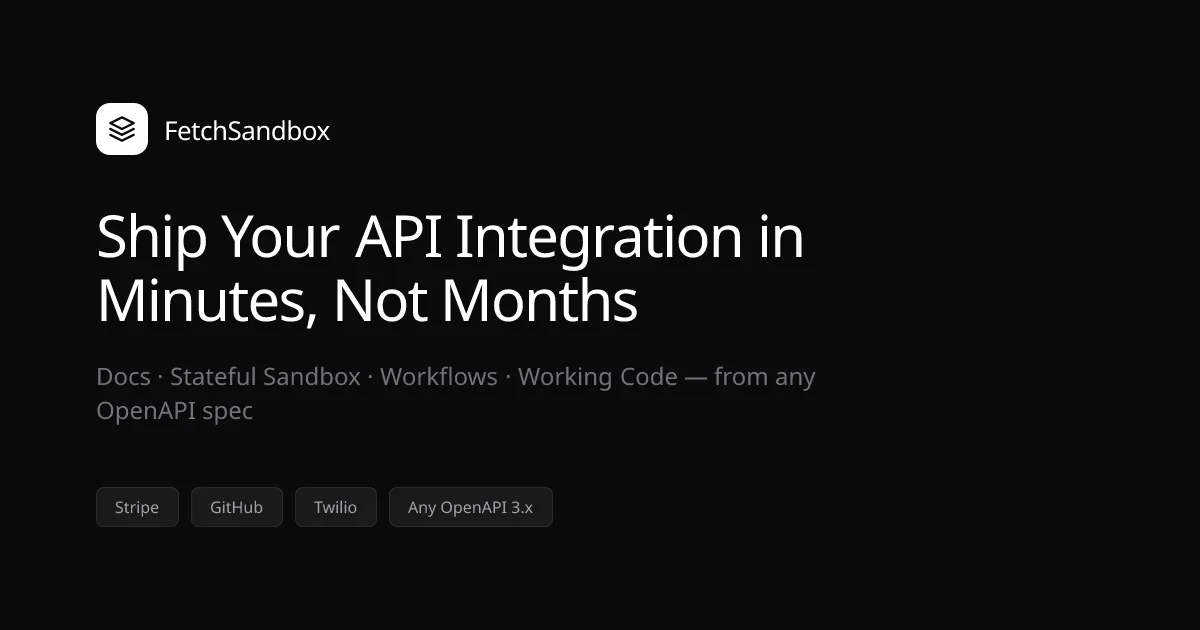
FetchSandbox turns OpenAPI into stateful sandboxes with webhooks and a memory graph—MIT MCP/CLI, 1,000 free runs/mo, $5 Pro. Built for Cursor and Claude Code agents shipping Stripe-class integrations.
NewName Editorial
Editorial Team
A curl that returns 200 OK proves nothing about webhooks, idempotency keys, or duplicate invoice.paid events three hours later. FetchSandbox sells runnable integration scenarios: stateful sandboxes for 67+ bundled APIs (Stripe, GitHub, OpenAI, Twilio, Clerk, etc.), webhook delivery, and a memory graph that reproduces failure patterns—inside Cursor, Claude Code, Windsurf, and Codex via MCP. Judge it on whether your agent's PR includes a replayable receipt URL, not on a functional domain name scorecard.
Product thesis: integration behavior, not response theater
FetchSandbox's homepage contrast is explicit (fetchsandbox.com):
Traditional testing stops at HTTP status—no webhook confirmation, no workflow state, burns real API quota.
FetchSandbox runs scenarios where the sandbox carries state between steps, fires expected webhooks, and encodes spec-specific failure modes in a brain that matches bugs deterministically.
Each run is one complete scenario—not one API call. Example from pricing FAQ: Stripe accept_payment = create customer, attach card, charge, catch confirming webhook. Calls + state + webhooks end-to-end = 1 run.
Outputs developers actually share:
- Public replayable receipt URLs for PRs and Slack.
- Memory graph queries: "reproduce bug X" with same inputs → same failure.
- MCP tools agents call in-loop:
what workflows exist?,run this workflow,what state changed?,which webhook was expected?
Site metrics (July 2026): 3,200+ monthly visitors, 3,100+ npm downloads, 67 APIs live—early traction in the AI-coding-tool wedge.
Architecture: OpenAPI → state machine → agent loop
Per DEV Community post, FetchSandbox converts specs into:
- Stateful sandboxes with seed data
- Lifecycle state machines
- Auth simulation
- Guided workflow runners
- Webhook behavior
- MCP tools for IDE agents
Install path: npx local MCP server, connect in Cursor MCP settings, optional trigger-phrase skills from fetchsandbox.com/skills/install.
Example agent prompt from docs:
Use FetchSandbox to validate this Stripe integration. Run the available workflows,
compare expected terminal state and webhook events, then tell me what code paths need changes.
Open source split (pricing):
- MIT: github.com/fetchsandbox/mcp, github.com/fetchsandbox/cli
- Paid hosted engine: sandboxes, curated workflows, webhook simulation, team controls
This is the modern devtools pattern: open client, paid backend—like Supabase or PostHog's split, but for integration proof.
Business model: runs as the meter
| Plan | Price | Includes |
|---|---|---|
| Free | $0 | 1,000 runs/mo, all bundled APIs, CLI + MCP, OpenAPI import, community support |
| Pro | $5/mo | 10,000 runs/mo, +$5 per extra 10k runs, private integrations, webhook replay/history, Slack/email support |
| Enterprise | Custom | Unlimited runs, private API onboard, SSO/SAML, audit logs, SLA, VPC/on-prem |
Key FAQ points:
- No provider API keys required to start—isolated sandboxes, no real charges.
- Pro overage keeps working (no hard cutoff); spending caps available on request.
- Enterprise email: [email protected] for SSO/on-prem.
Revenue aligns with agent-era iteration volume: teams using Claude Code to generate integrations will burn runs faster than manual QA—$5/month is cheap vs one production double-charge incident.
Launch testimonials cite Omri Ben-Shoham (Genway AI co-founder) and founders from Dial, RADLAB, ThreadMine—positioning as falsifiable in 30 seconds via receipt replay.
Competitors: mocks vs state vs cloud sandboxes
| FetchSandbox | Postman mocks | WireMock | Stripe test mode | Provider sandboxes | |
|---|---|---|---|---|---|
| Core bet | Multi-API workflows + webhooks + MCP | Single-request stubs | Self-hosted HTTP mocks | Stripe-only truth | Per-vendor fidelity |
| Agent loop | Native MCP in Cursor/Claude | Manual collection runs | DIY | Dashboard + CLI | Varies |
| Sweet spot | AI-written multi-service integrations | Quick stubbing | Full control self-host | Stripe depth | Final pre-prod validation |
| Weak spot | Cloud-hosted (FAQ: no self-host on free tier) | Stateless | Setup labor | Single vendor | No cross-API orchestration |
| Pricing | Runs/month tiers | Freemium Postman | Infra + time | Free test keys | Often free but fragmented |
Choose FetchSandbox when agents ship event-driven integrations and you need webhook + state proof in the IDE loop.
Choose WireMock when air-gapped self-host is mandatory.
Choose Stripe test mode when scope is Stripe-only and you accept manual cross-service gaps.
Workflow library and agent-era QA
FetchSandbox's curated workflows encode provider-specific invariants: Stripe idempotency keys, duplicate webhooks, GitHub retry policies, Twilio delivery callbacks. The DEV post emphasizes agents asking "what should I change in the app?" after a failing step—shifting QA from human-run Postman collections to MCP-invoked scenarios in the same IDE session. npm 3,100+ downloads on MCP/CLI packages suggest developers install locally even on free tier; monetization converts when teams exceed 1,000 runs/month or need private OpenAPI onboard (Pro).
Enterprise path (pricing): VPC/on-prem, SSO/SAML, audit logs—targets regulated shops that still want agent loops but cannot use multi-tenant cloud sandboxes for pre-production. MIT OSS on MCP prevents lock-in at the editor layer; hosted engine remains the sticky billing surface.
What a run proves in PR review
A receipt URL is falsifiable evidence: reviewers replay the same webhook order, same terminal state, same failure injection. Ryan Davis (RADLAB) testimonial on site describes duplicate invoice.paid exposing check-then-add dedup—not atomic—a class of bugs unit tests miss. Gal Dayan (Dial CTO) notes baking preconditions into scenario specs makes failures explainable, not flaky. For AI-generated integrations, that shifts review from "did Copilot write plausible code?" to "did the sandbox verify invariants?"
Postman collections still win ad-hoc REST exploration; FetchSandbox wins stateful multi-step contracts where step three depends on webhook from step two. WireMock wins air-gap; FetchSandbox wins zero-setup bundled APIs when your agent needs Stripe+GitHub+Clerk in one afternoon.
Skills install and trigger phrases
FetchSandbox ships optional agent skills from fetchsandbox.com/skills/install—trigger phrases that nudge Claude Code/Cursor to run workflows without engineers memorizing MCP tool names. That lowers adoption friction in agent-native teams where README snippets replace internal wiki pages. Combined with public receipt URLs, PR templates can require: "link FetchSandbox receipt or explain why scenario N/A"—turning integration review into falsifiable checklist.
Memory graph queries ("reproduce bug X") encode deterministic failure replay—critical when flaky webhooks masquerade as application bugs. Pro tier private OpenAPI onboard matters for internal microservices not in the 67-API catalog; Enterprise VPC/on-prem is the compliance upsell when sandboxes must not leave tenant network—even if agents still run in IDE.
China / compliance note
FetchSandbox is a US-cloud SaaS integration lab. Mainland teams building for global payments still use it in dev VPN environments; PIPL-sensitive production data should never enter sandboxes. For Alipay/WeChat Pay integrations, bundled Western APIs dominate—validate domestic rails separately. MCP in Cursor is popular among 出海 engineering teams standardizing on the same stack as SF startups.
Verify before your agent standardizes on it
-
Run budget. 1,000 free runs/month exhausts fast with agent loops—watch dashboard counters.
-
Scenario coverage. Confirm your APIs exist in the 67-API catalog or import OpenAPI on Pro.
-
Receipt discipline. Require receipt URLs in PR templates—otherwise you're back to "works on my machine."
-
SOC2/self-host. FAQ addresses enterprise paths; free tier is not air-gapped.
-
Final mile. FetchSandbox explicitly says it does not replace final provider sandbox sign-off—it's preflight, not certification.
FetchSandbox's edge is deterministic integration proof in the agent loop: memory graph, webhook chaos, MIT MCP, and $5 Pro that maps to engineering time saved—not another mock server that high-fives your first HTTP response.