OctoAlly Pro Sells Agent Workflow, Not Another Terminal Tab
OctoAlly Pro adds kanban, multi-agent handoffs, and iOS/Android parity to the open-source Claude Code/Codex dashboard—waitlist for early summer 2026. Free OSS edition ships today.
NewName Editorial
Editorial Team
Claude Code and OpenAI Codex can implement features—but managing long-running agent sessions still devolves into terminal tabs, Slack pings, and "what was that agent doing?" OctoAlly starts from an open-source dashboard for dual-CLI sessions (Claude Code + Codex), tmux terminals, git diffs, and Whisper dictation. OctoAlly Pro (waitlist, early summer 2026) adds kanban, automated multi-agent pipelines, and full mobile apps. Judge it on whether cards move from Backlog → Done without you babysitting stdout—not on portmanteau naming analysis.
Product stack: OSS dashboard → paid autopilot
Free today (octoally.com): open-source edition runs locally with:
- Specialist agent library (dev, review, test, security, infra, data)
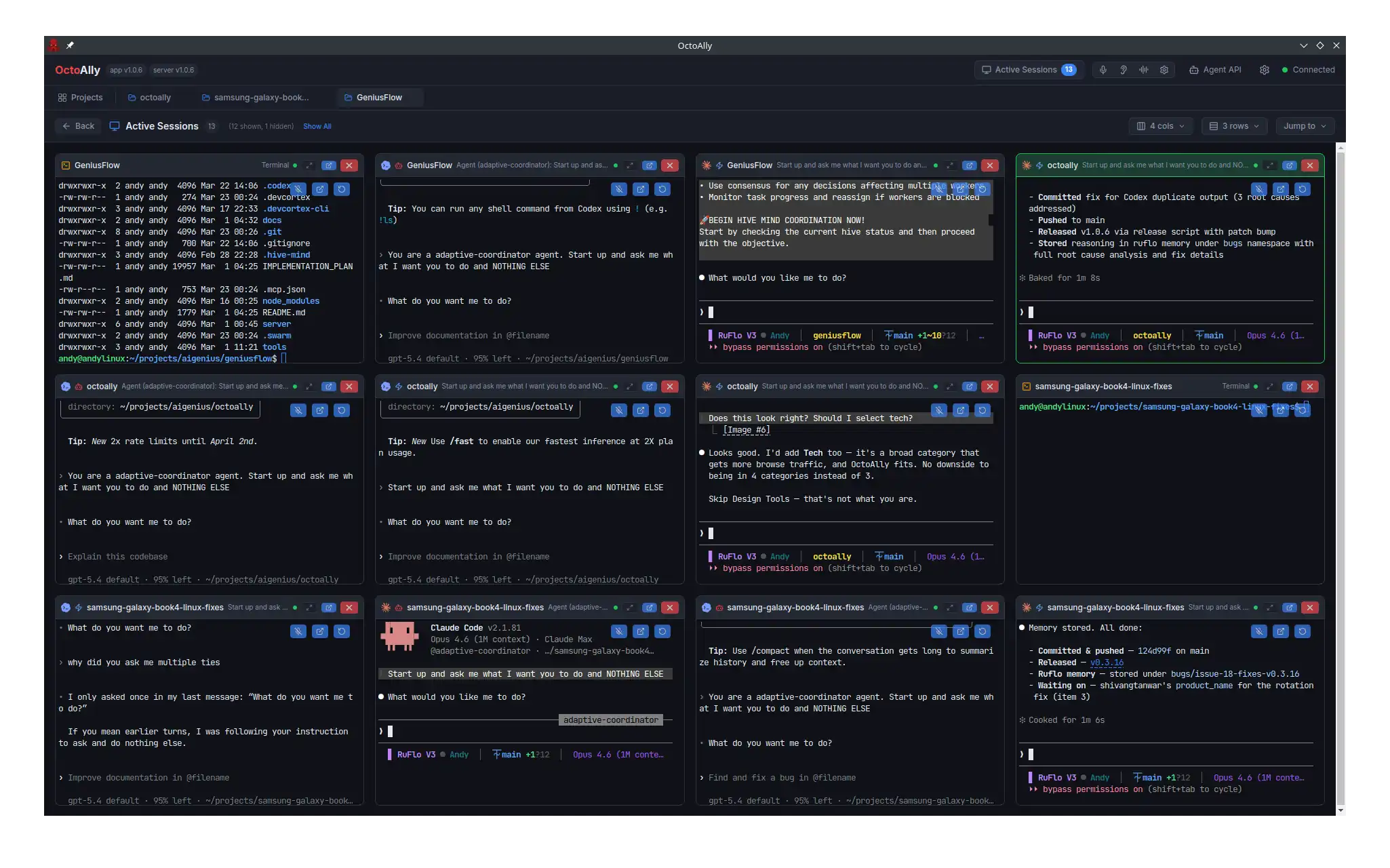
- Active sessions grid with live streaming output
- Dual CLI per session—Claude Code and Codex with separate commands/settings
- tmux-backed interactive terminals that survive reboots
- Built-in git with side-by-side diffs and commits
- Voice dictation via local Whisper STT or cloud APIs; API keys encrypted AES-256-GCM at rest
Pro v1 (paid, waitlist) adds three upgrades (site):
| Feature | What it changes | Business logic |
|---|---|---|
| Kanban | Cards: Backlog → Research → Plan → Implement → Human Review → Done | Shared mental model replaces tab archaeology |
| Automated workflow | Research → planner options → implementer; you decide at gates | Developer becomes approver, not babysitter |
| Mobile (iOS/Android) | Same backend/view as desktop—review diffs, run terminals on cellular | Push decisions while away from desk |
Post-launch roadmap: shared projects, live team activity, multi-agent swarms with file-ownership boundaries—team tier, not v1.
Distribution: waitlist email only ("One email when we ship. No newsletter, no spam"). Pricing undisclosed—classic pre-launch devtools.
Why kanban for agents is a monetizable wedge
AI coding tools solved capability; the second wave solves process. OctoAlly Pro bets that:
- Long tasks need visible stage gates (plan approval before implement burns tokens).
- Mobile check-in beats SSH from a phone for "approve this diff."
- OSS base builds trust—developers try free dashboard, upgrade when autopilot saves hours.
Trade-offs:
- Not every bugfix fits Research-Plan-Implement—overhead for quick patches.
- Tight coupling to Claude Code + Codex—Copilot/Cursor-only shops won't care.
- Mobile terminal UX is check-in, not sustained coding.
Competitors: IDEs vs observability vs OctoAlly
| OctoAlly Pro | Cursor / IDE agents | LangSmith / agent observability | tmux + scripts | |
|---|---|---|---|---|
| Core bet | Workflow orchestration for coding agents | Inline edit in editor | Trace/debug LLM chains | Free, DIY |
| Kanban | Native | No | No | No |
| Mobile | Full parity claim | Limited | Web dashboards | SSH only |
| Sweet spot | Power users running Claude Code/Codex daily | General coding | ML ops debugging | Hackers |
| Pricing | TBD (waitlist) | Subscription | Usage tiers | $0 |
Choose OctoAlly when you already run Claude Code/Codex from a dashboard and want pipeline + mobile approval without building internal tooling.
Choose Cursor when the agent should live inside the editor, not a second app.
Open-source base and Pro monetization hypothesis
The free OctoAlly dashboard already ships specialist agents (code review, security audit, infra, data engineering)—each with scoped tools. That library is the free tier moat: developers who live in tmux-backed sessions daily feel pain when Pro adds kanban routing. Pro pricing will likely anchor against Cursor Pro + separate PM tool—if waitlist converts at $20–40/month for autopilot, revenue funds mobile sync infrastructure.
AES-256-GCM key storage and optional local Whisper address enterprise whisper concerns about cloud dictation. Dual CLI support matters because Codex and Claude Code diverge on auth, streaming, and tool schemas—unifying them in one grid is operational value, not branding. Post-launch team swarms with file-ownership boundaries attack the "two engineers, one branch" problem parallel agents create—likely the Enterprise upsell.
Session grid as control plane
The OSS active sessions grid is OctoAlly's current monetization hook: see every Claude Code/Codex/tmux session streaming in one view before Pro adds kanban stages. Git side-by-side diffs + commit in-dashboard reduce context switch to external GUI clients. Voice dictation (local Whisper) matters for mobile Pro parity—approving plans by voice on phone completes the "walk away" story.
Competitive response: Cursor 2.x agent mode and Claude Code native subagents could absorb kanban without third dashboard—OctoAlly must ship Pro before IDEs bundle workflow. Waitlist GTM collects emails of high-intent Claude Code users—cheap validation before pricing.
Token economics and stage-gate ROI
Each skipped Human Review gate can burn thousands of tokens on wrong implementation paths. Kanban stages externalize that cost: Research cards force literature/codebase scan before Implement agents touch files. For teams billing API usage to clients, OctoAlly Pro becomes margin protection—not a productivity toy. The OSS grid already surfaces live token-adjacent signals (streaming stdout, diff size) so approvers can kill runaway sessions early.
Mobile approval matters when CI is green but diff is wrong—engineers on commute can reject a plan card without reopening laptop VPN. That workflow is common in distributed teams where code review latency exceeds generation latency. Pro's automated pipeline (research → planner options → implementer) maps to how senior engineers already delegate—OctoAlly productizes the handoff instead of Slack screenshots of terminal output.
Failure mode: teams that only ship one-shot fixes will see kanban as process theater. OctoAlly should honestly market to multi-hour agent tasks (migrations, test suite rewrites, security audits)—the specialist agent library already signals that ICP.
China / remote-dev context
OctoAlly targets global Mac/Linux developers on Anthropic/OpenAI CLIs—common among 出海 teams and VPN-backed eng in mainland China. Mobile approval helps async handoffs across time zones (SF product + China eng). No localized billing or 微信 support—expect direct download/OSS install. Compliance-sensitive teams should verify where cloud dictation APIs send text if not using local Whisper-only mode.
Specialist agents as free-tier SKU
Each OSS specialist (security audit, infra, data engineering) is a pre-packaged prompt + tool scope—not a generic chat wrapper. That design reduces token waste: a security agent doesn't rewrite your entire codebase when asked to scan dependencies. Pro kanban routes those specialists through stage gates—security findings become Research cards before Implement agents touch production paths.
For solo founders, the OSS dashboard replaces a second monitor full of terminal tabs. For small eng teams, post-launch shared projects (roadmap) attack the "who owns this agent session?" problem—likely per-seat pricing. Until Pro ships, OctoAlly's revenue is $0 with validation via waitlist size and OSS GitHub activity—classic devtools land-expand pattern.
Verify before you join the waitlist
-
Run OSS first. Pro builds on the free dashboard—validate session stability before paying for kanban.
-
CLI fit. Confirm your stack is Claude Code and/or Codex—not Copilot-only.
-
Workflow honesty. Count how many tasks/week need multi-stage agents vs one-shot fixes.
-
Mobile realism. Test whether you actually approve diffs on phone—or only monitor.
-
Pricing when announced. Team roadmap implies future seat pricing—watch for OSS bait-and-switch.
OctoAlly Pro's edge is operationalizing agent sessions: kanban stages, automated handoffs, mobile parity atop proven OSS. It is not a new model—it is process layer for tools that already write code. Win if waitlist converts power users tired of terminal babysitting; lose if IDEs absorb kanban natively.