Waabi's Simulation-First Bet — When Driving Miles Stop Being the Scoreboard
Founded by ex-Uber ATG chief scientist Raquel Urtasun in 2021, Waabi trains its Waabi Driver inside Waabi World—a closed-loop neural simulator—before Texas trucking runs and a $750M Series C into robotaxis. Here is the simulation-first thesis, verified funding, and how it stacks against Waymo, Aurora, and a post-Cruise landscape.
NewName Editorial
Editorial Team
For twenty years, autonomous driving progress was measured in miles driven: Tesla's consumer fleet, Waymo's mapped metros, Aurora's hub-to-hub pilots. Waabi bets the scoreboard is wrong. The Toronto company trains and validates its Waabi Driver inside Waabi World—a closed-loop, generative neural simulator—before putting semis on Texas highways. Judge Waabi on whether simulation replaces mile-chasing, not on whether "Physical AI" clears a generic startup showcase template.
The thesis: AI-first autonomy when road testing is the bottleneck
Waabi launched in June 2021 from stealth with Raquel Urtasun as sole founder and CEO. Urtasun spent two decades in AI research, led R&D as chief scientist at Uber Advanced Technologies Group (later absorbed into Aurora), and holds a professorship at the University of Toronto. Her founding insight, repeated in TechCrunch and IEEE Spectrum interviews: the industry over-indexed on real-world fleet scale when the hard problems—rare edge cases, safety validation, geographic expansion—are better attacked in simulation first.
Waabi's AI-first stack combines three pieces Urtasun has described since day one:
- End-to-end trainable models that map sensor inputs to driving actions—capable of complex reasoning, not a hand-stitched modular pipeline.
- Probabilistic inference and optimization layered on deep nets so decisions are more traceable than a pure black-box network—addressing the interpretability critique that has stalled regulators on end-to-end AV.
- Waabi World, a closed-loop simulator with real-time fidelity where the full software stack runs against synthetic traffic, weather, and sensor noise at cloud scale.
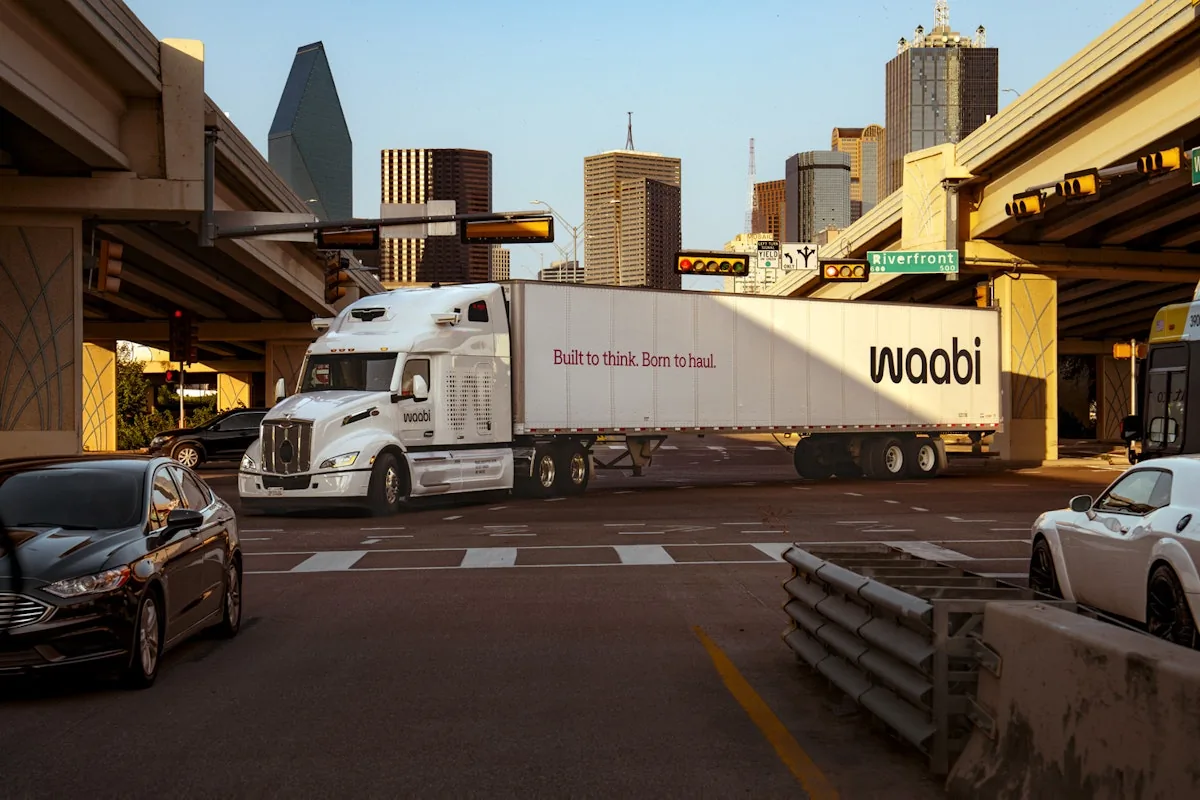
The company still operates a physical test fleet—IEEE Spectrum documented geofenced Dallas–Houston cargo runs in retrofitted Peterbilts with safety observers from fall 2023. But the simulator is meant to front-load edge-case exposure: "We can even prepare for new geographies before we drive there," Urtasun told TechCrunch at launch. In a Mobility 2021 interview, she claimed Waabi World is high enough fidelity that performance in sim can be mathematically linked to real-world behavior—a bold claim competitors dispute, but central to the company's capital-efficiency story.
Waabi chose long-haul trucking first—driver shortages, predictable highway economics, Sun Belt weather—while keeping architecture vehicle-agnostic. The same model is now marketed as a shared brain for robotaxis, announced alongside the January 2026 Series C and an expanded Uber partnership.
Waabi World + Waabi Driver: simulation loop, not a demo reel
| Layer | What it is | Why it matters |
|---|---|---|
| Waabi Driver | End-to-end L4 driving AI; integrated on OEM platforms (Volvo VNL Autonomous, NVIDIA DRIVE Thor) | One brain targeted at trucks and robotaxis—not separate siloed stacks |
| Waabi World | Generative, closed-loop neural simulator; Copilot4D world model | Billions of synthetic miles; edge cases (blizzard, tire blowout, jaywalker) without physical risk |
| Mixed Reality Testing (MRT) | Real vehicle on closed course + virtual actors injected by sim | Alternative to expensive closed-course fleets; unveiled with 99.7% sim-realism score claims (Waabi COO hire post) |
| Commercial shell | Uber Freight 10-year partnership; Volvo Autonomous Solutions co-development | Software licensor model—Waabi is not building custom Origin-style vehicles |
Architecturally, Waabi sits opposite the modular stack Waymo and Aurora refined for a decade: separate perception, prediction, planning, and control modules with HD maps as scaffolding. Waabi argues maps and modules don't generalize cheaply—every new city or vehicle type reopens engineering. An end-to-end model trained in a high-fidelity loop should, in theory, learn concepts (merges, four-way stops, construction zones) that transfer.
The trade-off is well known: when an end-to-end model fails, root-cause analysis is harder. Waabi's counter is simulation volume plus probabilistic traceability—not a solved problem, but a different safety bet than "drive until the disengagement rate drops."
Public operations today are real but gated. Waabi and Uber Freight run commercial loads Dallas–Houston in Texas with a safety driver aboard—not driver-out L4 as of mid-2026. The company had publicly targeted fully driverless trucks by end-2025; that milestone was not met, with validation of the purpose-built Volvo VNL Autonomous platform cited as the gating item (DEPLOY registry, CNBC Aug 2025). Honest accounting matters: simulation-first does not mean simulation-only, and timelines slip.
Funding arc: $83.5M → $200M → $750M and a robotaxi lane
| Date | Round | Amount (USD) | Signal |
|---|---|---|---|
| Jun 2021 | Series A (Khosla-led) | $83.5M | Stealth exit; Uber, Aurora, Radical, Geoffrey Hinton, Fei-Fei Li among backers (GlobeNewswire) |
| Jun 2024 | Series B (Uber + Khosla co-led) | $200M | NVIDIA, Volvo Group VC, Porsche, Scania, Ingka join; total >$280M (GlobeNewswire, CNBC) |
| Jan 2026 | Series C (Khosla + G2 co-led) | $750M + Uber milestone investment | Largest Canadian raise; robotaxi expansion on Uber platform; ~$1B cumulative (Waabi, Bloomberg) |
Strategic hires track commercialization, not just sim R&D. Lior Ron—Uber Freight co-founder who scaled that business to roughly $5B revenue—joined as COO in August 2025 to lead go-to-market while the Uber Freight partnership continues (Waabi, Forbes).
Competitors: same problem, different safety bets
| Waabi | Waymo | Aurora | Tesla FSD | Gatik | |
|---|---|---|---|---|---|
| Core bet | Simulation-first end-to-end AI | HD-map robotaxi + trucking (Waymo Via) | Modular Aurora Driver; hub-to-hub trucking | Vision-only E2E in consumer fleet | Fixed middle-mile routes |
| Primary lane (2026) | Trucking → robotaxi via Uber | Robotaxi (SF, Phoenix, LA, etc.) | Trucking with Volvo/Uber Freight overlap | L2 driver-assist at scale | Short-haul B2B logistics |
| Validation story | Waabi World billions of sim miles | Real-world ops + simulation | Real-world + sim; public company discipline | Fleet data volume | Conservative geofencing |
| Capital / status | Private; ~$1B raised | Alphabet-backed | Public (AUR); cash constraints | Public (TSLA); no L4 trucking | Smaller, commercially operating |
| 2026 reality check | Safety driver in TX; driver-out delayed | Paid robotaxi rides scaling | Driver-out trucking timeline cautious | Not L4; regulatory scrutiny | Driver-out on select routes |
Versus Waymo: Waymo is the operational proof that L4 robotaxis can charge fares in mapped cities—but expansion is slow and map-heavy. Waabi argues simulation lets it skip the per-city map tax and reuse one brain across trucks and taxis. Waymo's safety record is the benchmark Waabi must eventually match in public data, not press releases.
Versus Aurora: The closest trucking peer—shared Volvo and Uber Freight relationships, overlapping Texas footprint. Aurora's modular stack is easier to audit module-by-module; Waabi's end-to-end stack is harder to debug but potentially cheaper to generalize. Aurora being public forces quarterly honesty on burn; Waabi's private status hides details but bought runway with Series C.
Versus Cruise: A cautionary tale—GM-backed robotaxi unit suspended operations after safety and governance failures, then retrenched. Cruise built custom Origin vehicles and chased urban robotaxi scale before proving unit economics. Waabi's OEM-licensor model and trucking-first sequencing is explicitly designed to avoid that capital trap.
Versus Tesla: Both pursue end-to-end neural nets, but Tesla's FSD remains Level 2 driver monitoring in consumer cars with no autonomous trucking product. Waabi targets Level 4 commercial lanes with simulation-gated validation—not the same product category despite shared vocabulary.
China: parallel AV race, different gravity
Waabi is Toronto- and Texas-centric; it does not operate in mainland China. But any autonomous-driving analysis for a bilingual audience needs 中国自动驾驶 context—because the competitive frame is global even when deployments are not.
How China's stack differs:
- Permit-driven robotaxi pilots in Beijing, Wuhan, Shenzhen, and other cities—led by Baidu Apollo, Pony.ai, WeRide, and OEM-backed players—optimize for local regulatory sandboxes, not Texas-style freight economics.
- 车路协同 (V2X) infrastructure investment remains a national priority; many Chinese stacks assume smart-road data Waabi's US trucking thesis does not require.
- Data localization and cross-border cloud rules mean Waabi World-style training pipelines cannot simply "copy to CN" without domestic compute, mapping partners, and 测绘资质 for HD data collection.
Where the analogy helps Chinese readers:
- Waabi's simulation-first approach mirrors debates inside Chinese AV labs: real-world fleet scale (especially for rare events) is expensive; 仿真闭环 is the proposed accelerant—though Chinese regulators still demand 封闭场地 + 公开道路测试 mileage gates.
- Trucking-first vs robotaxi-first sequencing splits both markets. China faces severe 物流司机短缺 and corridor automation interest; Waabi's Dallas–Houston commercial loads with Uber Freight resemble how Chinese firms pilot 港口/高速 corridors before urban robotaxi.
- OEM partnership models (Waabi + Volvo; Chinese stacks + 北汽/广汽/etc.) show software winners may license brains rather than manufacture vehicles—relevant to domestic 智驾 Tier 1 consolidation.
Where Waabi does not translate directly:
- US state-by-state trucking regulation (Texas-friendly) has no single Chinese equivalent; 工信部 / 交通运输部 frameworks move on different timelines.
- Post-Cruise US robotaxi skepticism does not map to 2024–2026 Chinese permit expansions—local policy momentum can diverge sharply from North American headlines.
The old startup-showcase template treated AV as one global horse race. Reality: Waabi competes in North American freight and Uber's robotaxi network; China's L4 leaders fight a separate permit and infrastructure game—converging on AI-first stacks, diverging on regulation and road data.
The name (briefly—Urtasun's words, not folklore)
- "Waabi" — Urtasun says the name carries "she has vision" and "simple" in Japanese (TechCrunch launch). Not a wabi-sabi branding essay—a deliberate short coinage.
waabi.ai— exact brand on the.aiTLD signals AI-native identity; appropriate for a company selling software, not steel.- Tagline evolution toward "Physical AI" reflects expansion beyond trucking—same simulator thesis, broader form factors.
That is positioning vocabulary, not a five-act domain scorecard.
Simulation audit: questions before you treat Waabi World as proof
"Simulation-first" is not a homepage adjective. Run this before treating Waabi as validated L4:
1. Sim-to-real gap metrics. Ask for disengagement rates and intervention taxonomy on Texas commercial routes—not just sim mileage. Waabi claims high sim-realism scores; third-party audits are still scarce.
2. Driver-out timeline honesty. Distinguish feature-complete software from regulatory- and OEM-gated driver-out deployment. End-2025 driver-out did not arrive; track Volvo VNL Autonomous validation milestones publicly.
3. End-to-end debuggability. Stress-test how Waabi traces a failure across probabilistic layers versus Aurora/Waymo modular logs—insurers and DOT reviewers will ask.
4. Geographic generalization. One dense Texas lane proves little about snow, construction chaos, or Northeast urbanism—sim coverage claims must map to named ODD expansions.
5. Robotaxi lane scope. Series C adds Uber robotaxis; verify whether trucking safety cases transfer to urban passenger service or reopen validation from scratch.
What remains unknown—and why that is fine to say
- Public driver-out deployment date — delayed past 2025; no audited driver-out freight P&L yet.
- Independent safety benchmarks — sim-realism percentages are company-reported; NHTSA/transportation-agency filings lag press releases.
- Robotaxi ODD and city count — announced with Series C; operational detail still thin versus Waymo's public ride metrics.
- Unit economics — $1B raised buys time; cost-per-mile versus human drivers not publicly proven at scale.
None of these gaps make Waabi a gimmick. They mean readers should treat Waabi as the most capitalized simulation-first AV bet in North America—with real Texas loads, tier-one partners, and a thesis that could reshape validation economics if driver-out ops match the sim story.
Waabi's edge is not the loudest "we drove X million miles" banner. It is Waabi World as the primary proving ground, an end-to-end interpretable stack, >$1B raised, Volvo–Uber–NVIDIA distribution, and a founder who already survived one AV consolidation cycle at Uber ATG. The simulation-first thesis only wins when the safety driver comes out—and stays out. Until then, judge the simulator by the road, not the press release.