Neuron Industries
AI-native industrial controller replacing PLCs, HMIs, and historians in one box—with zero runtime licenses.
NewName Editorial
Editorial Team
The programmable logic controller has been the undisputed king of factory automation for over half a century. It's reliable, certified, and deeply entrenched—but it's also a 1980s architecture wrapped in vendor lock-in. Every major plant runs a patchwork of PLCs from Siemens, Rockwell, or Beckhoff, each with its own proprietary IDE, its own ladder-logic dialect, and its own per-tag licensing scheme. Engineers spend weeks wrestling with software that feels like a relic, while the factory floor generates data that never leaves the controller.
Neuron Industries, a Y Combinator-backed startup, is taking a different bet: throw away the PLC entirely and replace it with a purpose-built industrial controller designed for AI from the ground up. The Cortex AIC isn't a PLC with a ChatGPT wrapper—it's a clean-slate rebuild of the entire control stack, from the ARM-based hardware to the Synapse IDE that runs in a browser. The thesis is simple: if you can describe your machine's behavior in plain English and get deterministic, real-time Python code you can read, test, and own, the days of ladder logic and vendor lock-in are numbered.
The PLC's Grip Is Slipping—and It's Not Just About AI
The industrial control market is ripe for disruption, but not for the reasons most people think. It's not just that AI can now write code—it's that the entire economic model of traditional PLCs is increasingly untenable. A typical mid-sized factory runs dozens of controllers, each requiring a separate engineering license, an HMI package, a historian, and a protocol gateway. The software costs often exceed the hardware over the controller's lifetime, and the proprietary nature of each vendor's stack makes it nearly impossible to integrate modern IT systems without expensive middleware.
Meanwhile, the skills gap is widening. The average controls engineer is retiring, and the younger generation is far more comfortable with Python and Git than with ladder logic and function blocks. They expect to work with modern tools—version control, unit testing, and AI-assisted development—but the incumbents have been slow to modernize. Siemens and Rockwell have bolted on AI features to their existing platforms, but they're still fundamentally tied to their legacy architectures. Neuron's bet is that a new generation of engineers will prefer a clean-slate approach that speaks their language.
One Box, One Browser Tab: Rebuilding the Control Stack from Scratch
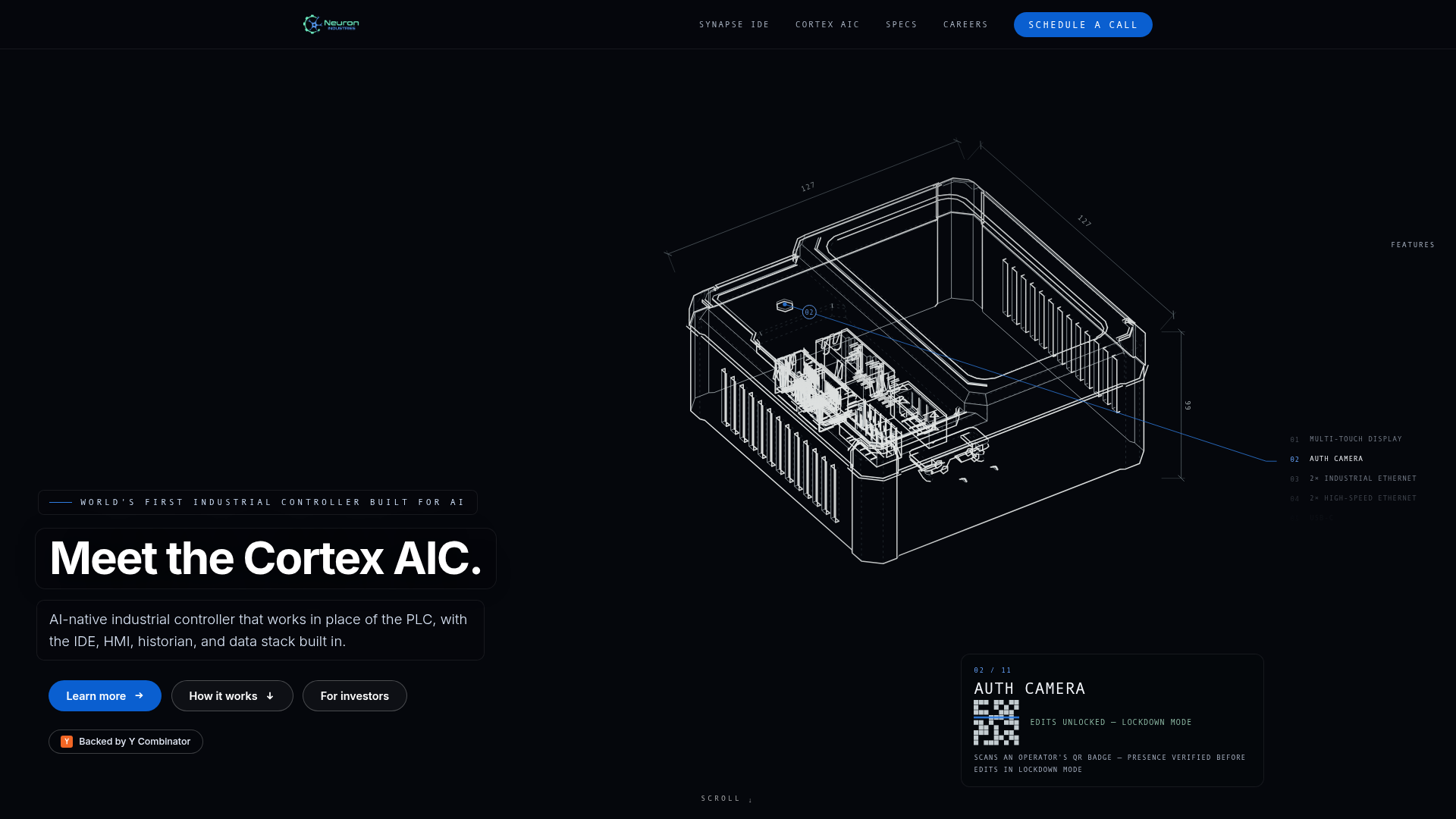
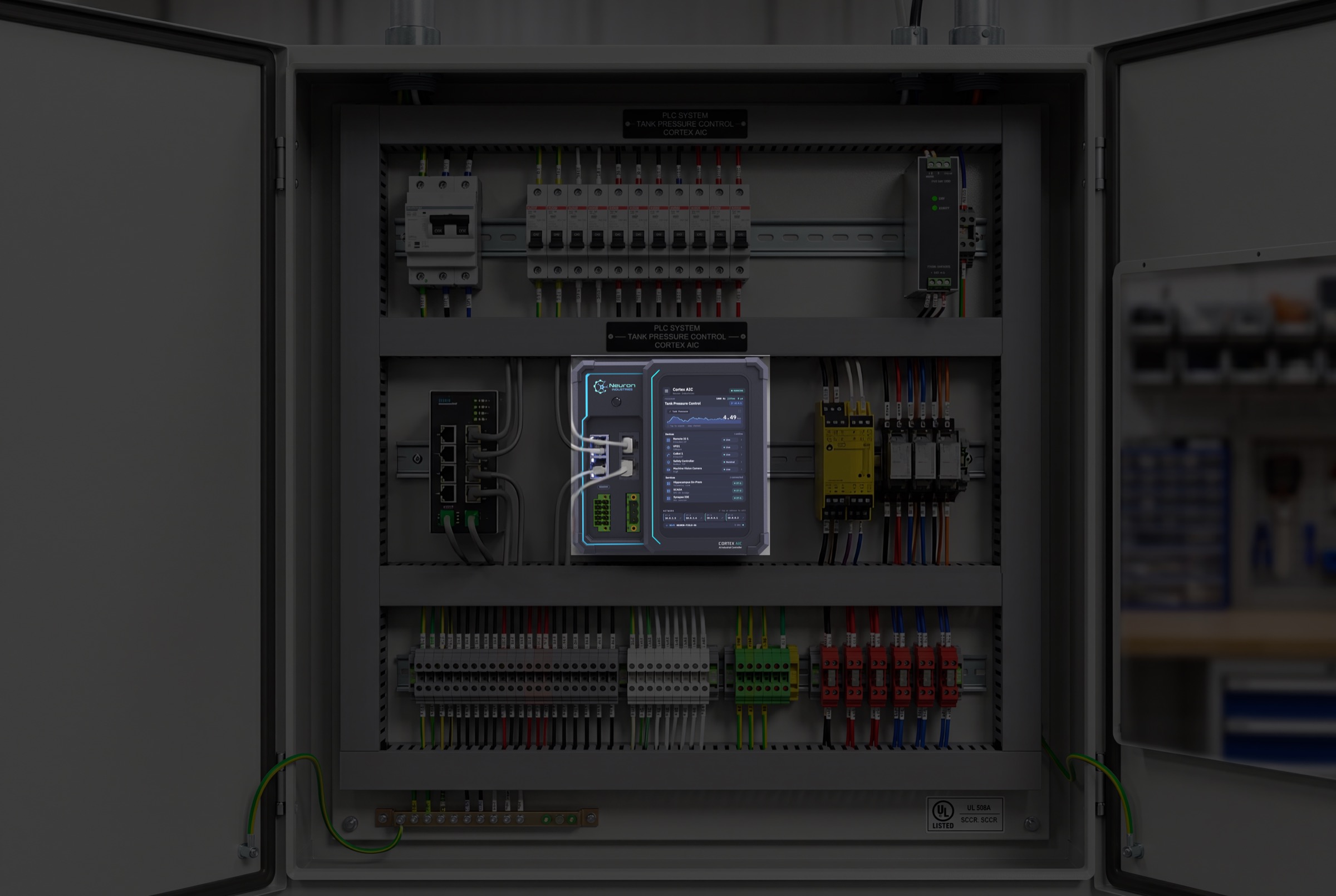
The Cortex AIC is a physical controller—roughly the size of a typical PLC—but it's what's inside that matters. It runs an 8-core ARM processor with a 6 TOPS NPU, and it comes with a multi-touch display, an authentication camera, and dual Ethernet ports for OT and IT connectivity. But the real innovation is the software stack. The Synapse IDE is served directly from the controller, so there's nothing to install—just open a browser tab, and you're in. It works fully air-gapped, which is a critical requirement for many industrial environments.
The workflow is radically different from traditional PLC programming. Instead of writing ladder logic or structured text, you describe the behavior you want in plain English. Synapse, the AI assistant, generates deterministic real-time Python code—a scan-cycle controller.py plus an event-driven supervisor—and keeps a readable behavior summary in sync. Before generating logic, it flags ambiguities and prompts you to resolve them, acting as a safety pass over edge cases and interlocks you might have missed. The result is code that's auditable, testable, and hand-tunable.
But the AI is only part of the story. The Cortex also includes a built-in HMI, historian, and data streaming—all integrated into the same box. You can upload a P&ID and have it become the operator screen, with live values pinned to tagged components. The historian, called Hippocampus, captures data at full rate and lets you explore it in the browser. And for data egress, it supports MQTT, OPC UA, ROS 2, and Zenoh out of the box, with no extra licensing fees. This is a complete control stack in one device, and it's designed to be owned by the customer, not leased by the vendor.
The Real Moats: Scan Rates, Jitter, and the Safety Certification Wall
For all the talk of AI, the hard part of industrial control is real-time performance and safety. A controller that can't guarantee a 1 ms scan cycle is useless for motion control or safety interlocks. Neuron claims the Cortex achieves a 4000 Hz max scan rate with 0.5 µs P99.9 jitter—numbers that rival traditional PLCs. The Cortex Mini, aimed at simpler machines, runs at 1000 Hz with 3 µs jitter. These are credible specifications, but the real test is whether they hold up under load and in the field.
The bigger challenge is safety certification. The Cortex offers SIL 1 safety, but many applications require SIL 2 or SIL 3. Neuron will need to invest heavily in certification if it wants to move beyond simple machines into critical safety applications. This is a long and expensive process, and it's one of the reasons incumbents have such a strong moat. But Neuron's approach—using Python for safety logic—could be a double-edged sword. On one hand, it makes the code more accessible and testable; on the other, it may raise questions about determinism and validation in safety-critical contexts.
Why the Incumbents Won't (or Can't) Copy This Overnight
Siemens, Rockwell, and Beckhoff have decades of installed base, deep relationships with system integrators, and extensive certification portfolios. They're not going to disappear overnight. But they face a classic innovator's dilemma: their revenue models depend on proprietary software licenses, per-tag pricing, and lock-in. An AI-native controller that costs a few thousand dollars and includes all software for free threatens that model.
They could try to copy Neuron's approach, but it's not just a matter of adding an AI chatbot to their existing IDE. It would require a fundamental redesign of their hardware and software architecture, and it would cannibalize their existing revenue streams. More likely, they'll acquire or partner with startups like Neuron, or they'll continue to bolt on AI features while hoping the market doesn't shift too quickly. Meanwhile, a new generation of machine builders, especially in robotics and advanced manufacturing, are more willing to take a chance on a startup that offers a modern development experience.
Pricing as a Wedge: One-Time Hardware vs. Per-Tag Licensing
Neuron's pricing is a direct attack on the industry's most hated practice: per-tag licensing. The Cortex Mini costs $2,950 and the Cortex costs $6,450—both one-time purchases that include all software, with zero runtime licenses. This is a fraction of the total cost of ownership of a traditional PLC system, which can easily run into tens of thousands of dollars when you factor in engineering software, HMI licenses, historian licenses, and protocol gateways.
This pricing model is a powerful wedge for several reasons. First, it aligns with the buyer's incentive to own their control stack outright, rather than paying ongoing fees. Second, it makes the cost of experimentation much lower, which is critical for startups and smaller machine builders. Third, it's a clear differentiator that Neuron can lead with in sales conversations. The risk is that the hardware cost is higher than a bare-bones PLC, but for most buyers, the total cost of ownership is likely to be lower, especially when you factor in the reduced engineering time.
The 3–5 Year Trajectory: From Machine Builders to the Factory Floor
Neuron's initial target is likely machine builders and system integrators who are building new equipment and are more open to new technology. These early adopters will validate the platform and provide reference cases. From there, the company can expand into end-user factories, particularly those with aging PLC infrastructure that's due for a refresh.
The key challenge over the next few years will be scaling beyond the early adopter niche. Neuron will need to build a partner ecosystem, including support for more third-party I/O and robot brands. It will also need to invest in certification and safety features to move upmarket. If it can do that, it has the potential to become a significant player in the industrial automation space. If not, it may remain a niche player for forward-thinking machine builders.
One thing is clear: the PLC is no longer the only option. Neuron Industries has planted a flag for a new kind of industrial control, and the incumbents are going to have to respond—or risk being left behind.