Rex
Rex: AI agents that run order-to-cash, from invoice to cash, under your guardrails.
NewName Editorial
Editorial Team


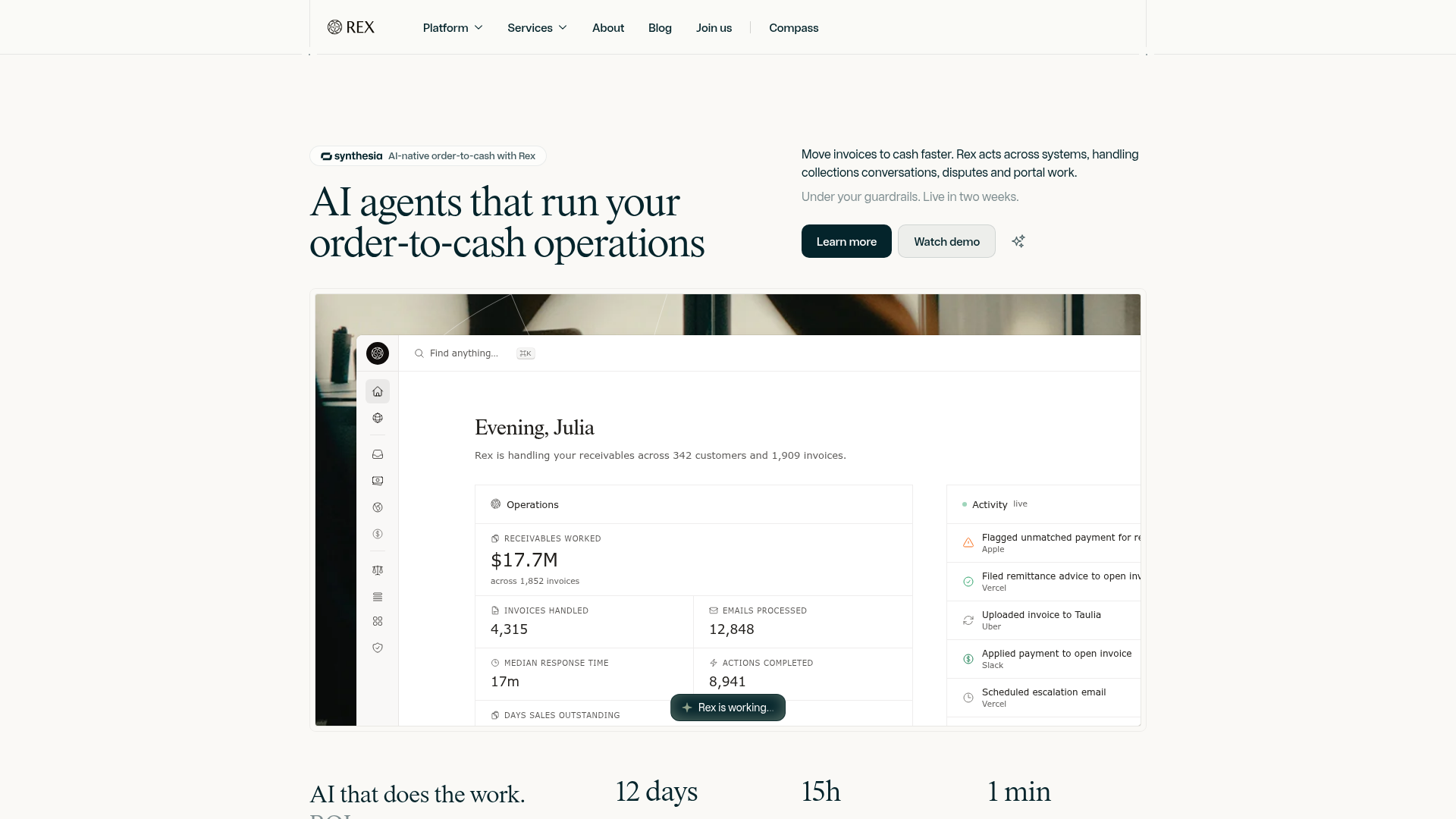
The last mile of the invoice is human. A CFO can approve a credit policy, an ERP can generate an invoice, but the actual work of getting paid—chasing a late payer, uploading a document to a customer portal, disputing a short payment—has always required hands. Rex, an AI operations partner for enterprise order-to-cash, is built to replace those hands. The company's pitch is blunt: "AI agents that run your order-to-cash operations." Not assist, not augment, but run. That's a different category claim than the usual copilot, and it's worth examining closely.
Rex is a seed-stage startup, backed by Y Combinator (S26) and winner of the Vercel AI Accelerator, but its ambition is enterprise-scale. The website shows a dashboard where "Rex is handling your receivables across 342 customers and 1,909 invoices," with a live activity feed: "Filed remittance advice to open invoice," "Uploaded invoice to Taulia," "Matched payment to 3 invoices." The product is not a chatbot that suggests next steps; it's an operator that completes them.
The last mile of the invoice is human
Order-to-cash is a process that spans multiple systems: the ERP, the CRM, email inboxes, supplier portals like Ariba or Taulia, and spreadsheets that track follow-ups. The bottleneck is not the system—it's the manual work in between. A typical AR team spends hours triaging a shared inbox, logging into each customer portal to check PO status, sending dunning emails, and reconciling payments. Rex's website names the problem directly: "Tasks pile up across disconnected systems, leaving teams overloaded and payments delayed."
The solution is to deploy AI agents that act across these systems. Rex connects to the ERP (NetSuite, SAP, Dynamics, Workday, Oracle Fusion), CRM (Salesforce), and communication tools (Slack, Teams), and builds context from years of history. The claim is that no migration is required and the system can go live in days, not months. That's a sharp contrast to traditional ERP implementations or outsourcing transitions.
What Rex actually does: inbox triage, portal uploads, and the disputes nobody wants
The product page breaks down the work into four areas: AR inbox, order and PO readiness, collections, and disputes. Each is a discrete operational task that has historically been manual. The AR inbox is the first target: Rex auto-triages emails, categorizes them, and takes action—filing remittance advice, answering queries, escalating exceptions. The website claims a "90%+ inbox auto-triage rate" and an "average response time of 30m."
Portal work is another key area. Large enterprises often must upload invoices to customer portals like Ariba or Coupa to get paid. Rex does this automatically, as shown in the activity feed: "Uploaded invoice to Taulia," "Uploaded invoice to Coupa." This is the kind of tedious, high-volume task that AI is well-suited for, but it requires careful integration with each portal's quirks.
Disputes are the hardest part. They require judgment: understanding the context of a disagreement, gathering evidence, and proposing a resolution. Rex's approach is to "route the judgment calls" to humans. The workflow is: agents handle routine work, escalate exceptions with context and a recommended next step, and humans approve. This is a hybrid model that acknowledges the limits of AI while still automating the bulk of the work.
The comparison table that tells the real story
Rex's website includes a comparison table that positions it against "traditional outsourcing" and "transformation consulting." This is a revealing move. It signals that Rex sees its competition not as other software tools, but as the legacy ways of scaling AR operations: hiring offshore teams or hiring consultants to optimize processes.
The table contrasts pricing (outcome and SLA-based vs. headcount or time-and-materials), coverage (continuous vs. shift-based or engagement-limited), visibility (live vs. monthly reports), onboarding (days vs. months), and control (process changes by next day vs. recommendations). The message is clear: Rex is not a tool that helps you do the same work better; it's a replacement for the people and firms that do the work.
This is a bold positioning. It also raises the stakes: if Rex fails to deliver on its SLAs, the comparison to outsourcing invites a direct evaluation of cost and quality. The company is essentially saying, "We are the new offshore team, but faster, cheaper, and more visible."
Why 'Rex' works as a name for an AI operator
The name "Rex" is short, memorable, and carries connotations of authority (as in "rex" meaning king in Latin). For an AI that is supposed to run operations autonomously, the name suggests control and reliability. It's also easy to spell and type, which matters for a product that integrates with Slack and email. The domain rex.inc is clean and credible, even if it's not the most descriptive. The brand avoids the "AI" suffix or the "bot" label, positioning itself as an operator, not a chatbot.
However, the name is generic enough that it could be confused with other products (there are many companies named Rex). But for a B2B enterprise product, the name's authority and simplicity are assets. The tagline, "Turn enterprise order-to-cash into an autonomous operation," is specific and value-oriented, though a bit long.
The trust problem: guardrails, audit logs, and the human in the loop
Enterprise finance is a high-trust environment. You can't have an AI agent sending a wrong dunning email to a major customer without consequences. Rex addresses this with a security and compliance page: SOC 2 Type II (monitoring), GDPR compliance with EU data residency, AES-256 encryption, role-based access, and full audit logs on every action. The site emphasizes that customer data is never used to train models.
More importantly, the product is designed with guardrails. The workflow includes escalation to humans for approvals, and the dashboard shows a "risk score" for accounts that might slip past 60 days. This hybrid approach is likely essential for adoption. The website's demo shows a "Case · Boeing" with an "Active case" and a risk score of 82%—Rex is monitoring, not just acting.
The challenge is that trust is built over time. Rex's claim of "live in two weeks" is aggressive, but it may be necessary to convince enterprises to try a new model. The customer story with Synthesia (an AI video company) is a proof point, but it's a relatively young company, not a Fortune 500.
What's missing and what's next
Rex's website is polished and detailed, but it does not disclose pricing, specific customer names beyond Synthesia, or the exact SLAs it offers. The metrics (12 days DSO reduction, 15 hours saved per AR operator per week) are presented as "baseline dependent," which is honest but vague. The company is clearly in early stages, despite the impressive accelerator wins.
The biggest open question is whether AI agents can truly handle the long tail of exceptions that arise in order-to-cash. The website's focus on escalation suggests that Rex is aware of this. The product's success will depend on how well it learns from each escalation and reduces the need for human intervention over time.
For now, Rex is a compelling bet on the idea that the back office can be automated, not just digitized. It's a category-defining attempt to turn a software tool into an operational service. If it works, it could reshape how enterprises think about AR. If it fails, it will be because the last mile of the invoice is more human than AI can yet handle.