Osseus
Trace every downstream impact of a robotics design change, and merge a tested branch.
NewName Editorial
Editorial Team
Robotics development has a dirty secret: a single part change can silently break a dozen other things. Swap a motor, and the bracket might not fit, the wiring gauge could be too thin, the firmware limits need retuning, and the requirement documents go stale. Most teams discover these impacts at the worst possible moment—during integration, or worse, in the field.
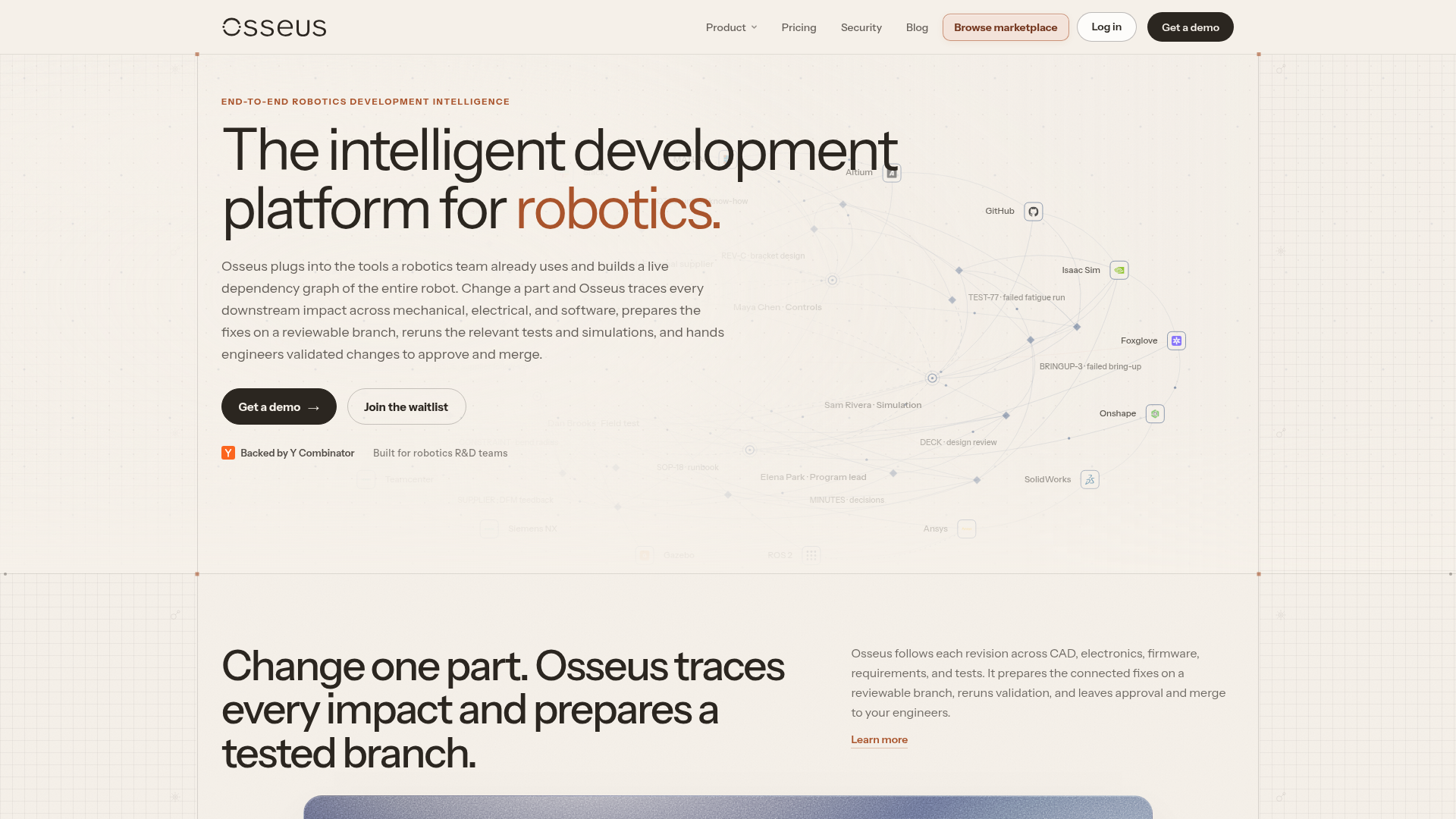
Osseus, a Y Combinator-backed startup, is building what it calls "the intelligent development platform for robotics." The pitch is deceptively simple: plug into the tools a robotics team already uses, build a live dependency graph of the entire robot, and when a part changes, trace every downstream impact across mechanical, electrical, and software domains. Then, prepare the fixes on a reviewable branch, rerun the relevant tests and simulations, and hand engineers validated changes to approve and merge.
It's a software engineering workflow applied to hardware. And it might be exactly what the robotics industry needs.
The 3 a.m. motor swap that breaks the whole robot
Consider a typical scenario: a drive motor changes from an MX-18 to an MX-24. The new motor has a different mount, draws 4 A more peak current, and needs firmware retuning. In a traditional workflow, an engineer updates the CAD model, then manually checks the wiring harness, then remembers to update the firmware limits, then hunts down the requirement documents to see if anything else is affected. The process is error-prone, slow, and relies on tribal knowledge.
Osseus automates this. The website shows a demo where a motor swap triggers a chain of updates: the motor bracket is resized, the wire harness is upgraded to a heavier gauge, the motor firmware is retuned, and the requirements and tests are updated. All of this is prepared on a reviewable branch named motor-swap/mx24, with six updates across CAD, wiring, firmware, requirements, and tests. Validation is rerun, and 12 out of 12 tests pass, including mount and clearance simulation, and power and firmware tests.
The key insight is that Osseus doesn't just flag impacts—it prepares the fixes. Engineers don't have to figure out what needs to change; they review the proposed changes and approve or reject them. This is a fundamental shift from reactive change management to proactive change preparation.
Osseus treats a robot like a codebase
The mental model is powerful: treat the entire robot—CAD models, electronics schematics, firmware code, requirements, and tests—as a single, interconnected codebase. Just as a code change in a software project can break a dependent module, a hardware change can break a dependent subsystem. Osseus builds a dependency graph that captures these relationships.
The platform plugs into existing tools: GitHub for code, Autodesk EAGLE for electronics, SharePoint for documents, Jira for issue tracking. It reads revisions from these sources and builds a live graph. When a change is detected, Osseus traces the impact and drafts updates to the connected files, in the tool that owns them. For example, when a battery pack changes, Osseus updates the BOM sheet, the getting-started guide, and the controls mapping document—all in their native tools, and only after the document owner approves.
This is more than just a notification system. Osseus is actively maintaining the consistency of the entire robot's documentation and codebase. It's like having a tireless engineer who never forgets to update the docs.
The change-impact demo: from MX-18 to MX-24
The website's demo is a masterclass in clarity. It walks through a drive motor swap, showing the impact chain: motor bracket, wiring + power board, motor firmware, requirements + tests. Each item has a specific action: resize, heavier gauge, retune limits, update. The result is a reviewable branch with 6 updates, and validation rerun with 12/12 passing.
Another demo shows a battery pack change (+180 g, +2.4 W) that affects mass, power, and thermal budgets. Osseus flags that the mass is at 94% of the limit, with only 1.8 kg reserve, and prepares a branch to lighten the bracket. It also re-checks the payload requirement and weight limit, passing both.
These demos are not just marketing fluff—they illustrate the core value proposition: Osseus prices the tradeoffs before you commit. Engineers can see the impact of a change before it becomes a revision, and they can evaluate alternatives.
Where the memory layer earns its name
One of the most interesting features is the "memory layer." Osseus remembers decisions, impacts, and owners. When a supplier comments on a drawing, that comment is captured as a permissioned memory, along with the revision it came from. This means that future design reviews can check against past constraints. For example, a supplier note about ±0.1 mm positional tolerance is saved and carried into the next design review of the same part.
This memory layer is also what enables the connected documents feature. Osseus knows which documents read each part, pin, or connector, and when a revision merges, it drafts the exact edit into every one of them. This is a huge time-saver for maintaining consistency across a robot's documentation.
The memory layer turns Osseus from a simple change tracker into a knowledge base that grows with the project. It's a bet that the biggest cost in robotics development is not the hardware, but the coordination and knowledge transfer between teams.
The naming bet: Osseus as the skeleton of robotics development
The name "Osseus" comes from the Latin for "bony" or "osseous." It evokes a skeleton—the structural framework that holds a body together. For a platform that aims to be the backbone of robotics development, the name is fitting. It suggests strength, structure, and support.
The domain, osseus.ai, is short and memorable, with a clear AI connotation. The branding is clean and technical, with a logo that looks like a stylized 'O' or a cross-section of a bone. The tagline, "Build robots at the speed of software," reinforces the software engineering metaphor.
The name is a deliberate contrast to softer, more abstract names like "Roboflow" or "RobotOps." Osseus sounds solid, almost biological. It positions the product as an essential layer of the robotics development stack, not just a nice-to-have tool.
However, the name might be a bit obscure for non-technical stakeholders. It doesn't immediately scream "robotics" or "development platform." But for the target audience of engineering teams, it's a memorable and distinctive choice.
What Osseus doesn't solve yet
The website is light on specifics about pricing, security, and integrations. The pricing page exists but is not detailed in the provided materials. Security is mentioned, but no details are given. The marketplace is a notable feature, allowing teams to buy or rent specified parts, but it's unclear how it integrates with the rest of the platform.
Osseus is also in early access, with a waitlist. The Y Combinator backing suggests some traction, but no customer names or metrics are disclosed. The demos are illustrative, and the website notes that "document wording is illustrative."
There are also open questions about the complexity of the dependency graph. Building a live graph across CAD, electronics, and firmware is technically challenging. How does Osseus parse native Eagle files? How does it handle different CAD formats? The website mentions reading from Eagle, but not from SolidWorks or other common tools. This could be a limitation for teams using a diverse toolchain.
Finally, the platform's success depends on the quality of its change-impact tracing. If it misses a critical dependency, the consequences could be severe. The demos show a high level of automation, but real-world validation is still needed.
Who should care
Osseus is built for robotics R&D teams, specifically those working on complex electromechanical systems. If you're building a robot with multiple actuators, sensors, and a custom PCB, and you're tired of manual change management, Osseus is worth a look.
The platform is also relevant for teams that need to maintain rigorous documentation for compliance or safety reasons. The ability to trace requirements to tests and evidence is a huge plus for safety-critical applications.
For now, Osseus is in early access, and the team is clearly focused on getting the core experience right. The demos are impressive, and the vision is compelling. If they can execute on the technical challenges, Osseus could become the standard for robotics development—the skeleton that holds the whole process together.