Impact-Site-Verification: 41b53a0c-6d04-458b-a457-fe9e29acde1a

SaaS & Productivity·Seed··7 min read

Vieu

Vieu maps the world's business relationships so every team can sell through trust.

NN

NewName Editorial

Editorial Team

Vieu product image 1
Vieu product image 2

The relationship graph is the new sales battleground, and Vieu is making a bold claim: that the next decade of B2B go-to-market belongs not to self-reported networks like LinkedIn, but to inferred, machine-readable graphs built from observed signals. The Seattle startup, founded by former Microsoft leaders, has launched what it calls the 'World's Business Graph' — a live map of 4 billion entities and 14 billion relationships, inferred from shared work history, board affiliations, and other high-provenance sources. For anyone who has ever stared at a cold email list and wondered who actually knows someone at the target account, Vieu's pitch is seductive: stop guessing, start with a warm introduction.

The relationship graph as the new sales battleground

For decades, sales intelligence has been a game of lists. ZoomInfo gives you contacts, LinkedIn gives you profiles, and both leave the hard part to you: figuring out who in your network can actually get you in the door. Vieu's thesis is that the missing layer is the relationship itself — not the static connection, but the living, verified path between your team and the decision-maker you need to reach. The company's tagline, 'AI-ready map of business relationships,' signals that this isn't just another CRM add-on; it's an attempt to build the foundational layer for how companies understand and leverage their collective network.

The timing is no accident. As AI agents begin to automate outreach, they need more than email addresses; they need context about trust. Vieu is positioning itself as the source of that context, a graph that both humans and machines can query. The company's website declares, 'Relationships run the world. Now they run for you.' It's a confident statement, and one that challenges incumbents who have built their moats on self-reported data.

What LinkedIn got wrong about business relationships

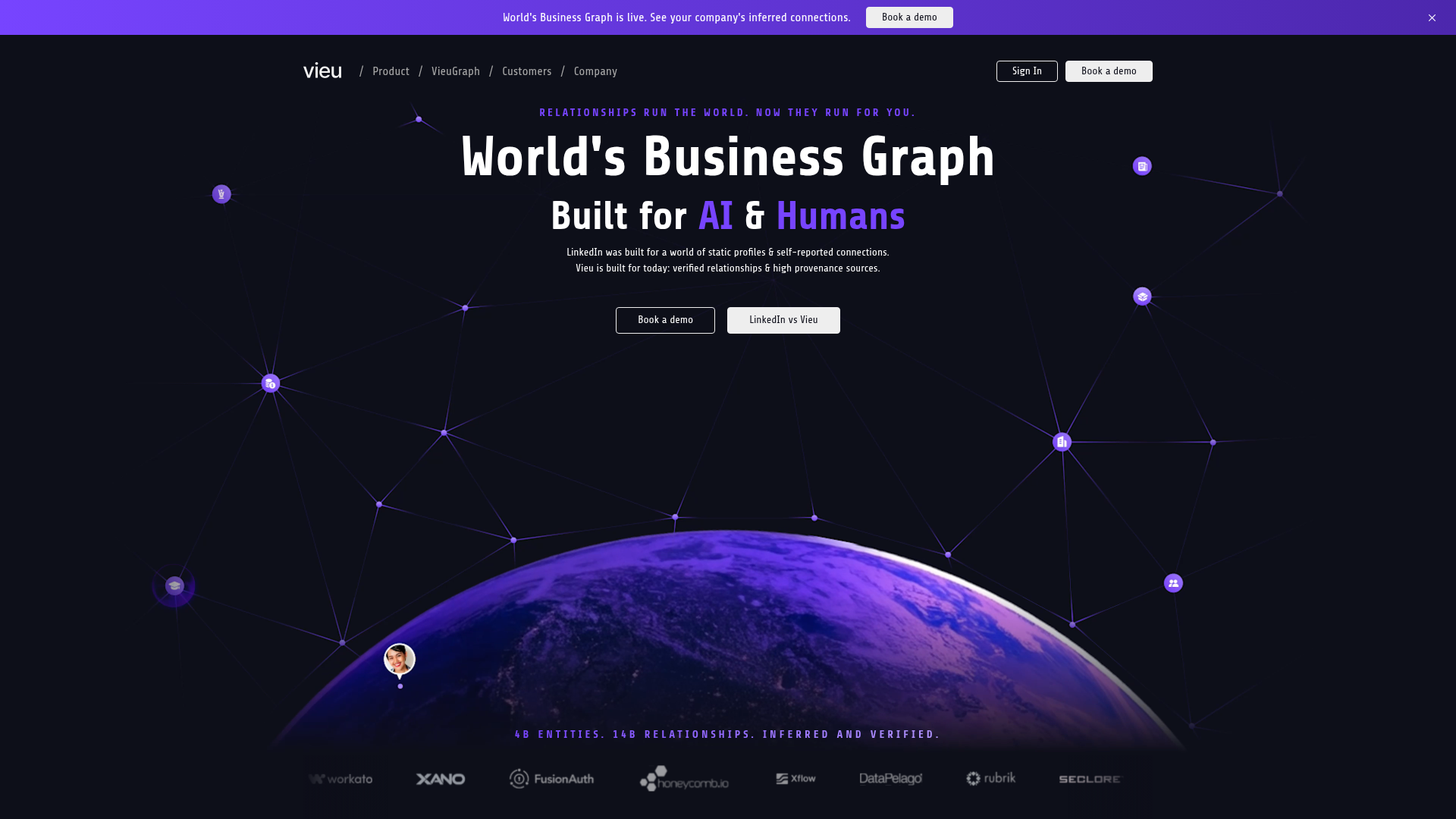
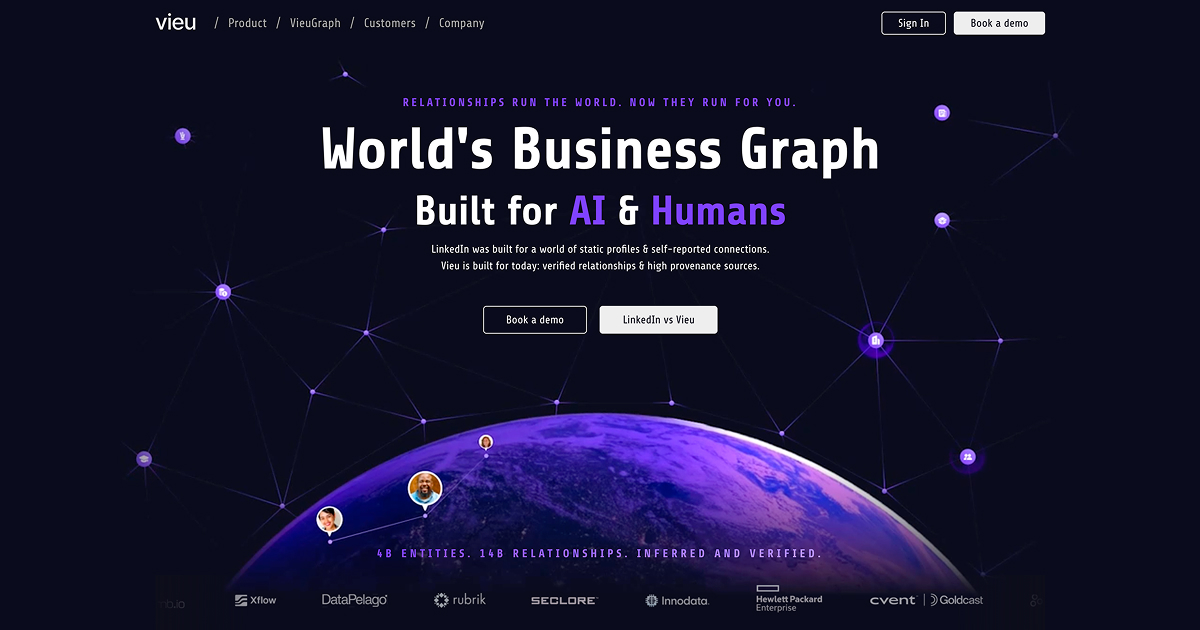
LinkedIn's core assumption is that people will accurately represent their own connections. But anyone who has used it knows the reality: connections are often superficial, outdated, or simply wrong. Vieu's critique is sharper: 'LinkedIn was built for a world of static profiles & self-reported connections. Vieu is built for today: verified relationships & high provenance sources.' Instead of asking users to declare who they know, Vieu observes signals — where someone worked, who served on the same board, who co-authored a patent — and infers the relationship from that evidence.

This is a fundamental shift. A self-reported connection is a claim; an inferred relationship is a conclusion drawn from data. The distinction matters for sales. When a rep reaches out to a mutual contact, they need to know not just that the contact exists, but that the relationship is real and likely to be helpful. Vieu's approach aims to provide that confidence by grounding each connection in observable facts. It's a different epistemology of business relationships, and it's one that could prove more reliable at scale.

The 4B/4B graph: scale as a product statement

The numbers on Vieu's homepage — 4B entities, 14B relationships — are more than vanity metrics. They are a product statement. The company is betting that the value of a relationship graph grows with its completeness. If you can only see your own team's connections, you have a useful tool; if you can see the entire world's inferred network, you have a platform. Vieu claims to have built that platform, and the scale is intended to signal that this is not a niche tool but a new infrastructure.

Of course, scale alone is not enough. The graph must also be accurate and fresh. Vieu says its relationships are 'inferred and verified,' but the company does not disclose the methodology or the update frequency. That is a gap that will matter to enterprise buyers who have been burned by stale data in the past. Still, the ambition is clear: Vieu wants to be the definitive map of who knows whom in the business world.

From cold email to the warm path: Vieu's workflow

The practical promise of Vieu is that it replaces cold outreach with warm introductions. The website describes a workflow that starts before the first email: 'Surface the warmest path into every cold account before a rep sends a single email.' For sales teams, this means that instead of guessing which of your colleagues might know someone at a target company, Vieu shows you the exact path — and ranks it by trust.

The use cases extend beyond sales. Vieu has dedicated pages for marketing, customer success, partnerships, fundraising, and HR/talent. For each, the pattern is the same: identify the relationship, use it to open the door. For customer success, it's about retaining revenue before a churn alert fires by finding new paths into an account when a key contact leaves. For fundraising, it's about mapping your investor landscape before you start outreach. The breadth of use cases suggests that Vieu sees itself as a horizontal layer for any team that runs on relationships — which, as the company notes, is every team.

MCP-native from day one: the agent-ready graph

One of the most distinctive aspects of Vieu is its embrace of the Model Context Protocol (MCP). The company describes itself as 'MCP-native from day one,' meaning that AI agents can query the graph directly at machine speed. This is a strategic bet on a future where AI agents are the primary consumers of data, and it sets Vieu apart from incumbents that are only now adding AI features.

The website makes a pointed comparison: 'A prompt sends an LLM searching the web for 40s. A query hits Vieu's persisted graph and answers in 287 ms.' That 287-millisecond response time is a claim that speaks to the architecture. Vieu is not a search engine; it's a database with a query interface. For companies building AI agents for sales or marketing, this means they can embed relationship intelligence directly into their workflows without the latency and unreliability of web searches.

This agent-ready positioning is also reflected in Vieu's integrations. The site lists Salesforce, HubSpot, Gmail, Outlook, and even Claude and Perplexity, suggesting that Vieu wants to be the relationship layer that powers both human workflows and AI-driven automation. It's a forward-looking move that could give Vieu an edge as enterprises begin to deploy agents at scale.

The name 'Vieu' and the view it promises

The name 'Vieu' is a play on 'view,' and it encapsulates the company's promise: to give you a clearer view of the business world. It's short, memorable, and easy to spell, which is no small thing in a category full of acronyms and invented words. The domain, vieu.com, is a strong asset — a four-letter domain that is brandable and global. The name also carries a subtle French elegance, which may appeal to an international audience.

But the name also implies a passive perspective. 'Vieu' suggests looking, not acting. The company's tagline, 'AI-ready map of business relationships,' reinforces this: a map is a tool for navigation, not a destination. This positioning is smart, as it leaves room for the product to evolve from a map to a guide — from showing you the path to walking you down it. The name is a bet on clarity, and it's a bet that seems to be paying off in the brand's early traction.

What Vieu still has to prove

Vieu's ambition is impressive, but it faces significant challenges. The most obvious is trust: can the inferred relationships be trusted at the level that enterprise sales teams require? The company's website is light on details about how relationships are verified and how often the graph is updated. For a product that claims to replace cold outreach with warm introductions, a single bad recommendation could undermine confidence.

Another challenge is competition. ZoomInfo and LinkedIn Sales Navigator are entrenched, and they have the advantage of years of data and customer relationships. Vieu's differentiation — inferred, verified, agent-ready — is compelling, but it will need to prove that it can deliver on the scale it claims. The company has not disclosed funding or customer counts beyond the '200+ enterprise customers' mentioned on its About page, and public materials suggest it is still in the early stages of go-to-market.

Finally, there is the question of whether the world needs a 'World's Business Graph.' It's a bold claim, and it invites skepticism. But if Vieu can execute on its vision, it could redefine how companies think about relationships — not as a static list, but as a living, queryable asset. For now, the graph is live, and the view is promising.