Shiraz AI
Factory robots that learn from a single human demo, backed by YC and robotics veterans.
NewName Editorial
Editorial Team

The factory floor has a dirty secret: the robots aren't the bottleneck. The programmers are. Every time a production line shifts—a new part, a new pallet pattern, a new assembly step—someone has to write new motion paths, test them, and hope they don't crash into a $50,000 fixture. Shiraz AI, a stealth-stage startup out of Boston, is attacking that bottleneck with a deceptively simple premise: what if a robot could learn a new task from a single human demonstration, the way a new hire learns by watching the veteran?
That's the entire pitch on their website: "Deploy robots that learn new tasks from a single human demonstration in the factory." No mention of sensors, no talk of digital twins, no list of supported arms. Just a one-line thesis that could either be naïve or revolutionary.
The factory floor's hidden bottleneck: reprogramming, not hardware
For decades, industrial robotics has been a story of hardware sophistication. Six-axis arms, vision systems, force-torque sensors—each generation adds precision and speed. But the software layer remains stubbornly artisanal. A typical deployment still requires a robotics engineer to hand-code trajectories, define waypoints, and tune parameters for every new task. The cost isn't the robot; it's the expert-hours spent on integration.
Shiraz AI's positioning implicitly targets that pain. By focusing on "learning from a single human demonstration," they're not selling a faster arm or a better gripper. They're selling a way to compress the time between a task change and a working robot. If the demo works as advertised, a line worker could retrain a robot by physically guiding it or showing it a task once, rather than waiting for a programmer to write new code.
That's a fundamental rethinking of the human-robot interface. Instead of programming languages, the interface becomes the human's own motion. It's the difference between writing a recipe and just cooking the dish once while someone watches.
One demonstration is the whole pitch
The phrase "single human demonstration" is doing a lot of work. In the research world, one-shot imitation learning is a known but unsolved problem. It requires the robot to generalize from a single trajectory to new object positions, orientations, and slight variations. Shiraz AI is essentially betting that the problem is now tractable enough for commercial deployment, at least in constrained factory settings.
What's notable is what they don't say. There's no mention of "few-shot" or "zero-shot." They're not promising that the robot will learn from a video or a text description. It's specifically a human demonstration—a physical, embodied teaching signal. That suggests their approach is rooted in imitation learning, possibly with generative AI models that can synthesize variations from one example.
The choice to emphasize the single demo also sets a high bar. If a robot needs five or ten demonstrations, the value proposition weakens. One is a magic number—it implies that the system is truly learning the essence of a task, not just memorizing a path.
Stealth mode as a product strategy
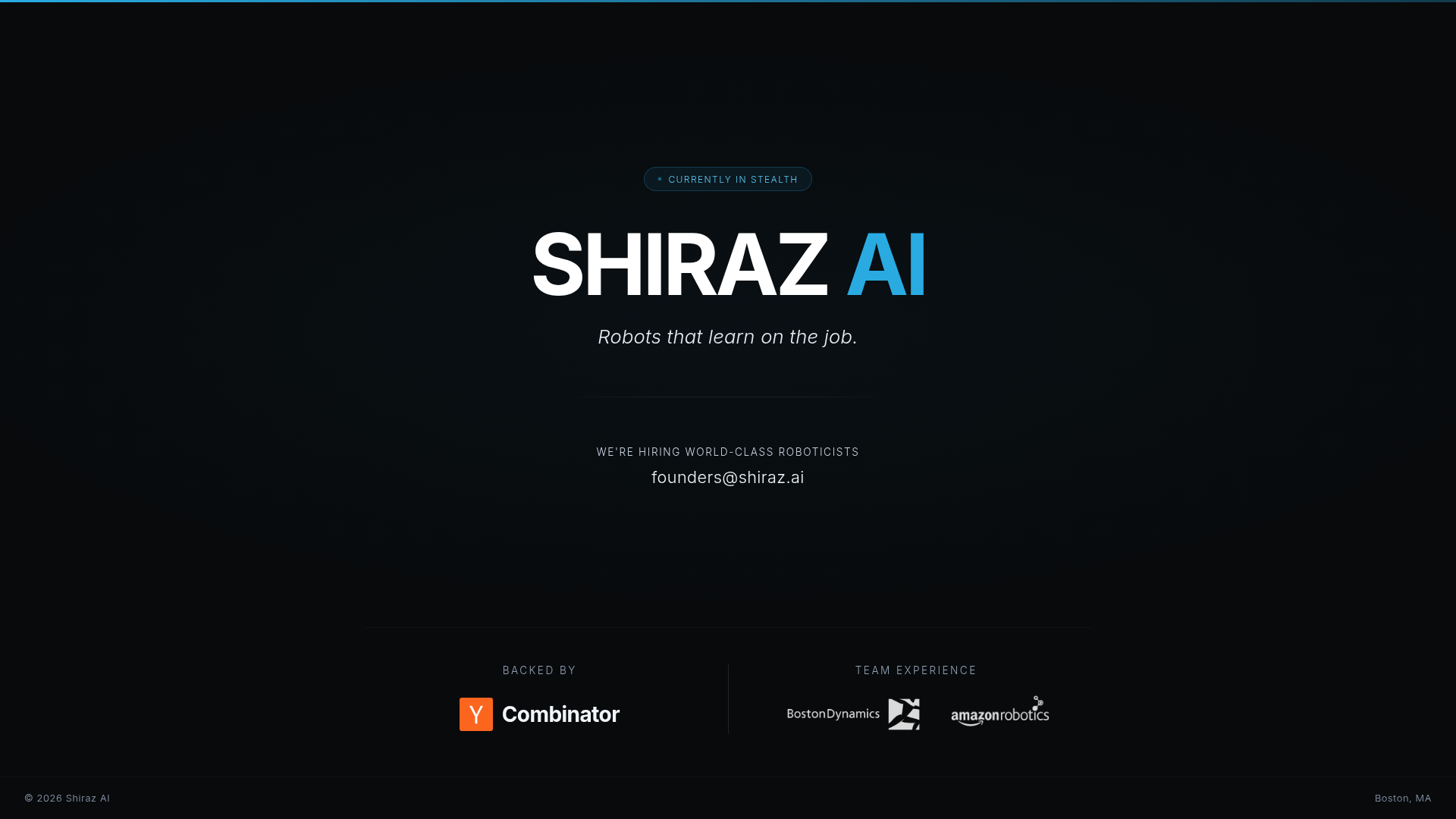
Shiraz AI's website is a study in minimalism. "Currently in stealth" is the first line. There's no product demo, no technical blog, no pricing page—just a call to action for hiring and a list of backers. For a company in a capital-intensive field like robotics, stealth is a deliberate choice. It lets them develop the technology without competitors copying their approach or customers forming expectations before the product is ready.
But stealth also creates a trust gap. Factories are conservative buyers; they want to see a robot work for months before they buy. A stealth startup with no public case studies faces an uphill battle. The site doesn't even list a product name or a specific robot model. It's all promise.
That's a risky move, but it's also a signal. The company is confident enough to show only a thesis and a team pedigree. They're betting that the idea is so compelling that early partners and hires will come to them, not the other way around.
The Y Combinator signal and the team behind the curtain
The website proudly displays "Backed by Y Combinator" and logos for Boston Dynamics and Amazon Robotics, presumably indicating where the founding team worked. This is a classic YC-era pattern: minimal website, credible backers, and a promise of technical chops.
Y Combinator's involvement is a meaningful filter. YC has backed a range of robotics companies, but it's not a guarantee of success. However, it does suggest that the idea passed a rigorous screening process and that the founders have some ability to execute. The Boston Dynamics and Amazon Robotics logos hint at deep experience in both cutting-edge locomotion and large-scale logistics automation—two worlds that Shiraz AI is trying to bridge.
Amazon Robotics, in particular, is relevant. Amazon's fulfillment centers are a proving ground for robotic manipulation and mobile robots. If the founders came from that environment, they've seen firsthand the cost of reprogramming at scale. Boston Dynamics, on the other hand, is known for pushing the boundaries of what robots can physically do. Together, they suggest a team that understands both the hardware constraints and the operational realities of deploying robots in messy, real-world environments.
What Shiraz AI still hasn't told us
For all the promise, the public information is thin. There's no mention of which robot platforms they support, whether they're building their own hardware or software-only, or how they handle safety certification. No pricing, no pilot programs, no technical whitepapers. The about page is a 404.
This is both a strength and a weakness. The strength is that they're not overpromising. The weakness is that there's nothing to evaluate. As a journalist, I can only report on what's public: a thesis, a team, and a backer. The real test will come when they emerge from stealth and show a robot learning a task in a real factory.
Until then, Shiraz AI is a company to watch, not a product to buy. The single-demonstration approach is a bold bet on the future of human-robot collaboration. If it works, it could democratize factory automation, putting the power to reprogram robots in the hands of the people who know the work best. If it doesn't, it'll be another cautionary tale about the gap between research demos and factory-floor reliability.
Either way, the thesis is worth taking seriously. The factory floor's bottleneck isn't the robot—it's the programmer. Shiraz AI is trying to make the programmer obsolete.