Amabrik
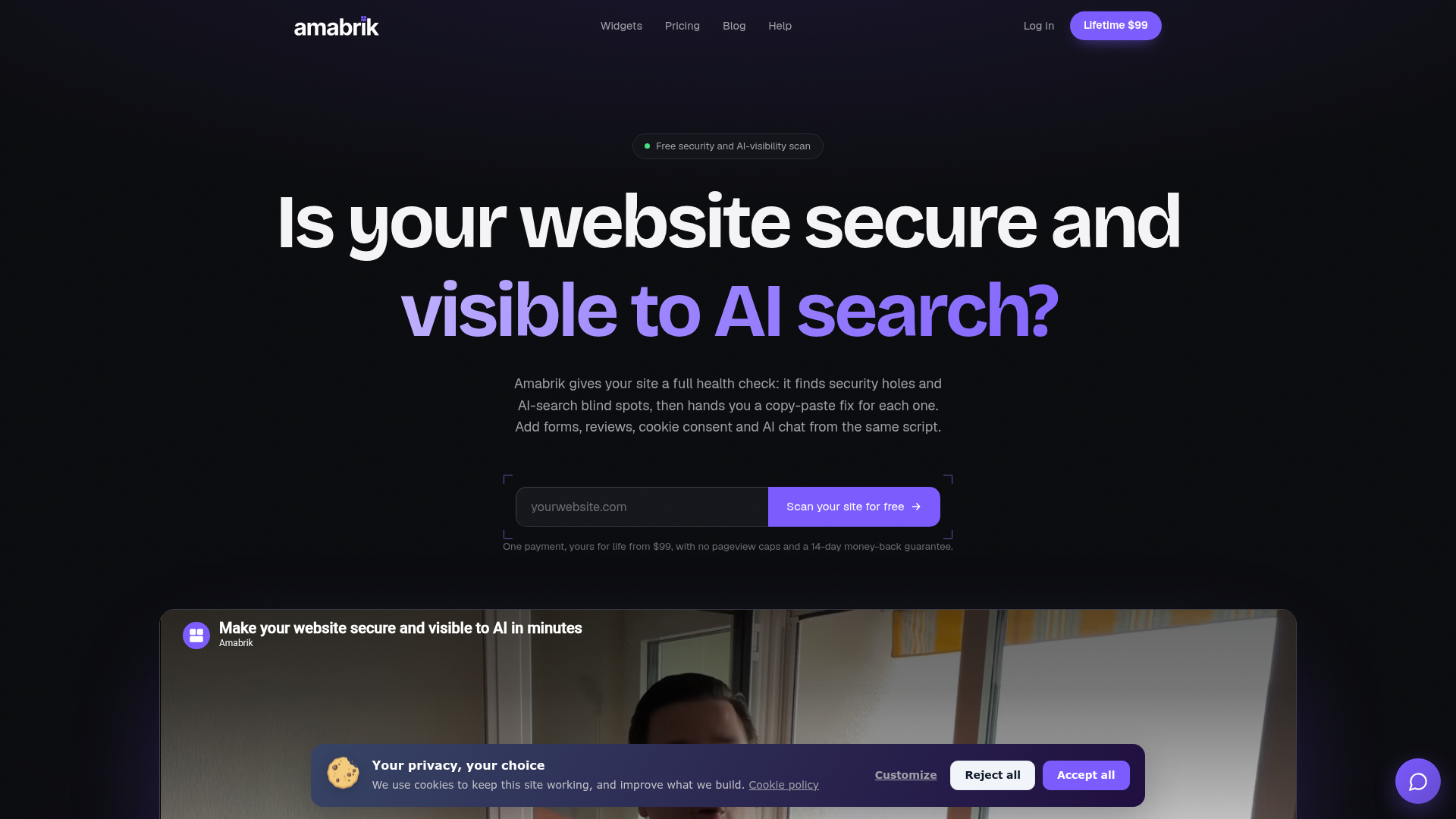
One script that scans your site for AI visibility and security holes, then adds the widgets you need — for life.
NewName Editorial
Editorial Team


Every website now has two audiences: humans and AI crawlers. Google's crawlers have long decided who gets traffic, but ChatGPT, Claude, and Perplexity are becoming a second gatekeeper — one that most site owners can't see. Amabrik, a new SaaS tool, tries to solve that blindness while also patching a more traditional problem: the security holes that fast-built sites often ship with. Its pitch is unusual: two scanners and ten widgets, all behind one script, for a single lifetime payment. That's a lot of promises, and the real question is whether one small tool can deliver on all of them.
The new trust signals: AI crawlers and leaked keys
Amabrik's core thesis is that websites face two distinct trust failures. The first is invisibility to AI search. If ChatGPT can't read your page, it can't cite you, and you lose referral traffic from the fastest-growing discovery channel. The second is leaked secrets — API keys, open databases, missing security headers — that undermine visitor confidence and can lead to real damage. Amabrik scans for both, and the homepage makes the stakes vivid: "More than 60% of AI-built sites leak an API key or leave a Supabase or Turso database open to the public." That statistic is a bold claim, and while Amabrik doesn't cite its source, it reflects a real concern in the AI-assisted development community: speed often comes at the cost of security hygiene.
The tool's answer is to make the invisible visible. You verify your domain, run a scan, and get a plain-English report of what's wrong and why it matters. For each issue, Amabrik provides a copy-paste prompt you can drop into Claude, ChatGPT, or Cursor to generate a fix. That's a clever workflow: instead of telling you to hire a developer, it turns the AI you may already use into your fixer.
Two scanners, one dashboard: what the audit actually checks
The first scanner is the SEO & AEO scan. AEO stands for Answer Engine Optimization, a term for making your content retrievable by AI assistants. Amabrik checks whether ChatGPT, Claude, Perplexity, and several other crawlers can access your pages, and it also scores your classic Google SEO. The output includes a score out of 100 and specific reasons why a page might be invisible — for example, "Meta AI is blocked in robots.txt." That kind of granularity is useful, because AI crawler access is still a new and confusing area for most site owners.
The second scanner is the security scan. It checks for exposed API keys, open databases, and missing security headers. The example in Amabrik's marketing shows a critical finding: "API key exposed in your page source — anyone who opens devtools can read it." That's a concrete, scary scenario, and Amabrik's fix prompt is designed to resolve it quickly. The scan runs from the dashboard, so there's nothing to install on the site itself — you just verify the domain.
Both scans are bundled into every plan, including the lifetime one, with 1,000 scan credits. That's enough for a decent audit, but heavy users might need more, and Amabrik doesn't publicly detail what happens when you run out.
Ten widgets that replace a stack of monthly subscriptions
The widget suite is where Amabrik tries to become a one-stop shop. There are ten widgets: cookie consent, AI chatbot, forms, bookings, popup, reviews, chat button, social proof, social feeds, and banner. Each one replaces a separate paid tool — Cookiebot for consent, Typeform for forms, Calendly for bookings, and so on. The value proposition is clear: instead of paying $10–$50 per month for each service, you pay once and get them all.
The cookie consent widget is particularly well-developed, with a 13-month proof log and the ability to block cookies until consent — a requirement under GDPR. The AI chatbot is trained on your own content, which is a nice touch for support-heavy sites. The social proof widget shows real sales and signups, which can boost conversion.
But there's a catch: bundling ten widgets into one script means you're trusting Amabrik to do all of them well. A specialist tool might offer deeper features or better integrations. Amabrik's widgets are likely sufficient for small sites, but they may not satisfy power users who need advanced form logic or complex booking rules.
The lifetime bet: $99 for a permanent toolkit
Amabrik's pricing is its most distinctive move. The Lifetime plan costs $99 once, with a launch discount from $199, and includes unlimited sites and views, every widget, and no pageview caps. There's also an Annual plan at $59/year for one site. The lifetime model is a bold bet: it assumes the cost of serving a customer over time is low enough to be covered by a single payment, and that the product will keep improving without ongoing revenue.
For customers, the appeal is obvious: no recurring fees, no surprise overage charges. But it also raises questions about sustainability. How will Amabrik fund continued development, security updates, and support? The company is small — its YouTube channel has one subscriber — and lifetime deals can be a double-edged sword. If the product stagnates, you're stuck with a tool that doesn't evolve.
Still, the 14-day money-back guarantee mitigates the risk for early adopters. And the "no pageview caps" promise is a strong differentiator in a market where many analytics and widget tools throttle free tiers.
Naming and positioning: 'Amabrik' as a blank canvas
The name "Amabrik" is a coined word, likely a blend of "amiable" and "brick," suggesting a friendly building block for your website. It's distinctive and easy to remember, but it doesn't convey what the product does. That's a tradeoff: a unique name helps with brand recognition, but it requires more marketing to explain the category. The tagline — "AI visibility and security scans, cookie consent and 10 widgets, one script" — does the heavy lifting of positioning. It's a mouthful, but it's specific.
Amabrik's positioning as a Swiss Army knife for website trust is clever, but it also makes the product harder to categorize. Is it a security tool? An SEO tool? A widget manager? The answer is all of the above, which can confuse potential customers who are looking for a point solution. The name doesn't help clarify that; it's a brand name, not a descriptive one.
What Amabrik doesn't tell you yet
Amabrik's website is transparent about what it offers, but it leaves several questions unanswered. There's no public information about the company's team, funding, or history — the founder field is empty in our data. The security scan's claim about "60% of AI-built sites" is unverified, and we don't know how Amabrik defines an "AI-built site." The scan credits system is mentioned but not fully explained — what happens when you exhaust 1,000 credits? The chatbot's training process and accuracy are also unclear.
More importantly, the lifetime pricing model raises a long-term viability question. If Amabrik's costs grow, will it honor its promise? The company's small subscriber count suggests it's early, and early-stage tools often pivot or change terms. That's a risk for anyone considering a lifetime purchase.
Despite these unknowns, Amabrik addresses a real and growing need. As AI search becomes more influential, site owners need tools to audit their visibility. And as AI-generated code becomes more common, the risk of leaked secrets grows. Amabrik's dual-scanner approach is timely, and its widget bundle offers genuine convenience. If you're a small site owner who wants a simple, affordable way to handle AI visibility, security, and common widgets, Amabrik is worth a trial. Just go in with eyes open about the tradeoffs.