ScreenerHub
AI-assisted stock screening with 30 years of data, watchlists, and automated monitoring for serious investors.
NewName Editorial
Editorial Team
Is this your product?
This write-up was published by NewName editorial. Claim it to edit copy, add screenshots, and get the listing badge. Sign in with a company-domain email or verify the website — you don't need an invite.
Claim this listing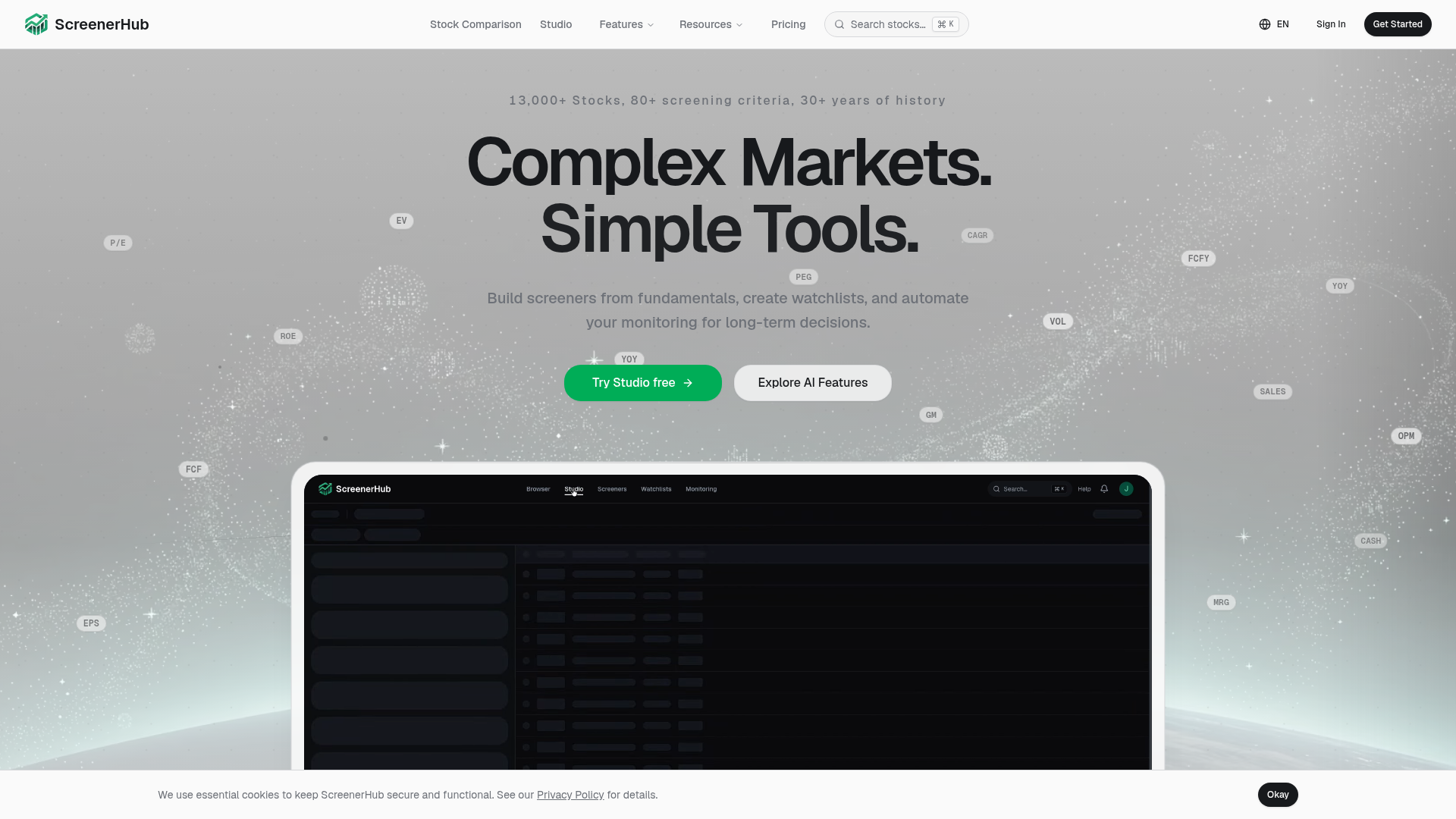
The stock screening market has a structural gap. At one end, free tools like Finviz offer a shallow but broad view—real-time quotes, a handful of valuation metrics, and a user interface that has barely changed in a decade. At the other end, institutional terminals like Bloomberg deliver depth but demand a six-figure annual commitment and a steep learning curve. In between sit tens of millions of serious retail investors and self-directed savers who want fundamental depth, historical context, and a repeatable workflow—without paying enterprise prices or wrestling with spreadsheet macros. ScreenerHub, a new entrant from a solo founder, is aiming squarely at that uncomfortable middle with a pitch that is almost disarmingly simple: 13,000+ stocks, 80+ screening criteria, 30+ years of history, and AI tools that help you build and validate screeners. The bet is that the market has moved past the point where a list of filters is enough; the next differentiator is helping investors decide which filters matter.
The Uncomfortable Middle of the Stock Screening Market
The retail investing boom of the early 2020s created a new class of investor who is neither a day trader nor a passive indexer. These are people who want to own individual stocks for years, who care about return on equity, debt-to-equity ratios, and earnings growth consistency, but who lack the research infrastructure of a professional fund. For them, the existing toolset is a patchwork. Finviz gives a quick technical and valuation snapshot but caps historical data at a few years and offers limited fundamental depth. TradingView excels at charting but treats screening as an afterthought, with a query language that intimidates newcomers. The most committed investors end up exporting data to Excel and maintaining their own models—a workflow that is error-prone, time-consuming, and nearly impossible to keep current.
ScreenerHub's positioning directly addresses this friction. The landing page leads with "Complex Markets. Simple Tools." and emphasizes long-term decisions, not intraday moves. The product is built around three integrated components: a screener with 80+ criteria, watchlists, and a monitoring lab that re-runs watchlists against screeners over time. This is not a tool for finding a hot stock today; it is a system for maintaining a disciplined investment process. The explicit mention of "30+ years of historical data" signals that this is for investors who care about how a company has performed through multiple economic cycles, not just the last quarter.
From Manual Filtering to AI-Assisted Screener Construction
ScreenerHub's most distinctive feature is its AI assistance layer, which is integrated directly into the screener-building workflow. The AI Screener Generator lets a user describe a strategy in plain language—for example, "find large-cap tech stocks with consistent revenue growth and low debt"—and translates that into concrete filters. The user remains in control: the AI proposes criteria, but the user can adjust, add, or remove them before saving. This is a meaningful departure from the typical "AI stock picker" that promises to find winners. Instead, ScreenerHub uses AI to reduce the mechanical burden of translating an investment thesis into a query, which is a common pain point for retail investors who know what they want but struggle to express it in the syntax of a screening tool.
The AI Screener Validator is equally pragmatic. It reviews an existing screener and flags whether it is too narrow, too loose, or missing criteria that would make the strategy easier to evaluate. This addresses a subtle but critical issue: many investors create screeners that are either so restrictive they return zero results or so broad they return thousands. The validator acts as a second pair of eyes, helping users refine their criteria before they waste time sifting through irrelevant stocks. This is a clever use of AI because it does not pretend to have market-beating insights; it simply improves the user's own process.
The Data Depth Moat: 30 Years of Fundamentals vs. Real-Time Noise
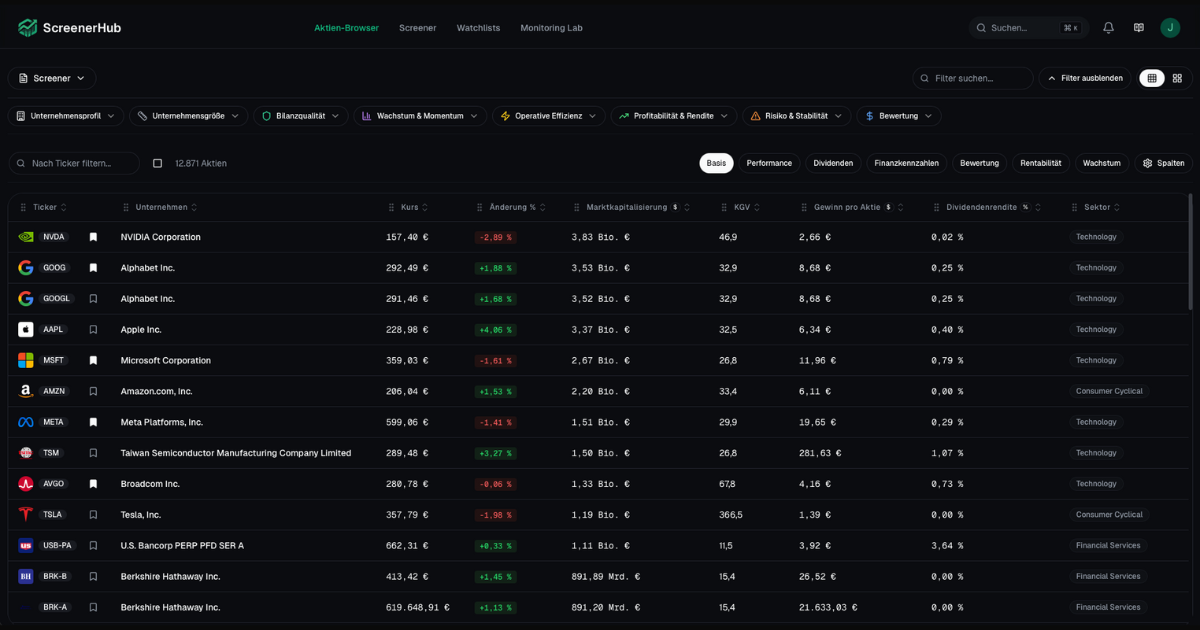
ScreenerHub's most defensible asset is its data depth. The platform offers 30+ years of historical fundamental data for 13,000+ stocks across US and several international exchanges. This is a significant differentiator in a market where most retail tools provide only a few years of history. Long-term investors need to see how a company's margins, cash flow, and debt levels have evolved over decades, especially when evaluating cyclical industries or turnaround stories. The 30-year dataset also enables more robust backtesting, allowing users to see how a screener would have performed in past market conditions—a feature that is rare in consumer-grade tools.
The source of this data appears to be Financial Modeling Prep, based on the image URLs for stock logos. This is a well-known API provider, which means ScreenerHub's data is only as reliable as its upstream source. However, the value lies not in owning the raw data but in the curation and presentation. ScreenerHub normalizes the data, makes it searchable, and provides the AI layer on top. That is a defensible product moat, even if the underlying data is commoditized.
Competitive Positioning: Finviz, TradingView, and the Spreadsheet Workaround
The competitive landscape for retail stock screening is fragmented. Finviz is the incumbent for free, web-based screening, but its fundamental data is limited and its historical depth is shallow. TradingView is the charting king, but its screener is secondary and its data plans are add-ons. There are also premium tools like Stock Rover and Zacks, which offer deep fundamentals but at a higher price point and with a steeper learning curve. And then there is the spreadsheet workaround: downloading data from Yahoo Finance or SEC filings and building custom models in Excel. This is the default for many serious investors, but it is unsustainable for ongoing monitoring.
ScreenerHub's positioning against these alternatives is clear: it offers the depth of a premium tool at a freemium price, with AI assistance that neither Finviz nor TradingView provides. The AI Screener Generator and Validator are unique in this market segment. While Finviz has added some AI features recently, they are largely descriptive summaries, not interactive tools for query construction. TradingView's Pine Script is powerful but requires programming knowledge. ScreenerHub's natural language interface lowers the barrier to entry for investors who are not coders.
The main risk is that Finviz or TradingView could add similar AI features, given their larger user bases and engineering resources. However, ScreenerHub's focus on long-term fundamental screening, rather than short-term technicals, creates a distinct niche. The company is not trying to be a charting platform; it is trying to be the definitive tool for fundamental stock selection and monitoring.
Freemium Economics and the Self-Serve GTM Motion
ScreenerHub offers a free tier with no credit card required, which is a standard customer acquisition strategy for SaaS products. The free tier likely includes basic screening and watchlists, while the Pro tier unlocks advanced features like 30-year historical data, AI features, and monitoring. The pricing page is not detailed in the provided evidence, but the freemium model is clear from the "$0 To Get Started" messaging.
The go-to-market motion appears to be content-led, with a resources section featuring guides on momentum screening, building a screening routine, and monitoring watchlists. This is a smart approach for a solo founder, as it builds organic search traffic and establishes credibility. The founder, Malte, launched the product on Uneed, a community for makers, which suggests an early focus on product-hunt-style exposure rather than paid advertising.
The unit economics are likely favorable for a SaaS product of this type. Data costs from Financial Modeling Prep are usage-based, but the freemium tier can limit API calls to keep costs manageable. The AI features, if powered by an LLM API, will have variable costs, but the validator and generator are likely lightweight in terms of token usage. The main challenge will be converting free users to paid, which will depend on the perceived value of the 30-year history and the monitoring features.
Where the Category Goes: From Screening to Continuous Monitoring
ScreenerHub's long-term trajectory depends on its ability to evolve from a screening tool into a comprehensive investment research platform. The monitoring lab is a step in that direction, as it automates the process of re-checking watchlists against screeners. This is a sticky feature because it creates an ongoing dependency: users log in to see which stocks have drifted from their criteria, and that regular engagement is the foundation of a subscription business.
The next logical step is to expand into backtesting, portfolio tracking, and perhaps even paper trading. Backtesting would be a natural fit given the 30-year dataset, and it would deepen the value proposition for serious investors. Portfolio tracking would allow users to monitor their actual holdings against their screeners, closing the loop between research and execution. Paper trading would attract a younger demographic and provide a low-risk entry point.
The biggest constraint is the solo founder's capacity. Building a feature-rich platform with AI, monitoring, and international exchange coverage is a massive undertaking. The founder will need to prioritize carefully and possibly bring on additional help. The market opportunity is real, but the execution risk is significant. If ScreenerHub can maintain its focus on the serious retail investor and continue to differentiate with AI-assisted workflow tools, it has a credible path to becoming a niche leader in a market that is currently underserved.