Unitpost
Unified email platform for transactional and marketing—React, AI agents, one allowance.
NewName Editorial
Editorial Team
Is this your product?
This write-up was published by NewName editorial. Claim it to edit copy, add screenshots, and get the listing badge. Sign in with a company-domain email or verify the website — you don't need an invite.
Claim this listing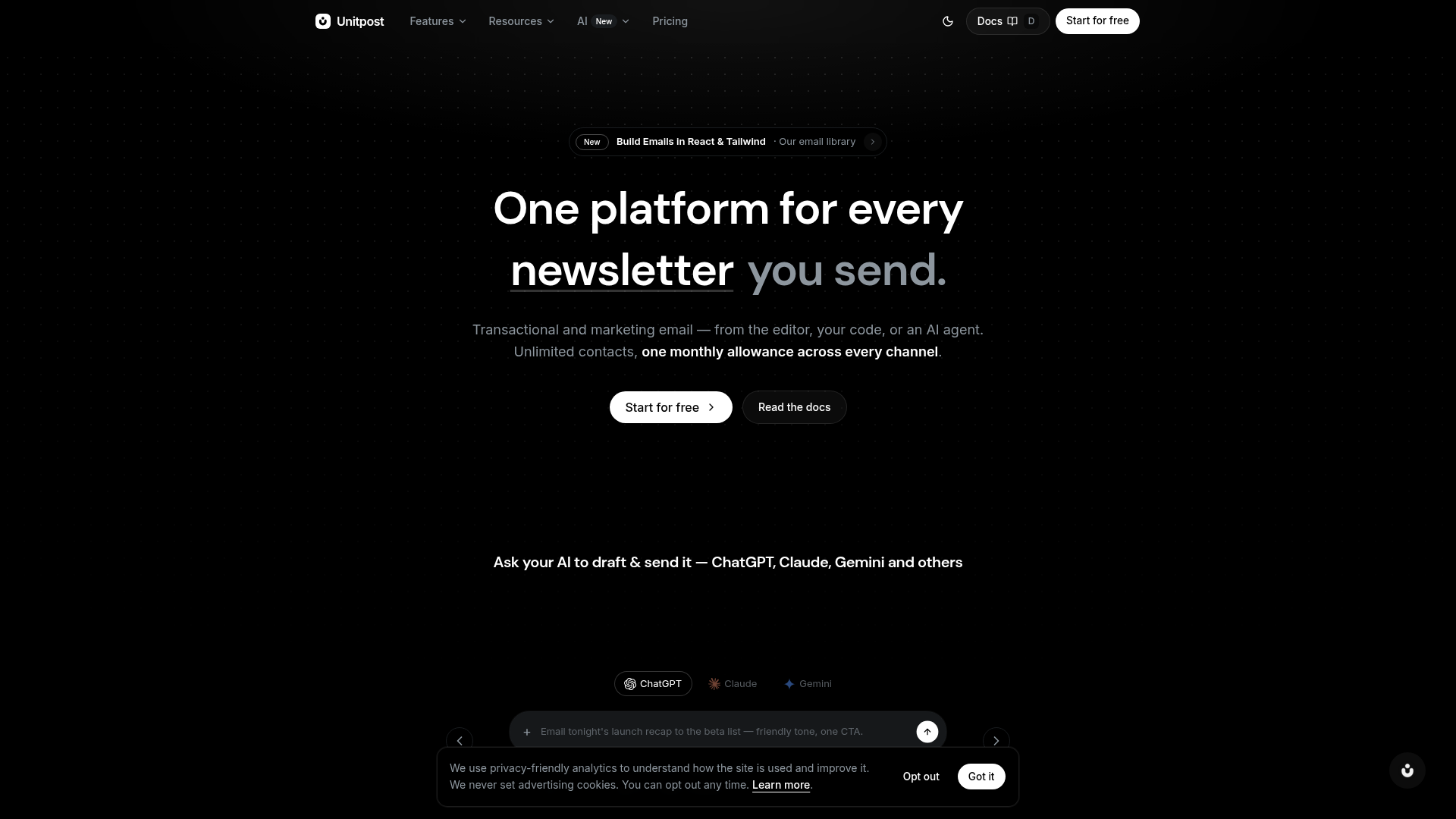
For years, product teams have lived with a schizophrenic email stack: a transactional API from one vendor (SendGrid, Postmark, SES) and a marketing platform from another (Mailchimp, Customer.io, Iterable). Two contact lists, two billing meters, two template systems, two deliverability reputations. Unitpost's pitch is disarmingly simple: one platform for every email you send, whether it's a password reset, an abandoned-cart nudge, or a five-step drip campaign. The bet is that the historical reasons for this split—different sending patterns, different compliance needs, different teams—are eroding under the pressure of AI agents and developer-led buying. If Unitpost is right, the next wave of email infrastructure won't be about more features, but about fewer systems.
The Unbundling of Email Infrastructure Is Overdue
The transactional/marketing divide is a legacy of the 2010s, when the two use cases had genuinely different requirements. Transactional email needed rock-solid API reliability and low latency; marketing email needed list management, segmentation, and drag-and-drop editors. Vendors optimized for one or the other, and enterprises bought accordingly. But the operational reality for most modern product teams is that these boundaries are artificial. A welcome email is both a transactional trigger and a marketing moment. A receipt is a touchpoint that can drive upsells. The data that powers a password reset is the same data that powers a win-back campaign.
Unitpost attacks this fragmentation head-on. Its platform treats all email as a single continuum, with one contact list, one template system, and one set of APIs. The website's tagline—"One platform for every password reset, newsletter, OTP code, product update, receipt, promo, welcome email, weekly digest, invoice…"—reads like a laundry list of every email type a product might send. It's a deliberate provocation to the status quo: why should a developer have to learn two APIs, manage two suppression lists, and reconcile two bills just to send a password reset and a newsletter?
The timing is smart. As engineering teams own more of the customer communication stack (a trend accelerated by the rise of product-led growth), the appetite for a single, developer-friendly platform is growing. Unitpost is positioning itself as the Postgres of email—one tool that does everything, with predictable pricing and a modern developer experience.
One Allowance, Every Channel: The Unit Economics of Unification
Unitpost's most distinctive commercial move is its pricing model: unlimited contacts and a single monthly allowance across all channels. Instead of charging per contact (like Mailchimp) or per thousand emails (like SendGrid), Unitpost bundles transactional and marketing sends into one pool. For a startup sending 50,000 transactional emails and 10,000 marketing emails a month, this is a significant simplification. No more guessing which bucket a send falls into, no more surprise overage bills from a marketing platform when a product update goes viral.
The model is a direct challenge to the per-contact pricing that dominates marketing email. Incumbents like Mailchimp and Klaviyo charge based on list size, which punishes companies with large, engaged lists. Unitpost's allowance model decouples cost from list size, making it attractive for businesses with big databases but moderate sending volumes. For transactional-heavy products (SaaS, e-commerce, fintech), the economics are even more compelling: transactional email is often priced per thousand, and the costs add up quickly at scale. Unitpost's unified allowance means that a spike in transactional volume doesn't trigger a separate bill—it just draws down the same pool.
Public pricing is not disclosed on the site, but the "Start for free" call-to-action suggests a self-serve, usage-based tier. The unit economics work if Unitpost can maintain high margins on the allowance: the marginal cost of sending an email is low, but deliverability infrastructure and compliance (SPF, DKIM, DMARC, suppression lists) are fixed costs. The bet is that the simplicity of one bill will attract enough volume to achieve economies of scale, and that the developer-led GTM (free tier, API-first, SDKs) will keep customer acquisition costs low.
React and Tailwind as the New Email Design Standard
Email design has historically been a nightmare of table-based layouts, inline styles, and Outlook quirks. Unitpost's answer is to let developers compose emails in React and Tailwind, using a library that compiles to HTML emails. This is not a new idea—React Email has been gaining traction—but Unitpost is baking it into the platform, offering both a visual editor and a code-first workflow. The pitch is "design once, send anywhere," with pixel-perfect rendering across Gmail, Outlook, and Apple Mail.
For developer-centric teams, this is a major differentiator. Instead of wrestling with MJML or hand-coding HTML, they can use the same component model they use for their web app. The template gallery and AI-powered template generation ("Describe it. Get a template.") lower the barrier further. This is a wedge into the marketing team's turf: if the developer can build a beautiful newsletter in React, why does the company need a separate marketing platform with its own template language?
The risk is that the visual editor is a table stakes feature, and the React library is open-source (or at least, the concept is). Unitpost's moat is not the editor itself, but the integration: templates, sending, analytics, and AI agents all in one place. The question is whether the React approach will win over enough of the developer community to become a standard, or whether it remains a niche preference.
The AI Agent Wedge: MCP and the Future of Automated Sending
Unitpost's most forward-looking feature is its AI agent integration. The website shows a demo of an AI agent (ChatGPT, Claude, Gemini) drafting and sending an email directly through Unitpost, using the Model Context Protocol (MCP). This is a strategic bet on the future of AI-driven workflows: instead of a human writing a campaign, an agent will draft, segment, and send—with human approval as a safety gate.
The MCP integration is a smart move because it positions Unitpost as the email layer for the agentic web. As AI agents become more capable of executing multi-step tasks (e.g., "send a win-back email to users who haven't logged in for 30 days"), they need a reliable, API-first email provider that can handle the sending. Unitpost's unified platform is well-suited for this: an agent can use the same API to send a transactional alert or a marketing campaign, with the same template system and contact list.
This is a wedge that incumbents like SendGrid and Mailchimp are only beginning to explore. Their APIs are powerful but not designed for agentic use cases—they lack the MCP integration and the AI-friendly workflow. Unitpost's tagline, "Let AI-Agents generate and send production-ready Emails," is a direct claim to this emerging market. The execution risk is real: AI-generated emails can be generic, and the approval workflow is critical to avoid reputation damage. But if Unitpost can nail the agent experience, it could become the default email provider for AI-native startups.
Competitive Crossfire: Incumbents, Point Solutions, and the Developer GTM
Unitpost is entering a crowded market with entrenched players. On the transactional side, SendGrid, Postmark, and AWS SES are the incumbents, with massive scale and reliability. On the marketing side, Mailchimp, Klaviyo, and Customer.io dominate with feature-rich platforms. Unitpost's differentiation is the unification itself, but that's a double-edged sword: it risks being a jack-of-all-trades, master of none.
The developer GTM is Unitpost's best defense. By offering SDKs for Node, Python, and Ruby, a clean API, and a free tier, it can win the hearts of developers who are tired of stitching together multiple services. The React email library is a hook that resonates with modern frontend teams. The AI agent integration is a forward-looking feature that incumbents are slow to adopt.
But the competitive reality is that SendGrid and Mailchimp are not standing still. SendGrid has been adding marketing features; Mailchimp has transactional capabilities via Mandrill. The real opportunity for Unitpost is not to out-feature the incumbents, but to out-position them: to be the email platform for the AI-first, developer-led company. That means doubling down on the agent workflow, the unified allowance, and the React experience—and not getting distracted by enterprise features like advanced segmentation or A/B testing that incumbents already do well.
The threat from open-source alternatives (like Resend's open-source SDK, or self-hosted solutions like Postal) is also real. Unitpost's moat must be the managed experience: deliverability, uptime, and the AI integration. If it can't demonstrate better deliverability or a significantly better developer experience, it will be commoditized.
Risks and the Road Ahead: Deliverability, Trust, and Category Expansion
Unitpost's biggest risk is deliverability. Email is a trust game: if a sender's IP reputation tanks, emails go to spam, and the product becomes worthless. Incumbents have years of infrastructure and relationships with ISPs. Unitpost, as a new entrant, must prove it can maintain high inbox placement rates. The site mentions automatic suppression lists and a focus on sender reputation, but the proof will be in the data.
Another risk is the AI agent integration. If agents send poorly targeted or spammy emails, the backlash will be swift. Unitpost's approval workflow ("You approve before anything goes out") is a good start, but it adds friction to the agentic vision. The balance between automation and control will be tricky.
Looking ahead, Unitpost's trajectory depends on its ability to expand beyond email. The platform could add SMS, push notifications, or other messaging channels, all under the same allowance. That would make it a true customer communication platform, competing with the likes of Twilio and Braze. The company's name—Unitpost—suggests a broader ambition: a single unit for all posts, all messages. If it can execute on that vision, it could become a significant player in the communication infrastructure space.
For now, Unitpost is a promising challenger with a clear thesis: the future of email is unified, developer-friendly, and AI-ready. The incumbents have the scale, but they lack the agility. The next few years will show whether Unitpost can turn its wedge into a permanent place at the table.